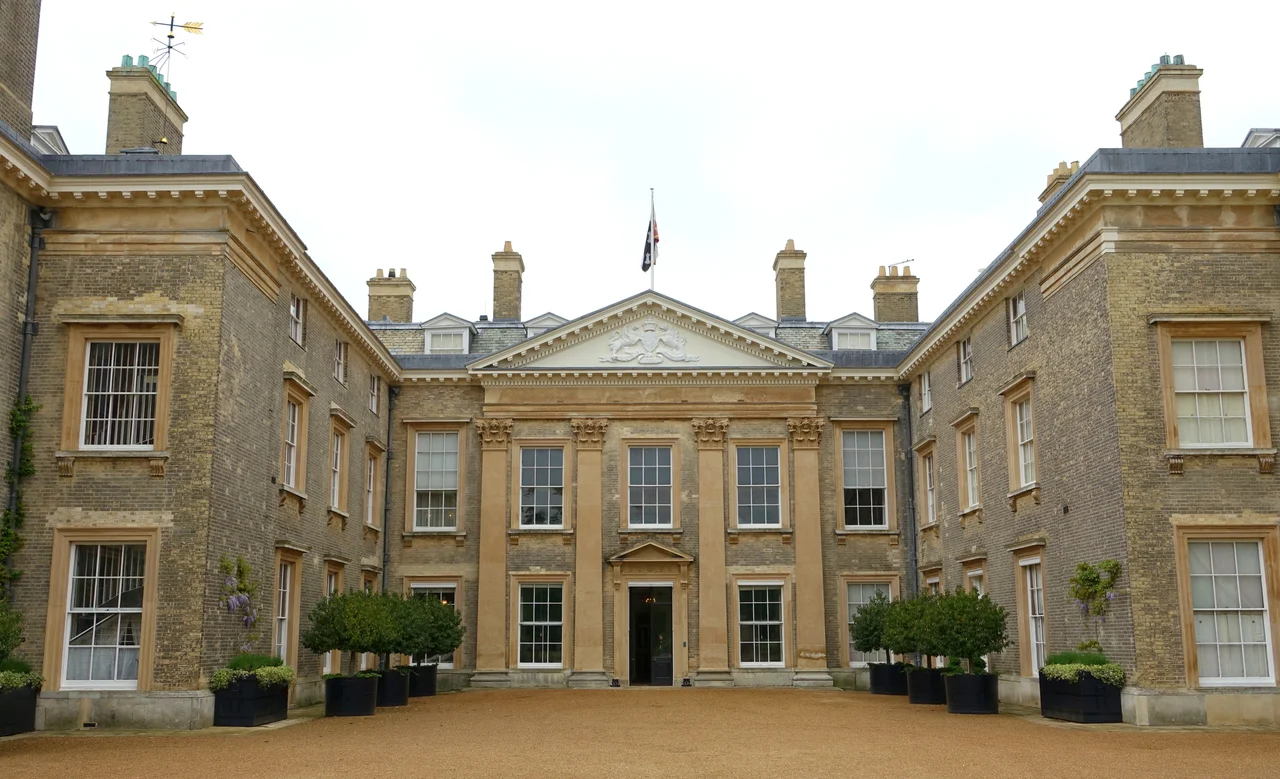

Althorp
John Spencer bought Althorp in 1508 with money from his family's sheep. He paid £800 to the Catesby family for a hamlet whose population had dwindled to nothing, four years of work to lay out a park, and a future he could not have predicted. Five hundred years later his descendants still own the place - the only English family to have held the same major estate for that long. The house has been an Elizabethan brick mansion, a Georgian palace tiled to look like stone, the largest private library in Europe, the venue for parties that consumed eleven thousand pints of beer in one night, and the childhood home of the woman whose marriage and death turned a quiet Northamptonshire estate into a place of international mourning. Diana, Princess of Wales lies on an island in a small ornamental lake at the centre of the gardens. The Spencer family is older than her, and continues without her. Both truths matter.
Five Centuries of Sheep, Books, and Politics
The Spencers were wool farmers before they were earls. John Spencer's purchase in 1508 was paid for by sheep, and his immediate descendants - High Sheriffs of Northamptonshire, Members of Parliament, courtiers - built outward from that base of agricultural wealth. The hamlet of Althorp itself had emptied out before John Spencer arrived; by 1577 most of the land was given over to four substantial sheep pastures. Queen Anne of Denmark stopped here in 1603 on her way south from Edinburgh to join her husband James I, welcomed by an entertainment scripted by Ben Jonson. King Charles I visited later in his reign; £1,300 was spent on the banquet, an extraordinary sum at the time. Henry Spencer, the first Earl of Sunderland, paid £3,000 for his earldom in 1643 and was killed at the First Battle of Newbury that September, aged twenty-two, by a cannonball. Estates passed son to son for generations after, through scandals, fortunes, political downfalls, and the long arc of English landed life.
The House That Was Tudor and Became Georgian
The current building dates to 1688, when Robert Spencer, 2nd Earl of Sunderland, replaced an older red-brick Tudor house that had stood here for a century. The diarist John Evelyn wrote that year of a 'noble uniform pile in form of a half H, built of brick and freestone à la moderne'. A hundred years later, in 1788, the architect Henry Holland was commissioned to transform it. Mathematical tiles - a Georgian invention that mimicked dressed stone - were laid over the red brick, encasing the Tudor walls inside a Palladian disguise. Four Corinthian pilasters were added to the front, made from Roche Abbey stone in Yorkshire that had reportedly been intended by Christopher Wren for St Paul's Cathedral. Wootton Hall, the central entrance, was described by Nikolaus Pevsner as 'the noblest Georgian room in the county.' Its black-and-white marble floor was laid by the 6th Earl around 1910, replacing the brown and blue tiles his father had installed in the mid-nineteenth century. The acoustics are remarkable. Diana Spencer, as a teenager, used to practise her tap dancing there.
The Book Collector and the Red Earl
George John, 2nd Earl Spencer, inherited Althorp in 1783 and turned the house into one of the great libraries of Europe. He served as a Whig MP, then Home Secretary under Lord Grenville's Ministry of All the Talents. He founded the Roxburghe Club in 1812 - an exclusive bibliophilic society that still meets - and accumulated rare books, manuscripts and incunabula until the obsession became all-consuming. When Napoleon dissolved the monastic libraries of south Germany, Earl Spencer used a Benedictine monk named Alexander Horn as his agent to acquire many of the displaced volumes. His library at Althorp grew past 100,000 books. By his death in 1834 he had also amassed a debt of £500,000 - an enormous sum that his son the 3rd Earl spent the next eleven years quietly paying off, in part by living for years at his farm in Wiseton, where running costs were £1,200 a year against the £5,000 needed to run Althorp. The library survived him. Sixty years later, in 1892, John Spencer, 5th Earl Spencer - known as the Red Earl for his Liberal politics and his beard - sold the bulk of it to Enriqueta Rylands, the widow building the John Rylands Library in Manchester. The library that took a century to assemble was dispersed in months. The University of Manchester still holds it.
Diana
Lady Diana Frances Spencer was born at Park House, Sandringham, in 1961 - the third daughter of Viscount Althorp, who would become the 8th Earl Spencer in 1975. After her parents' divorce, the children lived between their parents' houses, and Althorp became one of the homes she knew best. She moved here properly when her father inherited the estate. Six years later, on 29 July 1981, she married Charles, Prince of Wales, in a ceremony watched by 750 million people worldwide. Her later life - the public scrutiny, the philanthropy, the unravelling of the marriage, the divorce in 1996 - belongs to the world. Her death belongs partly to a quieter place. On 31 August 1997 she was killed in a car crash in Paris, aged thirty-six. The Spencer family chose to bury her on a small wooded island at the centre of the Round Oval, an ornamental lake at the heart of Althorp's gardens. The island is not open to visitors. Across the water stands a Doric-style temple with her name inscribed at the top, and a memorial walk leads through the park during the months the estate is open to the public. The exhibition centre that once held tribute material from millions of visitors closed in 2013. Her brother, the 9th Earl Spencer, has spoken of the island as a place where his sister rests undisturbed. That, finally, was what they could give her.
The Estate That Continues
Charles Spencer became 9th Earl Spencer in 1992 on his father's death, at the age of twenty-eight. As a teenager he had worked as a tour guide at the house and acquired a deep knowledge of its rooms. The estate covers about 13,000 acres, with twenty-eight listed buildings and structures scattered across it - the Grade I former falconry of 1613, the Grade II* stable block in mustard yellow, the West and East Lodges, nine listed planting stones. The park was originally laid out by André Le Nôtre in the 1660s, the same Frenchman who designed the gardens of Versailles, and substantially reshaped under Henry Holland in the late eighteenth century. The Spencer art collection has been diminished by generations of sales - a small Holbein portrait of Henry VIII sold by the 7th Earl in the 1930s for £10,000 was valued at £50 million by 1998 - but the Picture Gallery still holds Van Dyck's War and Peace, a John de Critz portrait of James I, a Mary Beale portrait of Charles II, and the family records of five centuries. Five hundred years of one family on one piece of English ground. The current heir is Louis Spencer, Viscount Althorp, born in 1994.
From the Air
Althorp lies at 52.280°N, 1.002°W in west Northamptonshire, about six miles northwest of the county town of Northampton between the villages of Great Brington and Harlestone. From altitude, look for the long approach drive leading north through wooded parkland, with the symmetrical Georgian-tiled house at the heart of formal gardens. The Round Oval lake at the centre of the gardens is visible to the trained eye. Sywell Aerodrome (EGBK) sits ten miles to the east; London Luton (EGGW) is thirty-five miles south. The M1 motorway runs five miles to the east, useful for orientation. The historic parkland still covers thousands of acres around the house.
Nearby Stories
- Battle of Bosworth Field 3.6 km away
- Murder of Ross Parker 7.2 km away
- Royal Leamington Spa 8.8 km away
- Buckingham 9 km away
- St Neots 9.4 km away
- Letchworth 10 km away
- Uppingham School 11 km away
- Sudeley Castle 39 km away