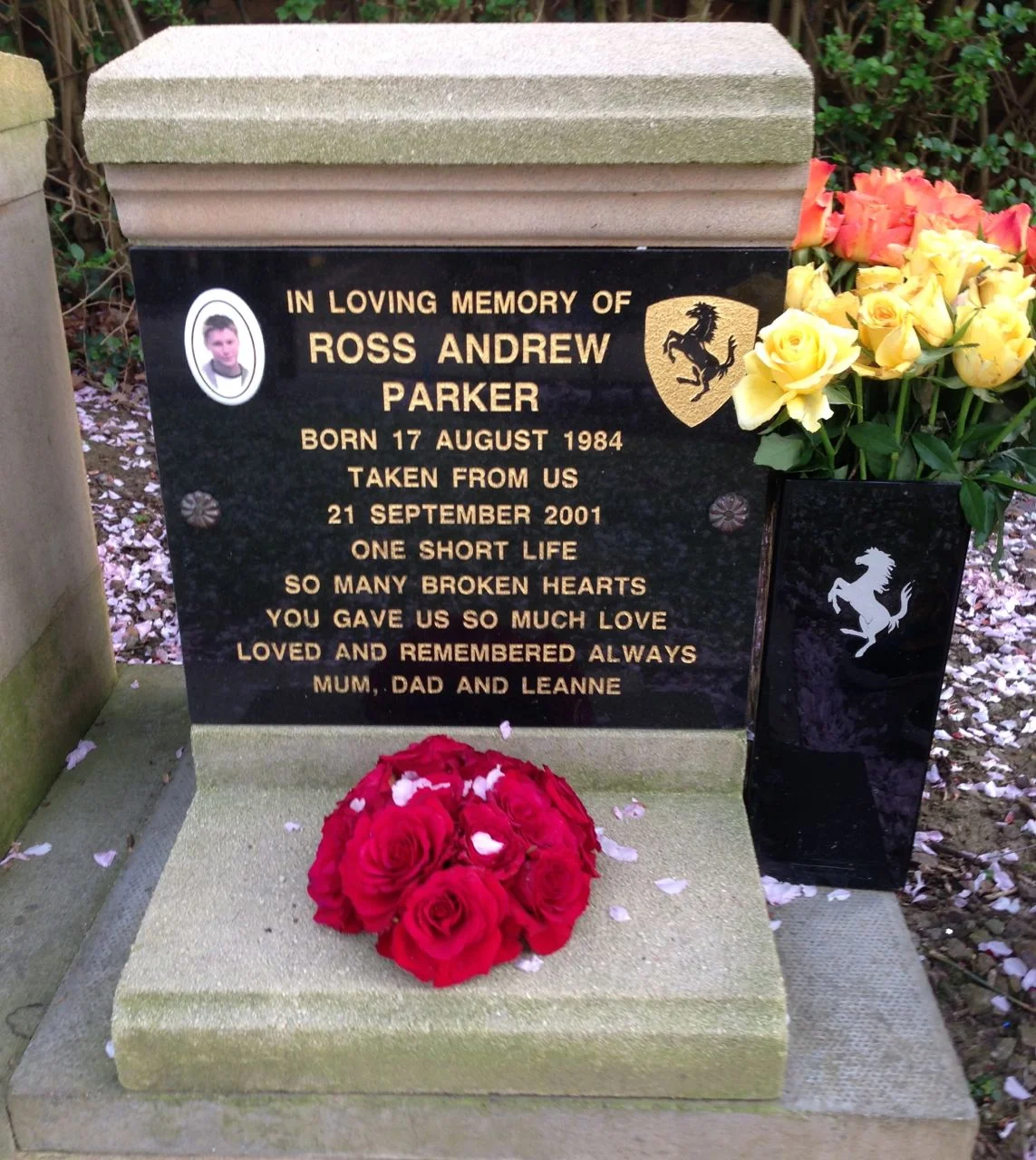

Murder of Ross Parker
Ross Parker had just turned seventeen. He had finished a GNVQ in business studies at Jack Hunt School and was planning to join the police force the following year. He had a girlfriend named Nicola Toms, whom he had met at the Solstice pub in Westwood where he worked behind the bar. He had two broken legs in his past and was five foot tall, which is why his friends called him Half-Pint. On the night of 21 September 2001, ten days after the September 11 attacks, he was walking with Nicola along a cycle path beside Bourges Boulevard in the Millfield district of Peterborough. Four men were waiting on the path with a hunting knife, a panel beater's hammer, and balaclavas. They had set out, the prosecution would later say, on a hunting party.
Who He Was
Ross was born to Davinia and Tony Parker in 1984. He played football for Netherton United, where his shirt number was 14, and he was good. His teammates loved him. The Reverend Geoffrey Keating, who would later preside at his funeral, called him a beacon of light who inspired so many people. He worked part-time as bar support at the Solstice, lived with his family in the Westwood area of the city, and was, by every account collected from his friends and family, the kind of cheerful, popular, slightly cocky seventeen-year-old who had a future planned out in some detail. He was ten days from being killed for nothing other than the colour of his skin.
The Attack
The cycle path runs alongside Bourges Boulevard near Russell Street in Millfield, an area where racial tensions had spiked after 11 September. Ross was punched in the stomach. Then he was stabbed three times from behind, through the throat and chest, with a foot-long hunting knife that went completely through his body on two of those strikes. As he lay on the ground, he was kicked repeatedly and struck with a hammer. Nicola ran to a petrol station and a man there gave her his mobile phone to call the police. While she made the call she could hear Ross crying out twice, then nothing. By chance a police car passed; she flagged it down and led the officer to where Ross was. He died beside the cycle path. Afterwards, four members of the gang returned to a garage in Millfield that they used as a base. Ahmed Ali Awan held up the bloodied knife and, according to a witness who later testified, said the words cherish the blood.
Trial at Northampton
Shaied Nazir, Ahmed Ali Awan, Sarfraz Ali, and Zairaff Mahrad stood trial at Northampton Crown Court in November 2002. The forensic case was overwhelming. The murder weapons were found in a shed at Nazir's house. DNA and fingerprints belonging to Nazir were on the hunting knife. Ross's blood was on the knife, the hammer, on the clothes of two of the accused, and on three balaclavas recovered at the same property. Nazir's younger brother Wyed testified that he had seen his brother cleaning the murder weapon on the night of the killing. The defendants told contradictory stories. Ali claimed to have been asleep at the time, but a recording from a police van indicated this was a story he had encouraged the others to stick to. Nigel Rumfitt QC, defending Awan, summed up the case in a single sentence the jury could not unsee: there is no doubt there was a hunting party looking for a victim. On 19 December 2002, Nazir, Awan, and Ali were found guilty of murder in unanimous verdicts. Each received life imprisonment with minimum terms ranging from 16 to 18 years. Mahrad was acquitted. Appeals in 2008 and 2009 upheld every sentence.
A Story That Should Have Been Bigger
The Ross Parker case has been described as the British counterpart to the murder of Stephen Lawrence, the Black teenager killed by a racist gang in south London in 1993. The Lawrence case shook British policing and journalism. Ross Parker's case did not. His mother, Davinia, said simply: because we are white, English, we didn't get the coverage. It's as if we don't count. The BBC Editorial Standards Committee in 2007 accepted that the corporation had underplayed its coverage of the Ross Parker case, and had similarly underplayed the murder of Kriss Donald, a white teenager killed by a racist gang in Glasgow in 2004. Politicians said little. In 2003 the Peterborough MP Helen Clark mentioned Ross in the House of Commons, but did not describe his killers as racist, referring to them only as men older than him. The local Muslim community in Peterborough behaved differently. They raised a reward for information that led to the arrests. The Detective Chief Inspector who ran the case, Dick Harrison, said publicly that the community's help was decisive.
What Remains
A plaque was installed in Netherton, the Peterborough neighbourhood where Ross's football team played, and an annual football match is still held in his memory. A further memorial sits at Peterborough Crematorium in Marholm, where his funeral was held on 23 October 2001. Four hundred mourners attended. His Netherton United number 14 shirt was draped over the coffin. His teammates formed a guard of honour in their playing kit. Davinia Parker was unable to work for three months afterwards and, by her own account, came close to suicide more than once. Tony Parker said after the appeals that the killers should never be freed. The Parker family left Ross's room largely untouched for three years because it was a place, they said, where they felt close to him. He had been planning to join the police force the following August. He had recently bought new trainers. His football boots were still in the hall. A seventeen-year-old boy in Peterborough, on his way home, in the late summer of 2001.
From the Air
Located at 52.58 degrees north, 0.25 degrees west, in the Millfield district just north of central Peterborough, Cambridgeshire. The murder scene was on a cycle path alongside Bourges Boulevard near Russell Street; Peterborough city centre, the cathedral, and the railway station all lie within 1 nautical mile to the south. The Netherton area, where Ross Parker's memorial plaque sits and where his football team played, is just east of central Peterborough. Best viewed from altitude as urban Peterborough surrounded by flat fenland. Nearest active airfield is RAF Wittering (EGXT) 8 nautical miles west; Cambridge City Airport (EGSC) lies 30 nautical miles south-southeast. This is a sensitive memorial site; aerial coverage should be treated with respect.
Nearby Stories
- Oakham Castle and Its Forfeited Horseshoes 3.2 km away
- Huntingdon 5.2 km away
- RAF Downham Market 5.6 km away
- Hunstanton 8.9 km away
- RAF Mildenhall 9 km away
- Sywell Aerodrome 10 km away
- Heckington Windmill 11 km away
- Bingham, Nottinghamshire 17 km away