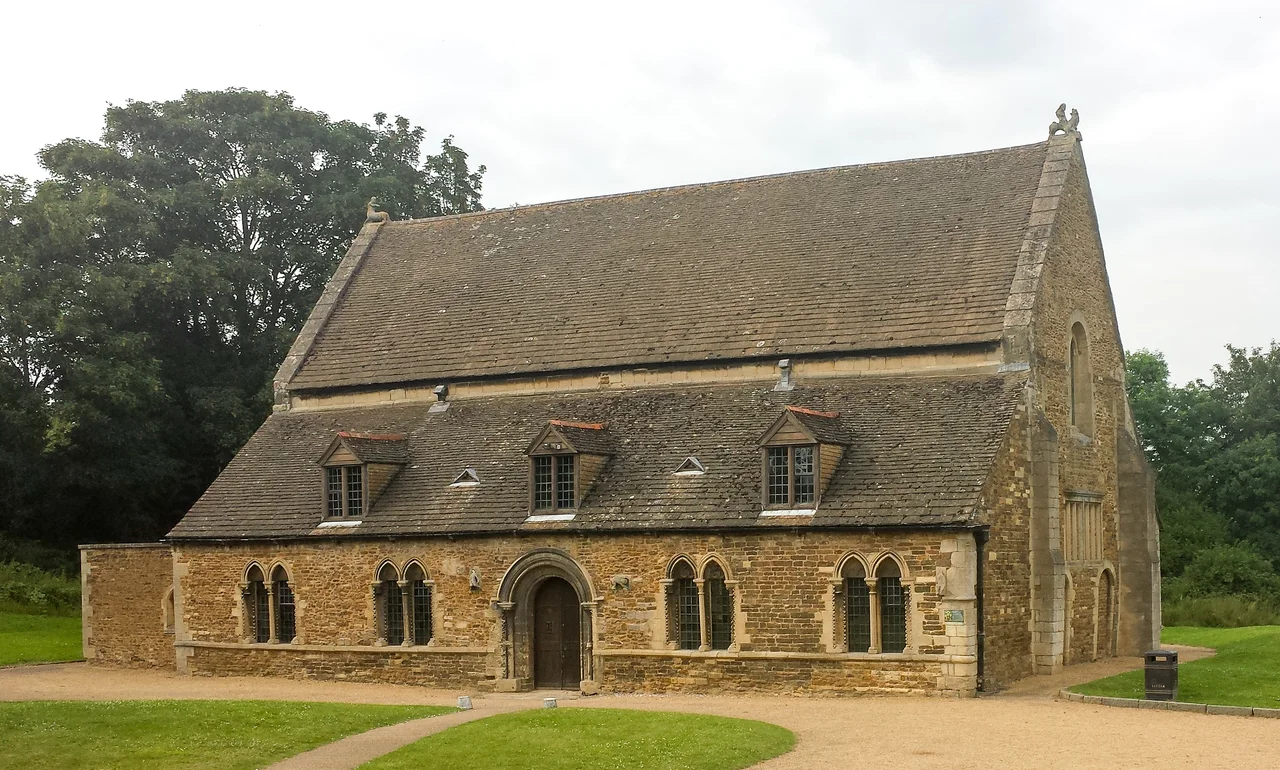

Oakham Castle and Its Forfeited Horseshoes
Pay your horseshoe at the door. Two hundred and thirty of them already hang on the walls inside, surrendered over the centuries by visiting peers of the realm under a tradition so peculiar it survives mostly because nobody has ever managed to stop it. The oldest of these horseshoes was given by King Edward IV in 1470, after his victory at the Battle of Losecoat Field. The newest were presented by the Duke and Duchess of Edinburgh in 2024. Between those two dates stretches an unbroken chain of nobility paying tribute, in the form of an iron shoe of varying size and craftsmanship, to the Lord of the Manor of Oakham in the smallest county in England.
The Great Hall That Survived
What is called Oakham Castle today is not really a castle, although it once was. The surviving stone hall is the inner chamber of a much larger fortified manor house built in the late twelfth century, complete with curtain wall, gatehouse, drawbridge with iron chains, towers at strategic points, and a moat that once ringed the whole complex. Most of those features are gone. The hall remains, and it is regarded by architectural historians as one of the finest examples of domestic Norman architecture left anywhere in England, a Grade I listed building from the era when domestic and military architecture had barely begun to separate. The hall's interior is severe and beautiful, with carved capitals that still bear the chisel marks of Norman masons working in the 1180s, and the same stone floor that has now hosted nearly nine centuries of judicial business.
Eight Hundred Years of Crown Court
Oakham Castle has been a seat of justice in England since 1229. A Crown Court has been held in the hall every two years for almost eight hundred years, an institutional continuity that survives transitions of monarchy, civil war, the abolition of the monarchy in 1649, its restoration in 1660, multiple reorganisations of English county government, and the merger and demerger of Rutland itself as an administrative unit. The judges still come. The hall is still set up as a court when required. It is one of the longest-running active seats of justice anywhere in the English-speaking world, and few of the people who pass through it appreciate quite how unbroken that line of dispensed verdicts actually is. The court is no longer where the most serious crimes in the region are tried, but the institutional ritual continues, an English insistence that some things should be done where they have always been done.
The Horseshoe Tradition
The horseshoes started, as best historians can reconstruct it, with the de Ferrers family. Henry de Ferrers came to England with William the Conqueror in 1066, and his family name derives from the Norman French word ferrier, meaning farrier or horseshoer. A horseshoe became their family symbol, and it followed the family wherever they went. Their lordship of the manor of Oakham eventually became the basis for the local custom that every peer of the realm visiting Oakham for the first time should forfeit a horseshoe to the Lord of the Manor. The shoes are made specially for the occasion, often enormous and ornamental, and they are hung on the walls of the great hall with their points downward, in what is the heraldic preference of Rutland custom. The same downward-pointing horseshoe now appears on the arms of Rutland County Council and on the flag of Rutland itself. The royal contributions of recent years have come from the Princess Royal in 1999, the future King Charles III in 2003 (then Prince of Wales), Princess Alexandra in 2005, the future Queen Camilla in 2014 (then Duchess of Cornwall), and most recently Prince Edward and his wife Sophie in 2024.
Time Team and the Lottery Restoration
In June 2012 the Channel 4 archaeology series Time Team spent three days excavating at Oakham, and what they found turned out to be unexpectedly substantial. Tony Robinson, the show's presenter, and the team's archaeologists uncovered a previously unmapped horseshoe and traced sections of the manorial perimeter wall that had been lost for centuries. The programme aired on 10 February 2013 and triggered a wave of renewed attention to the site. The following year, the castle was awarded a Heritage Lottery Fund grant of £2.165 million for a comprehensive restoration of the great hall and the surviving curtain wall, joint-bid by Rutland County Council, Oakham Town Council, and the Friends of Rutland County Museum. The castle closed to allow the work. On 30 May 2016, after careful conservation of fragile twelfth-century stonework and re-interpretation of the site for visitors, Oakham Castle reopened. The horseshoes had stayed on the walls throughout.
A Castle in the Smallest County
Rutland is the smallest historic county in England, eighteen miles across at its widest point, with a population of around 41,000 people. Oakham, its county town, sits at the centre, on flat ground south of the Vale of Catmose and a few miles east of the artificial reservoir of Rutland Water. Driving into Oakham past the market square, you pass the gateway into the castle precinct, a freestanding stone arch that resembles the gateways at nearby Burley-on-the-Hill and is thought to have been erected by George Villiers, the first Duke of Buckingham, in the early seventeenth century. Buckingham was the favourite of King James I and the most powerful courtier of his day, assassinated in 1628 in a quarrel over military strategy. He left behind, among other things, this small stone gateway in a small Midland county. The castle itself, the gateway, the horseshoes, and the unbroken Crown Court tradition together make Oakham one of the more concentrated bits of English continuity, hidden inside the smallest county on the map.
From the Air
Oakham Castle, Oakham, Rutland (52.67 N, 0.73 W). The castle sits at the centre of Oakham, the county town of Rutland, just east of Rutland Water (Britain's largest artificial reservoir by surface area). The castle complex occupies a low rise above the market square. Nearest commercial airport is East Midlands (EGNX), 25 miles north-west; Cambridge (EGSC) is 40 miles east. From low altitude, Rutland Water dominates the landscape to the west of Oakham; the castle's stone great hall is visible as a distinctive rectangular roof in the town centre, with the early-17th-century freestanding gateway nearby. Best aerial viewing is in late morning when the limestone of the great hall walls glows pale gold.
Nearby Stories
- Midland Railway War Memorial 4 km away
- Battlefield Line Railway 5.2 km away
- Electric Railway Museum 5.2 km away
- All Saints' Church, Brixworth 5.7 km away
- Murder of Bernadette Walker 6.2 km away
- Bingham, Nottinghamshire 6.7 km away
- Heckington Windmill 8.3 km away
- Hinchingbrooke House 12 km away