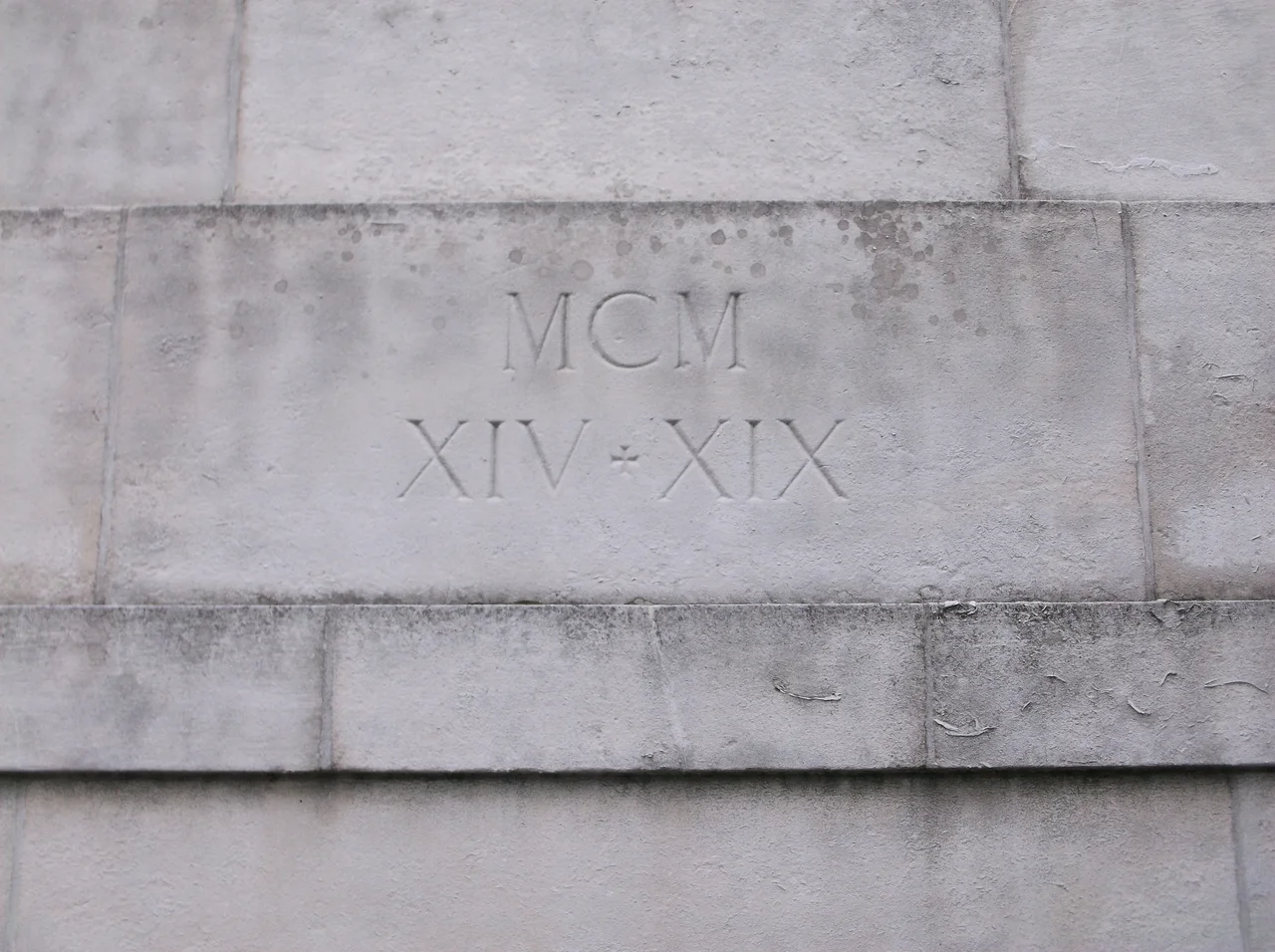

Midland Railway War Memorial
There is a step at the base of the Midland Railway War Memorial in Derby that exists solely so children can read the names. Edwin Lutyens designed it that way. The memorial commemorates 2,833 employees of one company, the Midland Railway, who died serving in the British armed forces in the First World War, and when it was unveiled on 15 December 1921 the company chose not to invite the bereaved families. There was, the railway said, not enough room for everyone. Instead they offered free travel passes to Derby for anyone who wanted to come later, alone, and find their name. The step is there so the smallest visitor can find the right plaque.
A Railway Town's Reckoning
In the early twentieth century Derby was a railway town in a way few places have ever been a company town. The Midland Railway had its headquarters here, more comprehensively rooted than any other British railway company in any other city, and at the turn of the century it employed more than 12,000 people in Derby alone. The company had built much of the visible town: Midland Station, the Midland Hotel, dozens of workshops, terraces of railway workers' housing. When war came in August 1914, more than 1,800 reservists were called up from the Midland's payroll within a week. By the end of the war, almost 23,000 men had left for military service, a full third of the company's workforce. Of those, 2,833 were killed. Another 7,000 were wounded. The names on the memorial are not random soldiers; they are draughtsmen, signalmen, fitters, porters, cleaners, drivers, and clerks, the entire ecology of a railway scattered across the battlefields of the Western Front and points east.
Lutyens and the Beautiful Death
Edwin Lutyens was the most prolific architect of British First World War commemoration. He designed the Cenotaph in Whitehall, the Thiepval Memorial on the Somme, and dozens of smaller cenotaphs across England. The Midland Railway memorial is one of his early provincial works, and its design became the prototype for Rochdale Cenotaph the following year. Built of Portland stone by J Parnell and Son Ltd at a cost of 10,309 pounds in 1921, it consists of a high cenotaph with rounded sides at the centre of a three-sided screen wall, with the bronze name plaques inset into rectangular alcoves on either side. The cenotaph carries the Midland Railway's coat of arms inside a laurel wreath, and at its summit sits the recumbent effigy of an unknown soldier. Lutyens, who was personally drawn to Theosophy and a kind of abstract pantheism, deliberately avoided explicit religious symbolism. He preferred, he wrote, the "abstract shape and intrinsic beauty" of classical forms. The soldier is dressed in a greatcoat, with his Brodie helmet and bayonet placed at his feet, and he rests on a catafalque whose four corners are carved as lion heads.
Why the Soldier Is High
The most studied design choice in the memorial is the soldier's position. Lutyens placed him at the top of the cenotaph rather than at eye level, deliberately too high to see clearly. The greatcoat is pulled across his face. The bayonet rests next to him. The official reading is that the height gives the soldier anonymity: anyone looking up could believe the figure was the husband, brother, or son they had personally lost. The unspecified soldier becomes, by absence of detail, every soldier. Lutyens also wanted the viewer's eye to rise, to focus on the geometry of the pylon and the carved heraldry, rather than fix on the violent fact of how these particular men had died. With rare exceptions, First World War memorials were not allowed to depict the actual violence of the trenches; the official aesthetic of British commemoration was what the period itself called a "beautiful death," an idealisation of sacrifice that the bereaved could carry without being annihilated by it. Lutyens, more honestly than most, understood that this was a kind of sleight of hand. He performed it with care.
The Unveiling and the Book
Charles Booth, chairman of the Midland Railway, unveiled the memorial on 15 December 1921, with a dedication given by Edwyn Hoskyns, Bishop of Southwell and Nottingham. The Midland also commissioned a book of remembrance, and a personalised copy was sent to the family of every man named on the cenotaph. The book contained a photograph of the memorial, the man's full name, his pre-war job within the company, his home depot or station, his regiment, and his rank. For families who could not afford to travel to Derby, the book brought the cenotaph home. The Midland's general manager Frank Tatlow wrote in the foreword that the memorial was an expression of the company's gratitude. Two years later, in 1923, the Midland was forced to merge with other railways into the London, Midland and Scottish under the post-war Railways Act, and Derby's pre-eminence as a national railway centre began a long, slow erosion.
Stolen and Returned
In August 2010 several of the bronze plaques bearing the names of the dead were ripped off the screen wall by metal thieves. The plaques were recovered within days, the thief apologised publicly to the people of Derby after his arrest, and the memorial was repaired. The British Legion in Derbyshire used the case as the basis for a campaign to protect war memorials from scrap-metal theft, which had become a national problem in the late 2000s. In 2010 a police pursuit also ended with a car crashing into the memorial. The Portland stone took the impact and was patched. Today the memorial sits in a designated conservation area, Grade II* listed by Historic England, who describe it as "an eloquent witness to the tragic impacts of world events on this company and the sacrifices made by its staff." The step at the bottom is still there. Children still climb up. Names are still read.
From the Air
The Midland Railway War Memorial stands at 52.92°N, 1.46°W on Midland Road in Derby, immediately south of Derby railway station and adjacent to the Midland Hotel. From the air it is a small Portland stone monument set in a landscaped enclosure between the station approach and the hotel garden. East Midlands Airport (EGNX) lies 9 nautical miles to the southeast, the closest major field. Birmingham (EGBB) is roughly 32 nm to the southwest. Recommended viewing altitude is 1,500 to 2,500 feet to read the railway station, the curving platform throat, and the cluster of memorial buildings on Midland Road.
Nearby Stories
- Prestbury, Cheshire 4.2 km away
- Stoke-on-Trent 5 km away
- Bingham, Nottinghamshire 8.6 km away
- Beauchief Abbey 9.6 km away
- Shot at Dawn Memorial 9.6 km away
- White Ladies Priory 13 km away
- Oakham 23 km away
- Battle of Gainsborough 24 km away