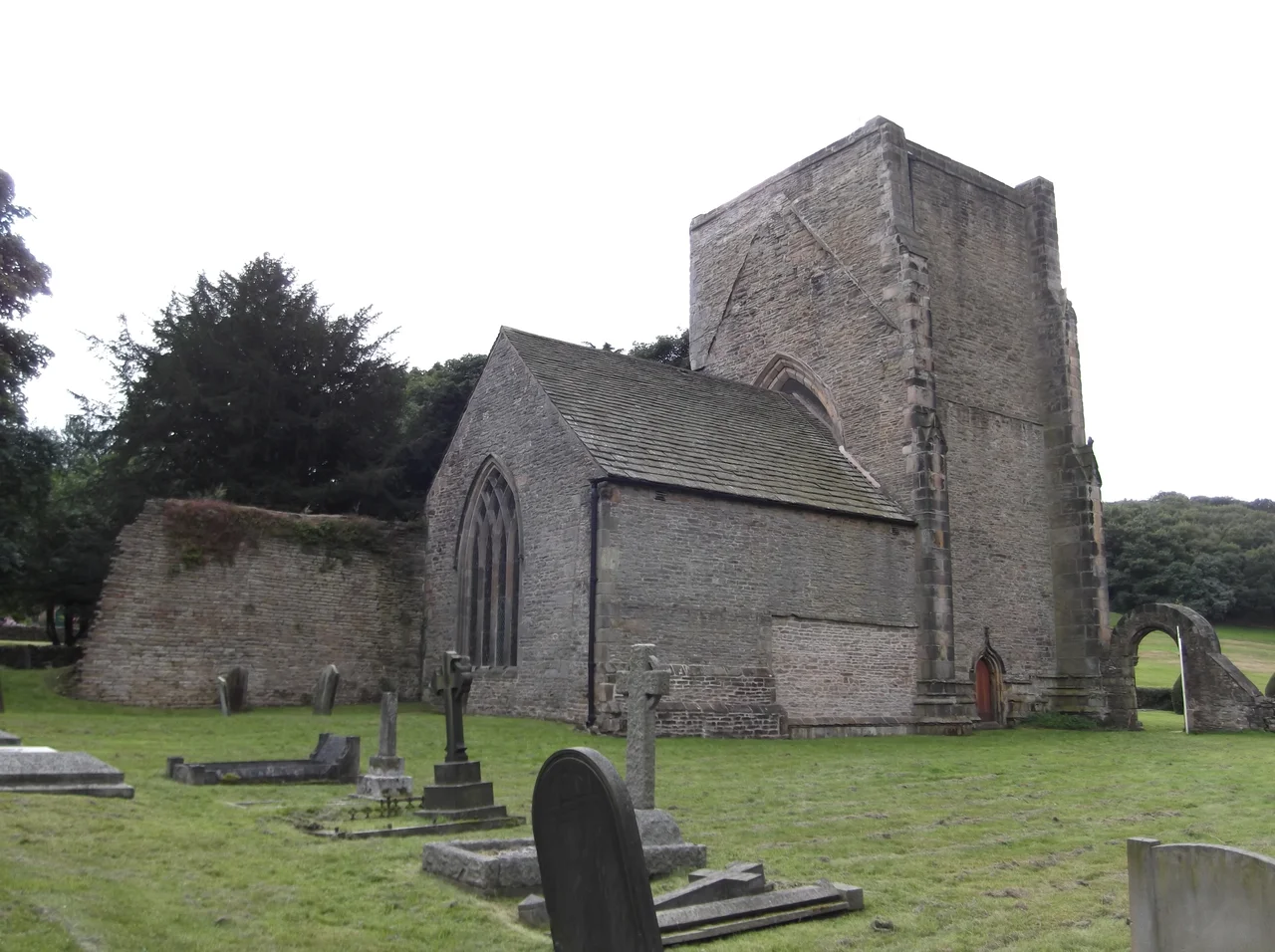

Beauchief Abbey
Robert FitzRanulph of Alfreton founded Beauchief Abbey sometime in the 1170s or 1180s, on a wooded slope above the River Sheaf where Sheffield now meets the open country. Local tradition held for centuries that FitzRanulph had been one of the knights who murdered Thomas Becket at Canterbury in 1170, and that he built this abbey in penance for that sin. The story is almost certainly false - careful historians have shown FitzRanulph had no connection to Becket's killing - but it stuck, partly because the founder did dedicate his new house to Saint Mary and the freshly canonised Becket, and partly because the legend was simply too good to lose. What survives today is a single stone tower, a Premonstratensian fragment standing among golf greens and ancient oak woods.
The White Canons
The Premonstratensian order, founded by Saint Norbert at Prémontré in northern France in 1120, was one of the great twelfth-century reform movements - canons who lived under monastic discipline but were ordained to serve parishes and pastoral work outside the cloister walls. They wore white woollen habits and earned the nickname White Canons. By the time Beauchief was founded, the order was spreading across England. The new abbey was modest: twelve to fifteen canons plus lay brothers, with the standard arrangement of buildings around a cloister - church, chapter house, refectory, dormitory - a stream diverted to feed water through the precinct and into a chain of fish ponds. Some of those ponds still exist, dug into the slope below the church, looking now like quiet woodland pools.
An Abbey That Ran a Furnace
The picture of monks at prayer is only half the truth. Beauchief, like nearly every medieval monastery, was also an industrial enterprise. The canons farmed the estate, ran outlying manors, smelted iron, extracted minerals, harvested coppiced woodland for charcoal and white coal, and operated mills on the River Sheaf - the same river from which the city of Sheffield, a few miles downstream, takes its name. The forests of Parkbank Wood and Ladies Spring Wood, just east and west of the abbey, are still pocked with the small circular q-pits and flat charcoal-burner's hearths where the monks' tenants once made fuel. The name 'Spring' in Ladies Spring Wood is Anglo-Saxon for coppicing. The pattern of work in these hills was set centuries before the abbey arrived and continued after it had gone.
Dissolution and Demolition
Henry VIII's commissioners suppressed Beauchief in 1537, in the early wave of the Dissolution of the Monasteries. The estate was granted to Sir Nicholas Strelley, and from him it descended through marriage to the Pegge family of Ashbourne. In 1671 Edward Pegge built Beauchief Hall as his family seat - using stone quarried from the now-roofless abbey ruins. A chapel was incorporated into the surviving west tower of the abbey church in the seventeenth century, and that chapel still serves as a parish church today. Everything else above ground is gone. The foundations are still visible in the grass, and the western tower with its blunt squared profile remains, attached to the much smaller seventeenth-century chapel that grew up around it like a barnacle. The site is a Scheduled Ancient Monument.
A Border That Outlasted Kingdoms
Ladies Spring Wood, the wood west of the abbey down on the riverbank, is one of the most quietly remarkable places on the edge of Sheffield. It is primary ancient woodland - never cleared, never replanted - and the evidence is in its shape and its name. The River Sheaf on its western edge was once the boundary between the parishes of Sheffield and Norton, before that the boundary between Yorkshire and Derbyshire, and before that, the frontier between the Anglo-Saxon kingdoms of Mercia and Northumbria. Borders attract neglect. Whatever king claimed it, neither side wanted to clear and farm right up to the line. The woodland persisted through all those changes of allegiance. Today it is a Site of Special Scientific Interest, full of sessile oak, birch, rowan and ash, with the white-throated dipper working the river and three species of woodpecker - green, great spotted and lesser spotted - hammering on the standing trunks.
What the Park Holds Now
Most of the old abbey estate is now occupied by two golf courses, Abbeydale and Beauchief, which feels incongruous until you notice that the topiaried fairways and the close-mown greens follow the curves of medieval ridge-and-furrow farming that the canons themselves laid out. Pockets of ancient woodland survive: Parkbank to the east, Old Park Wood and Little Wood Bank to the south, Gulleys Wood in the centre, Ladies Spring to the west. The Sheffield Round Walk threads through the estate, crossing the golf course on public rights of way that predate it by centuries. The fish ponds still hold water. The western tower still rises above the tree line. On a still afternoon you can stand by the chapel door and hear the river that drove the abbey's mills, and look up at masonry that has watched eight hundred years of weather come and go since the white-clad canons sang the offices inside it.
From the Air
Beauchief Abbey sits at 53.3326°N, 1.4999°W in the southern suburbs of Sheffield, on a wooded slope above the River Sheaf. From the air, look for the chapel's small stone tower in a clearing on the edge of green parkland and woods, with two golf courses spreading around it and the dense urban grid of southern Sheffield to the north and east. Recommended viewing altitude is 2,000 to 3,000 feet AGL; the surrounding ground rises to around 700 feet AMSL. Sheffield City Heliport (EGSY) lies about 4 nautical miles north, Doncaster Sheffield Airport (now closed for fixed-wing operations) about 17 nautical miles east-southeast, East Midlands Airport (EGNX) about 32 nautical miles south. The Peak District begins immediately west and weather can change rapidly across the moorland edge.
Nearby Stories
- Rochdale Pioneers Museum 3.4 km away
- Adlington Hall 4 km away
- National Coal Mining Museum for England 4.2 km away
- Sneyd Colliery Disaster 6.6 km away
- Southwell Minster 6.8 km away
- Belper North Mill 9 km away
- Selby Rail Crash 13 km away
- RAF Finningley 15 km away