
Sneyd Colliery Disaster
The miners of Sneyd Colliery did not work on New Year's Day. There was an old superstition in north Staffordshire that cutting coal on the first day of the year was unlucky, and for as long as anyone could remember the pit had stood quiet on 1 January while the rest of Burslem nursed its hangovers. But it was 1942. Britain was deep into the Second World War, the navy was running on coal, the factories were running on coal, and the men of Sneyd had been asked, like men everywhere, to give up the small comforts the old calendar permitted. They went to work on the morning of 1 January 1942. At 7:50 am, ten minutes into the shift, an underground explosion in No. 4 pit killed 57 of them.
Where the Pit Was
Sneyd Colliery sat in the Sneyd area of Burslem, one of the six towns of Stoke-on-Trent and a place built on coal almost as much as on pottery. Mining had been going on here since the eighteenth century. By 1896, Sneyd No. 2 and No. 3 shafts employed a combined 609 men and boys underground with another 124 on the surface, and the company was formally registered as Sneyd Colliery in 1900. By 1940 the pit was being worked by about 2,000 men and boys. The mine had killed before: three workers died in an underground fire in 1904. But fires and roof falls were the things miners feared as routine. The kind of explosion that came on New Year's morning 1942 was something else, the kind that takes a whole shift at once.
Sparks in the Dark
On the morning of the explosion, 295 men were working in No. 4 pit, which ran half a mile underground. The blast was strong enough to throw men off their feet at considerable distances from where it began. Reg Grocott, an apprentice of sixteen, was blown round a corner and his trajectory was finally stopped by an iron water drum, which he hit hard enough to be badly injured but not killed. The man he had been working alongside, thrown against a wall, did not survive. The official inquiry under Sir Henry Walker concluded that coal tubs (the small wagons that carried coal out of the mine) had derailed from their runners and cut into an electric cable, and that sparks from the damaged cable had ignited the fine coal dust suspended in the pit's air. Other accounts suggested the descending empty tubs had hit a compressed air pipe, raising a cloud of dust that a separate spark then ignited. The mechanisms differ. The result was the same.
The Families at the Pit Head
News of the explosion travelled fast through Burslem. Wives, sisters, and mothers ran to the pithead, where the bodies of 16 of the dead were brought up on the first day before the rescuers had to withdraw from the workings due to afterdamp (the suffocating mixture of carbon monoxide and carbon dioxide that follows a mine explosion). At that point it was announced that no more survivors could realistically be expected. The Sneyd Mines Rescue Team went in first; rescue teams from Black Bull, Chatterley Whitfield, Hanley Deep, and Shelton followed. The final toll of 57 left 32 widows and 35 fatherless children in this one Burslem street. Of the 24 men who had been unmarried, eight had been the sole support of widowed mothers; another 13 left both parents grieving. Burslem in early 1942 was a town walking through the same funeral over and over.
What the Pit Wheel Marks
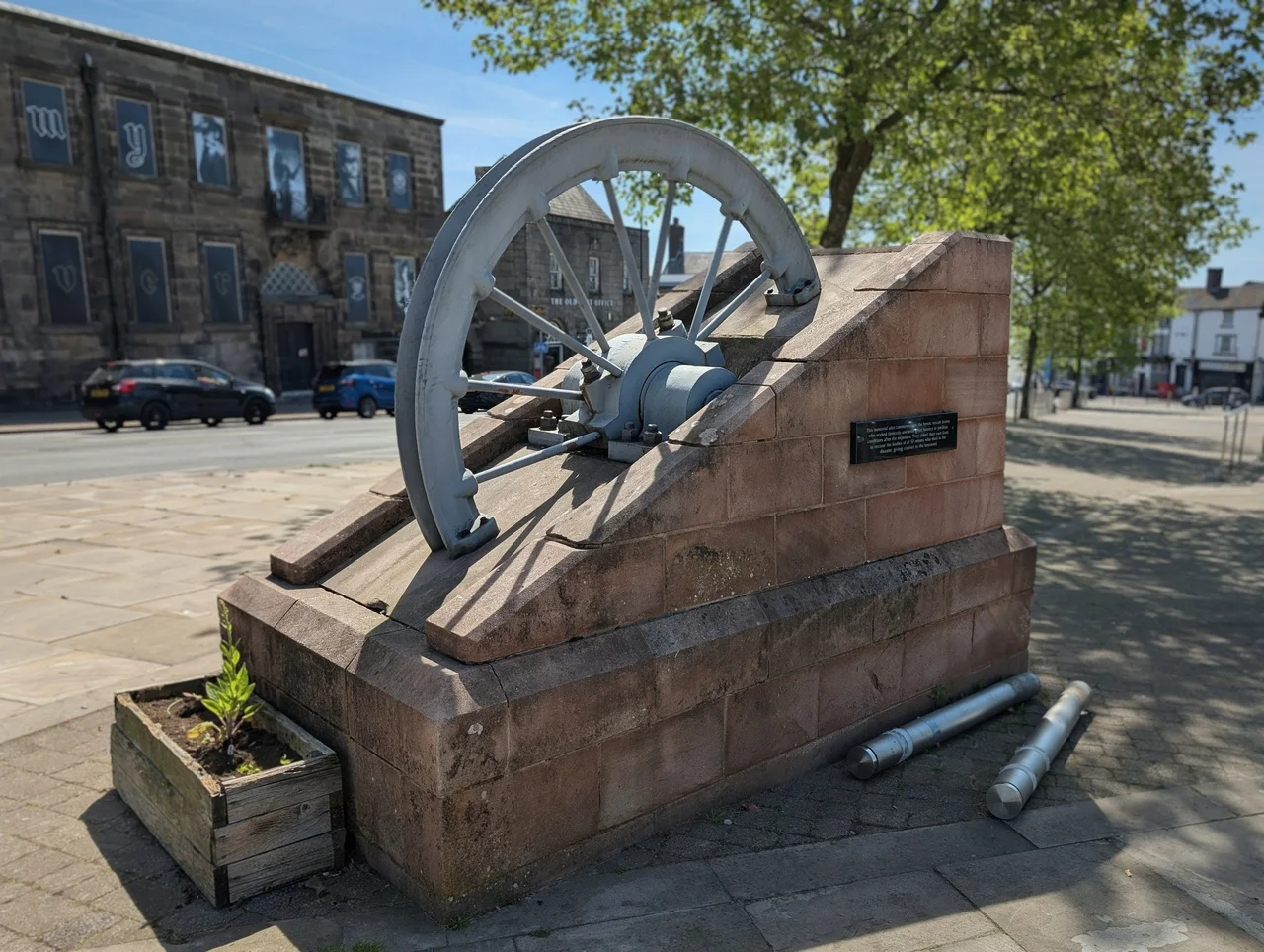
Sneyd Colliery was eventually connected underground to nearby Wolstanton Colliery, and over the following years coal was increasingly brought to the surface there rather than at Sneyd. The pit at Sneyd closed in the 1960s. Burslem changed shape. The pit cottages were demolished or sold off. But the names of 1 January 1942 stayed in the town's memory in the unforced way that disasters do in small communities, and in 2007 a memorial in the form of a pit wheel was raised in Burslem town centre with all 57 names on a plaque. Each year on the anniversary, the names are read at a service that draws descendants and survivors' families. The wheel is a working symbol turned still: the same machine that lowered the men into the dark, kept on the surface as a marker that they did not all come back. Reg Grocott, who lived because he hit an iron drum at exactly the right angle, was one of the few witnesses for many decades afterward.
From the Air
53.05 N, 2.18 W, in Burslem (one of the six towns of Stoke-on-Trent) in north Staffordshire. The colliery site itself has largely been redeveloped; the pit wheel memorial stands in Burslem town centre. From 2,000 to 3,000 feet AGL the area reads as densely built urban Stoke-on-Trent with the Potteries Loop Line corridor visible as a green strip running north. Nearby airports: EGCC Manchester to the north, EGNX East Midlands to the south-east, EGNR Hawarden to the west.
Nearby Stories
- National Memorial Arboretum 2.2 km away
- Stanlow Abbey 4.5 km away
- Alderley Edge 5.6 km away
- Lilleshall Abbey 7.2 km away
- Hope Cement Works 8.4 km away
- 2025 Wrexham National Eisteddfod 9.1 km away
- Tutbury Castle 16 km away
- Powis Castle 25 km away