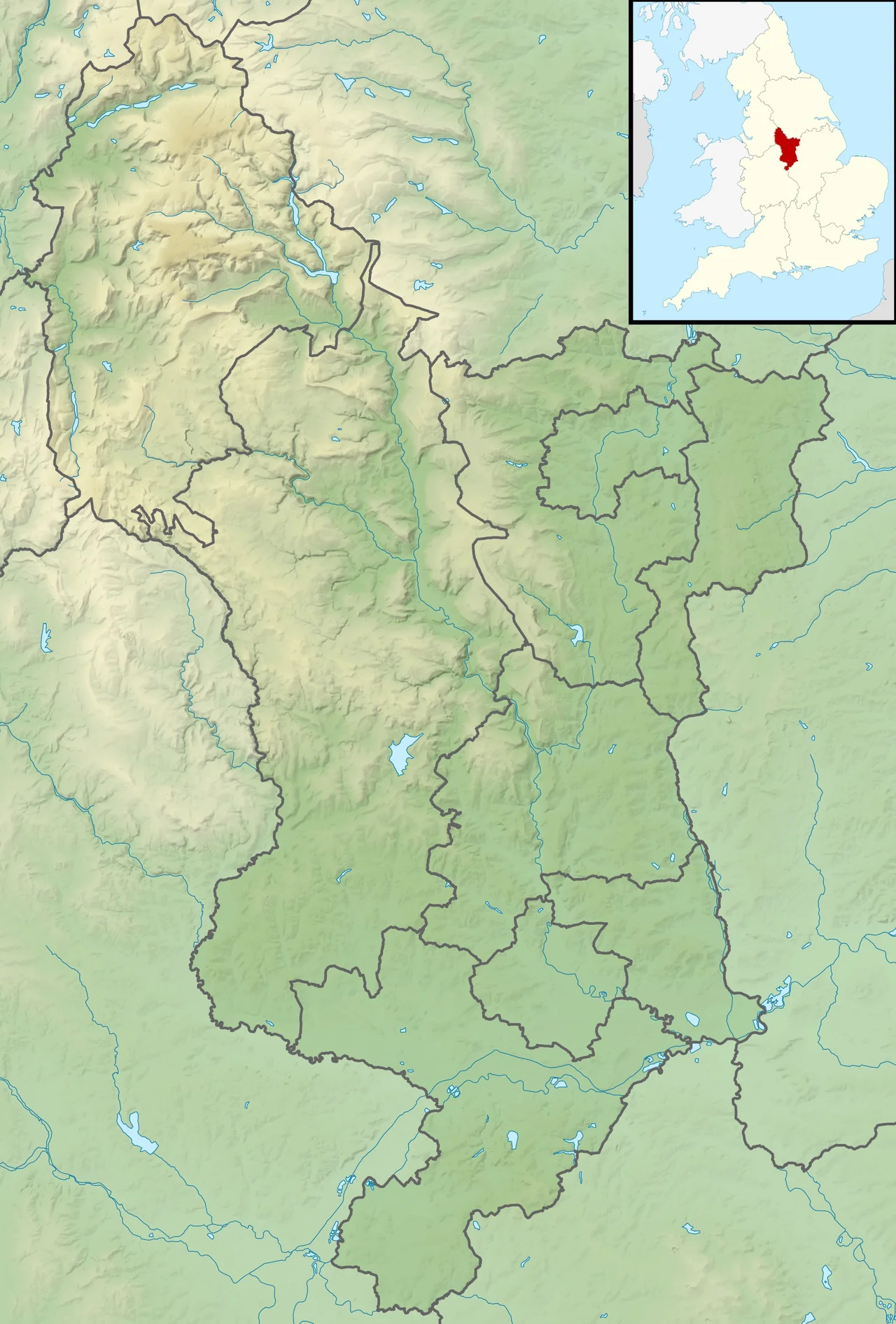

Hope Cement Works
Drive into Hope Valley from the east and you will see it before you see anything else: a single chimney, 132 metres tall, planted in the middle of the Peak District National Park. Around it sprawls a working cement plant that produces around 1.5 million tonnes of cement a year, more than any other in the United Kingdom. Hope Cement Works is the strangest of compromises - a heavy industrial site, parked inside Britain's first and most-visited national park, surrounded by walkers, sheep, and the gritstone edges of the Peak. It is here because the geology demanded it.
Where the Stones Meet
The trick of cement-making is finding limestone and shale in close proximity. Burn them together in a rotary kiln at around 1,450 degrees Celsius, grind the result with gypsum, and you have Portland cement, the binder that holds the modern world together. Hope sits on exactly the right geological seam. The Carboniferous limestone of the Monsal Dale Group rises to the south of the works, while the Edale Shale beds lie to the north and east. The plant chews into both. When the lime quarry produces its byproduct - the violet-and-purple mineral fluorspar - it is sold on as a chemical feedstock. G.T. Earle started full production in 1929 with a single wet-process line making 50,000 tonnes a year. Two more kilns came in the 1930s, a fifth in 1952, and by 1970 the whole plant had switched to the more efficient dry process - same fuel, more cement.
A National Park Reluctantly
When the Peak District National Park was created in 1951, Hope Works was already 22 years old. The park boundary was drawn around the plant rather than excluding it - which left the cement makers in an awkward position. Every expansion, every new quarry face, every pile of fines had to be argued through planning rules tighter than for any other British cement plant. The authorities pressed for as much traffic as possible to leave by rail, not road. Today around two thirds of the works' output - roughly a million tonnes a year - travels out along a mile-long branch that connects to the Hope Valley Line at Earle's Sidings, then fans out to depots at Dewsbury, Walsall, Theale, and Dagenham. The trains, the quarries, the white plume from the stack - all of it sits inside what is meant to be a protected landscape, and the contradiction has never quite resolved.
Carbon and Coal Tyres
Cement is one of the heaviest carbon emitters in industry, and Hope is no exception. A 2006 inventory found that the entire Peak District National Park emitted 1,648,890 tonnes of carbon dioxide that year - of which 65% came from this one plant. Coal was the traditional kiln fuel. The plant has experimented with alternatives. Chipped tyres and petroleum coke arrived in the early 2000s and cut some emissions but raised sulphur output. In 2010 the kilns burned dried sewage pellets. As coal-fired power stations declined after 2015, the plant lost easy access to pulverised fuel ash (PFA), a power-station byproduct used in cement chemistry, and applied to bring in alternative raw materials - slate quarry fines, marl, fireclay - at about 250,000 tonnes a year, largely by rail.
The Long Tail
Ownership has rotated through some of the biggest names in materials. G.T. Earle ran the works into the 1960s. BPCM took over, then Lafarge in 2001 after their acquisition of Blue Circle. In 2013 the plant was hived off into a standalone Hope Construction Materials before being acquired in 2016 by the Breedon Group for £336 million. A 2020 study found that the plant supports around 270 jobs and contributes over £60 million a year to the local economy. The limestone reserves once thought to last until 2038 are now expected to be exhausted by 2034. After that, the geology that drew an industry to a national park will have given its last. The chimney will likely fall before the century is done, though Hope - the village, the valley, the line - will keep its name.
From the Air
Coordinates 53.337°N, 1.751°W. Best viewed from 3,000-5,000 feet AGL. The plant sits in the Hope Valley in the central Peak District, with its 132-metre chimney visible from many miles around. Nearby airports: Manchester (EGCC) 19 nm west-northwest, Sheffield/Doncaster (EGCN) 26 nm east, East Midlands (EGNX) 32 nm south. The plant is surrounded by the conical peak of Lose Hill to the north, Mam Tor to the west, and the limestone scarp running south. The Hope Valley Line railway threads through the site on its way from Manchester to Sheffield. Best light is morning when the plume catches the sun.
Nearby Stories
- Rochdale Pioneers Museum 3.4 km away
- Adlington Hall 4 km away
- National Coal Mining Museum for England 4.2 km away
- Sneyd Colliery Disaster 6.6 km away
- Southwell Minster 6.8 km away
- Belper North Mill 9 km away
- Selby Rail Crash 13 km away
- RAF Finningley 15 km away