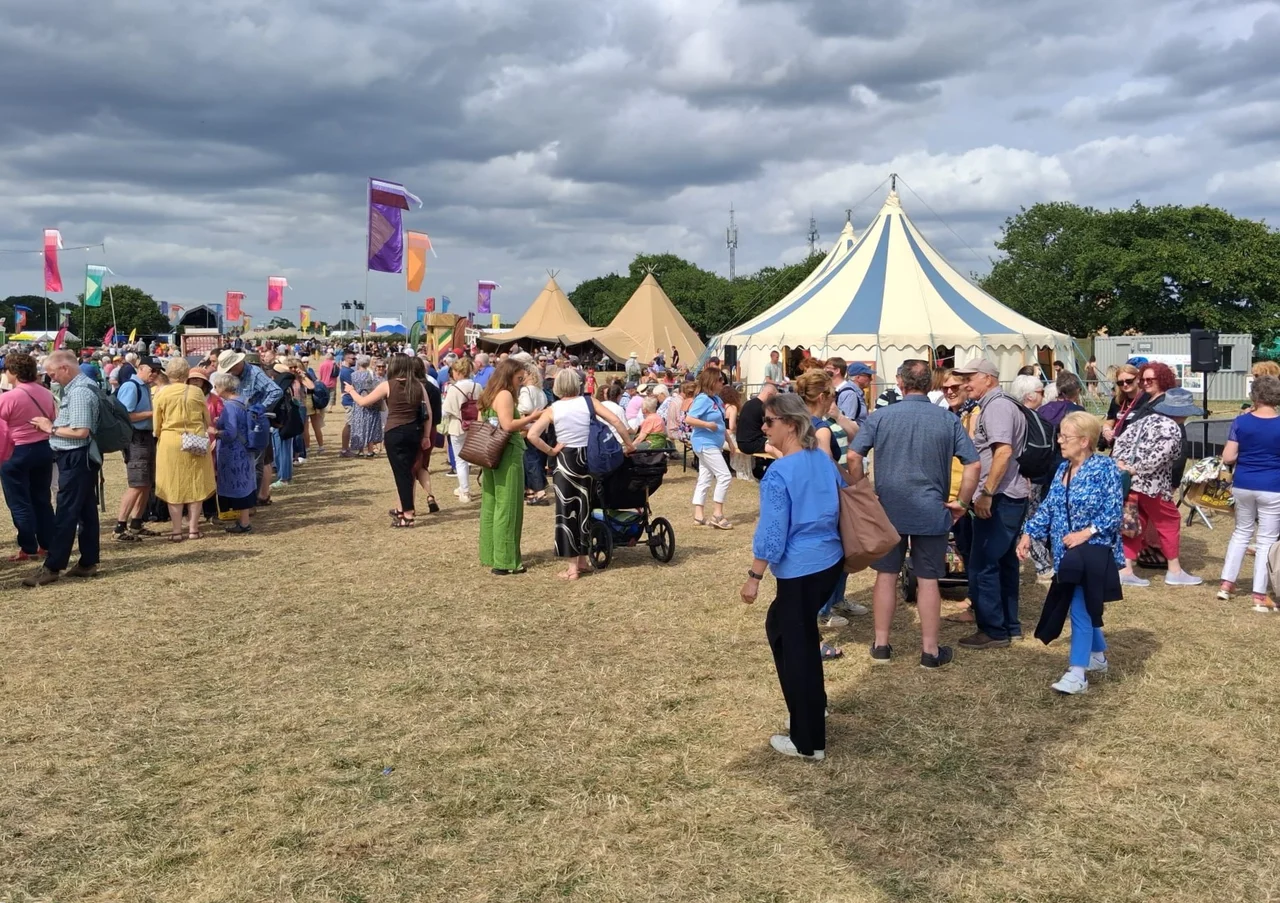

2025 Wrexham National Eisteddfod
From 2 to 9 August 2025, agricultural land off Ridley Wood Road in Isycoed - on the eastern outskirts of Wrexham - became, for one week only, the largest gathering of Welsh-language culture in the world. A fenced festival ground called the Maes appeared overnight. A free shuttle bus ran between Wrexham General railway station and the gates from eight in the morning until midnight. Six thousand competitors entered choirs, brass bands, recitations, science contests, cerdd dant and dance categories. Roughly 150,000 visitors came through during the week. Every word spoken, sung or judged on the official stages was in Welsh. Then the tents came down, the field went back to being a field, and another community somewhere else in Wales began preparing for 2026.
An Old Festival in a Field
The National Eisteddfod of Wales has run every year since 1861, with three gaps: 1914 for the outbreak of the First World War, and 2020 and 2021 for the COVID-19 pandemic. It alternates between north Wales and south Wales each year, hosted by a different region. Since 1950 it has been conducted entirely in Welsh: every competition, every adjudication, every announcement on the stages of the Pavilion and the side fields. About 6,000 competitors enter, which gives the festival a claim - alongside larger pop and rock festivals - to be one of Europe's largest music and poetry events. It is the longest continuous public competition for Welsh-language culture, and the most important annual landmark in the calendar of Welsh literary and musical life.
Why Wrexham, and Why Now
It was the seventh time the National Eisteddfod had been held in Wrexham, and the ninth in the wider county borough. The 2011 Wrexham Eisteddfod had lost between £80,000 and £90,000, making the council cautious about hosting again so soon. The momentum to return came as part of Wrexham's bid for UK City of Culture 2029 - the council had been one of four finalists for 2025, losing to Bradford, and the National Eisteddfod was one of seven major events used to strengthen the second bid. Rumours emerged in July 2022; Wrexham County Borough Council committed £300,000 in June 2023; the National Eisteddfod confirmed Wrexham on 1 August 2023. The Isycoed location - on the eastern edge of the city, near Wrexham Industrial Estate - was finally announced on 24 October 2024, after months of delay.
A Chair Built from Wrexham
Every National Eisteddfod has a Chair, an elaborate piece of furniture awarded to the year's winning poet of an awdl - a long poem in strict-metre Welsh cynghanedd. The 2025 Chair was designed by Gafyn Owen and Sean Nelson, and built entirely around symbols of Wrexham. The arches of the chair's back echoed the arches of Pontcysyllte Aqueduct. The seat was red - the colour of Wrexham Association Football Club, the team co-owned since 2020 by actors Ryan Reynolds and Rob McElhenney. The crest at the top referenced the Racecourse Ground, the club's stadium and the oldest international football ground still in regular use. The chair was won by retired university professor Tudur Hallam, who had won before but had been spurred to enter again after a diagnosis of untreatable cancer. His winning poem described receiving the diagnosis at Glangwili Hospital. Fifteen poets had entered - the highest number since 1989.
Dafydd Iwan, Once More
On Sunday 3 August, the folk singer and former Plaid Cymru politician Dafydd Iwan performed on the main stage for the final time. He had appeared at every National Eisteddfod since 1965 - sixty consecutive years - making him the festival's longest-serving regular performer. His songs, including 'Yma o Hyd' ('We're Still Here'), had become unofficial anthems of the Welsh national football team during their qualifying campaigns and Euro 2020 run. The crowd at Isycoed for his farewell set knew this would be the last time. They sang it back to him. Gold medals went to the painter Gareth Griffith, who had been exhibiting at the Eisteddfod since the 1970s, for fine art; and to London-based architecture practice Manalo & White for their conversion of St Mary's Church in Bangor into an arts and performance space.
Robes, Minecraft and the Future
On 27 April 2024, the Gorsedd Cymru - the assembly of bards, druids and ovates - held the proclamation ceremony in Wrexham, processing from Coleg Cambria Yale through the city to Llwyn Isaf in front of the Guildhall. The ceremony publishes each year's list of competitions. New Gorsedd members were inducted in green and blue robes - among the 2025 inductees were the politician Rhun ap Iorwerth, the broadcaster Dewi Llwyd, and figures from as far afield as Washington D.C. and Patagonia (Clare Vaughan of the Welsh-speaking community in the Chubut valley). Wrexham University ran a 10-week course called 'Croesawu'r Eisteddfod' - 'Welcoming the Eisteddfod' - to prepare locals for the festival. They also built a virtual version of the Maes in Minecraft. The Welsh Government provided a £200,000 grant to help locals on lower incomes attend. By the time the gates closed on 9 August, the festival had attracted estimated economic benefits of several million pounds to the region - a story Wrexham's City of Culture bid will be telling at length.
From the Air
The Maes was set up at Isycoed, on the eastern edge of Wrexham, at roughly 53.05 degrees north, 2.91 degrees west - close to Wrexham Industrial Estate and the A534. From the air during the festival week, the temporary city of marquees, the Pavilion big top, and the Maes B campsite stand out clearly against the surrounding farmland. Wrexham city centre lies a few miles west, with the Racecourse Ground football stadium identifiable in the centre. Cruise at 2,500-4,000 feet for the best perspective. Hawarden (EGNR) lies about 10 nautical miles to the north-east; Shawbury (EGOS) about 30 nautical miles south-east.
Nearby Stories
- Lilleshall Abbey 5 km away
- RAF Hooton Park 5.5 km away
- Gwrych Castle 6.7 km away
- Knutsford 7.5 km away
- Battle of Blore Heath 9.7 km away
- Ysbyty Ifan 14 km away
- Powis Castle 15 km away
- Machynlleth 28 km away