
RAF Hooton Park
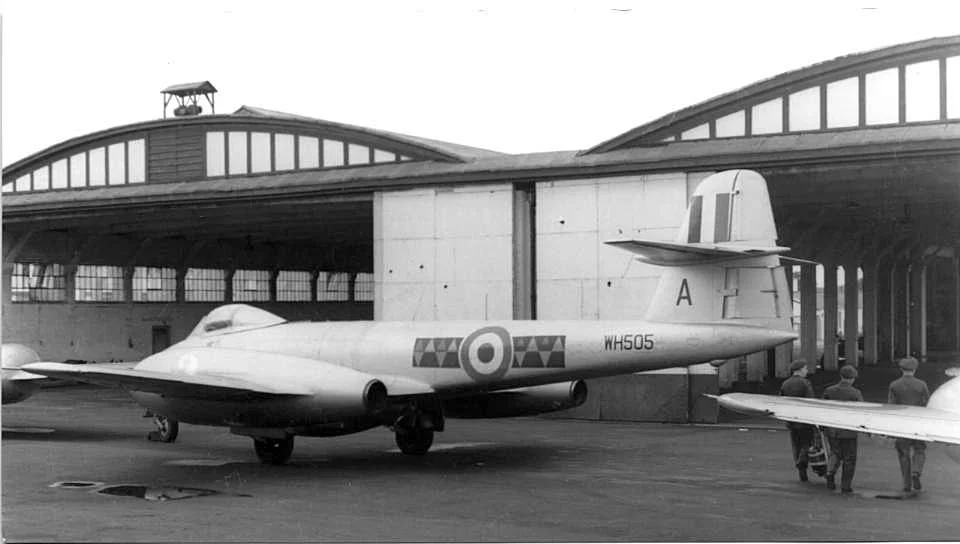
There is no airfield left at Hooton Park, not really - just three remarkable timber-roofed hangars built in 1917 and surrounded by car-plant sheds. But take off from any Wirral airfield today and you are flying out of the shadow of this place. Sopwith biplanes trained pilots here for the Western Front. Spitfires of 610 Squadron lifted off from these meadows for the Battle of Britain. Meteor jet fighters lined the apron in the early 1950s. When the RAF Auxiliary squadrons disbanded in 1957 the airfield was sold to Vauxhall Motors, who tarmacked over most of it for a car factory - but a campaign by aviation enthusiasts saved the original 1917 hangars from demolition in the late 1990s. They are now Grade II* listed, three double-bay Belfast-truss hangars surviving as a group, the only such ensemble left in Britain.
Belfast in Cheshire
The War Department needed pilots faster than the Royal Flying Corps could train them. In 1917 they requisitioned the Hooton Hall estate - racecourse, polo ground, the lot - and built one single and three double hangars at the eastern edge of the racecourse infield. The roofs were the unusual part. Belfast trusses are a latticed timber construction first developed in the Belfast shipyards to span big working areas cheaply, using short scraps of timber bolted together to form a curved arch. They were stiff, light, and could be put up by carpenters rather than specialist steelworkers - exactly what wartime construction needed. Three double-bay hangars went up almost simultaneously and Hooton Park became No. 4 Training Depot Station, training Royal Flying Corps pilots and large numbers of American and Canadian airmen for the Western Front. Some of those who died in training accidents are buried at the parish church in nearby Eastham.
A Gambling Hall and the Banker's Tower
The estate had its own complicated story. Hooton was granted in 1070 by William the Conqueror to Adam de Aldithly, and passed through marriage to the Stanley family - the future Earls of Derby. Their third hall, built in 1778 in the Italianate style, was sold in 1850 to cover gambling debts. A Liverpool banker called Naylor bought it for 82,000 guineas and spent another 50,000 guineas on extensions - a 100-foot tower, an art gallery, a vast dining hall, a heronry, a private racecourse, a stud farm, even a church he built for his first wife at Childer Thornton. He kept his yacht moored on the Mersey. Then in the 1890s the construction of the Manchester Ship Canal cut him off from his mooring, and he packed up and moved to Nottinghamshire. The hall was emptied to dodge rates and never properly recovered. The army wrecked what was left during the First World War. By the late 1920s it had been demolished. The racecourse and the wartime hangars outlived their owner's home.
Liverpool's First Airport
After the war the airfield went back to grass. In 1927 an aviation enthusiast named G. H. Dawson bought the site and hosted an air pageant that became the founding event of the Liverpool and District Aero Club. For three years - 1930 to 1933 - Hooton Park was officially Merseyside's airport, handling early scheduled services along with Speke across the Mersey. Two engineering officers set up businesses in the hangars: Nicholas Comper built the Comper Swift sporting monoplane here, and Douglas Pobjoy designed the small radial engines that bore his name. Dawson went bankrupt and died in 1933. The flying club moved to the new Speke airfield, with its better clubhouse and cheaper hangarage. Frank Davison and his pilot-engineer wife Elsie Joy Muntz bought Hooton in 1934 and ran joy-rides and air taxis as Utility Airways. When the Second World War came in 1939, the military took the airfield back. Most of Davison's aircraft survived the requisition by being stored under the old racecourse grandstand - until 8 July 1940, when the grandstand caught fire and 19 aeroplanes were destroyed in what is still known as the Great Fire of Hooton Park.
Battle of Britain Squadron
No. 610 (County of Chester) Squadron was formed at Hooton Park in 1936. The original pilots paid for their own private flying lessons to qualify - one observer said he had never seen so many Rolls-Royce cars in one place. The squadron flew bombers at first, then Hurricanes, then Supermarine Spitfire Mark Is. On 3 September 1939 they were mobilised and sent to RAF Wittering. The following summer 610 moved to RAF Biggin Hill and into the Battle of Britain, where they became one of the most successful fighter squadrons of the campaign. By the war's end the squadron had claimed 132 enemy aircraft and 50 V-1 flying bombs destroyed. Sergeant Ray Hamlyn shot down five enemy aircraft on a single day. In February 1945 Flight Lieutenant Tony Gaze, flying a Spitfire XIV, destroyed a Messerschmitt Me 262 jet over Germany - the older fighter taking a higher-tech kill. Meanwhile, at Hooton itself, Martin Hearn Ltd repaired thousands of Avro Ansons and de Havilland Mosquitoes and assembled the American Mustangs, Lightnings and Thunderbolts that arrived crated at the Mersey docks.
Saving the Hangars
When the auxiliary squadrons disbanded in March 1957 the airfield closed. The Cheshire Show used the runways until 1977. Shell Research tested cars at high speed on what was left of the concrete. In 1960 Vauxhall Motors bought the eastern section and built the Ellesmere Port plant, with the first Vauxhall Viva rolling off the line there in 1964. The original Belfast-truss hangars survived as Vauxhall storage and workshops. In 1985 they got Grade II listing - rare survivors of a once-common form. In 1998 Vauxhall applied to demolish them. The protest was loud and immediate. By October 2000, after twelve months of negotiation, Vauxhall transferred the freehold to the new Hooton Park Trust as a heritage gift, and contributed cash to the restoration fund. In 2003 the listing was upgraded to Grade II*. In 2022 the Trust reopened the restored south bay of hangar B16 to monthly public open days. The Aeroplane Collection - the oldest voluntary aircraft preservation society in England, founded in 1962 - displays its restored aircraft inside. From the air today you would not know there was an airfield here. From inside one of those Belfast-truss hangars, looking up at the timber latticework arching overhead, it is impossible not to.
From the Air
RAF Hooton Park sits at 53.303°N, 2.943°W on the southern Wirral, just inland from the Mersey shore at Ellesmere Port. Best viewed at 1,500-3,000 ft. Liverpool John Lennon Airport (EGGP) is 7 nm north-northeast across the Mersey; Hawarden Airport (EGNR) is 6 nm west-southwest. Look for the large Vauxhall plant complex - the three preserved Belfast-truss hangars sit at the northern edge, distinguishable by their distinctive curved roofs in three pairs.
Nearby Stories
- RAF Wrexham 3.3 km away
- Birkdale Palace Hotel 3.7 km away
- Turton Tower 4.1 km away
- Tatton Park 5.6 km away
- Abergele Rail Disaster 9.6 km away
- Diglake Colliery Disaster 13 km away
- Ysbyty Ifan 16 km away
- Celtic Array 62 km away