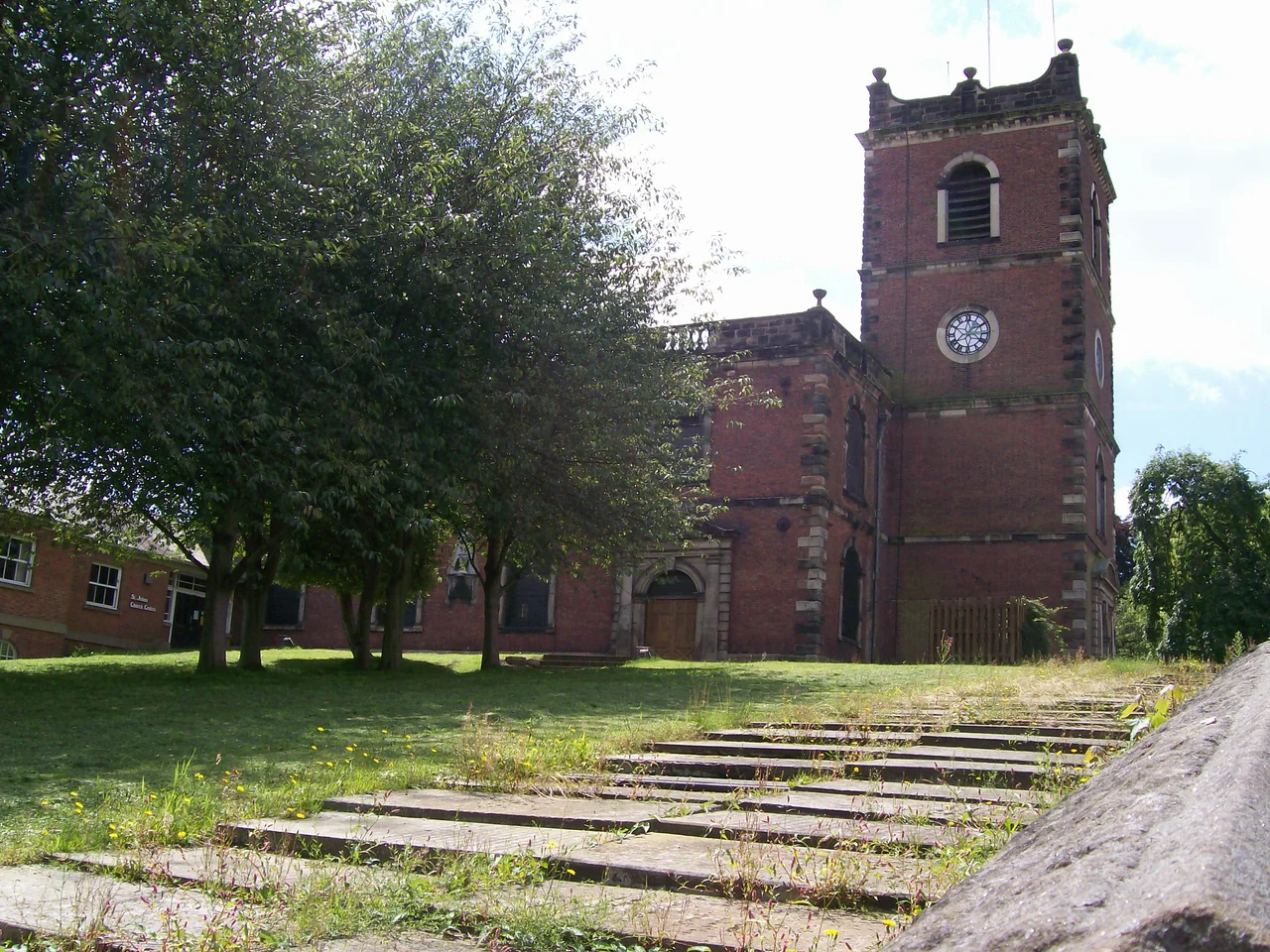

Knutsford
Every May Day, the people of Knutsford still pour coloured sand onto their streets in patterns and pictures. The tradition is at least three centuries old. Local memory traces it back to King Canute himself, who is supposed to have shaken sand from his shoes into the path of a wedding procession as he forded the River Lily, wishing the couple as many children as the grains beneath their feet. Queen Victoria saw the sanded streets in her journal of 1832. It is a small ritual, performed in a small Cheshire town, and it is one of the very few English customs that may genuinely have begun with a Viking king.
Canute's Ford
The Domesday Book of 1086 records the settlement as Cunetesford, Canute's ford, although the English Place-Name Society also allows for an Old English word meaning hillock-ford. Either way, the name pulls the place back into the eleventh century, when Knutr ruled England, Denmark, Norway, and parts of Sweden. In 1292 Edward I granted the town a market charter, and a thousand years after the Viking ford the market still anchors the centre. Two streets do most of the work: Princess Street higher up, known locally as Top Street, and King Street lower down, Bottom Street. At the narrow end of King Street, a quiet gateway leads into the parkland of Tatton, the estate that has lent its name to the parliamentary constituency.
The Town and the Novelist
Elizabeth Gaskell grew up here, on what is now Gaskell Avenue, and she is buried in the graveyard of the Unitarian Chapel that dates from 1689. Her novel Cranford is Knutsford lightly disguised, and many of its people and places are recognisable on the ground. When the BBC adapted Cranford in 2007, the filmmakers used Lacock in Wiltshire instead, although the script still names King Street and The Heath. Knutsford has appeared on screen in other guises too. In 1987 Steven Spielberg used Legh Road, designed by the eccentric architect Richard Harding Watt, as colonial Shanghai for the opening of Empire of the Sun. The town centre, in front of the Alfred Waterhouse town hall, served as a backdrop for the George C. Scott film Patton, which was filmed in the same place where the real General Patton had given the controversial 1944 speech that nearly ended his career.
The Gaol on Toft Road
Knutsford Gaol was built in 1817 and extended in 1853. It was not only a prison for the convicted; it also housed men who could not be employed, in keeping with the harsher logic of the Victorian poor laws. The First World War turned the gaol into a military prison, and from 1916 it held conscientious objectors who refused the Military Service Act. That April, after the Easter Rising failed in Dublin, at least 600 Irish rebels were brought by train from Holyhead and locked inside the Knutsford walls. Conditions were grim. Many prisoners were not properly fed and were reduced to eating grass and scraps left by visitors. The gaol was demolished in 1934, but the Governor's House from 1846 still stands on Toft Road, and the town council meets there. In 1919 the Toc H founder Tubby Clayton briefly used the abandoned cells to start an ordination school for men returning from the trenches.
Sanding the Streets
The May Day festival is the day Knutsford performs itself. Hundreds of villagers walk through the streets behind farm animals, morris dancers, and the leafy figure of Jack in the Green, on the way to crown the May Queen on The Heath. The sand-laying is the older heart of it. Coloured patterns and pictures appear on the pavement overnight, traceable in records to the late 1600s and possibly far older. Local folklore adds the highwayman Edward Higgins, who is said to have hidden his stolen goods in a tunnel under that same field. A travelling funfair, one of the largest in the UK, sets up alongside the crowning. Every ten years a separate but more eccentric tradition arrives in the form of an international three-hour endurance race for penny-farthing bicycles.
Engineers, Footballers, and the Tatton Set
Knutsford has always punched above its weight in residents. Henry Royce, the engineer half of Rolls-Royce, lived here between 1898 and 1912. The 1924 Olympic 200-metre breaststroke champion Lucy Morton was born just outside town at New Tatton. The miniature painter Edward Penny, born here in 1714, helped found the Royal Academy. Edmund Sharpe, the Victorian architect and railway engineer, was a local son. So was the actress Ruby Barnhill, who played the lead in Spielberg's 2016 BFG. Modern Knutsford sits near Cheshire's Golden Triangle, with house prices that climbed past £4 million in places by 2017, and a Barclays IT campus of 3,000 staff at Radbroke Hall just outside the centre. Add Manchester Airport five miles away, the M6 and M56 junctions within easy reach, and a Norman king's accidental wedding gift on the cobbles every spring.
From the Air
Knutsford lies at 53.3025 N, 2.3708 W in Cheshire, 14 miles south-west of Manchester. The town sits on the Cheshire Plain just north of the M6 (junction 19) and south of the M56 (junction 7). Manchester Airport (EGCC) is roughly 5 miles to the north-east, and Liverpool John Lennon (EGGP) is about 25 miles to the west. Tatton Park's deer parkland and meres lie immediately north of the town and provide a clear visual landmark. Recommended viewing altitude is 2,500 to 4,500 feet AGL.
Nearby Stories
- Hope Cement Works 1.5 km away
- Liverpool John Lennon Airport 3 km away
- Diglake Colliery Disaster 3.4 km away
- Holt Castle 4.6 km away
- Bank Hall 6.9 km away
- Rochdale Pioneers Museum 8.3 km away
- National Coal Mining Museum for England 9.6 km away
- Belper North Mill 19 km away