
Holt Castle
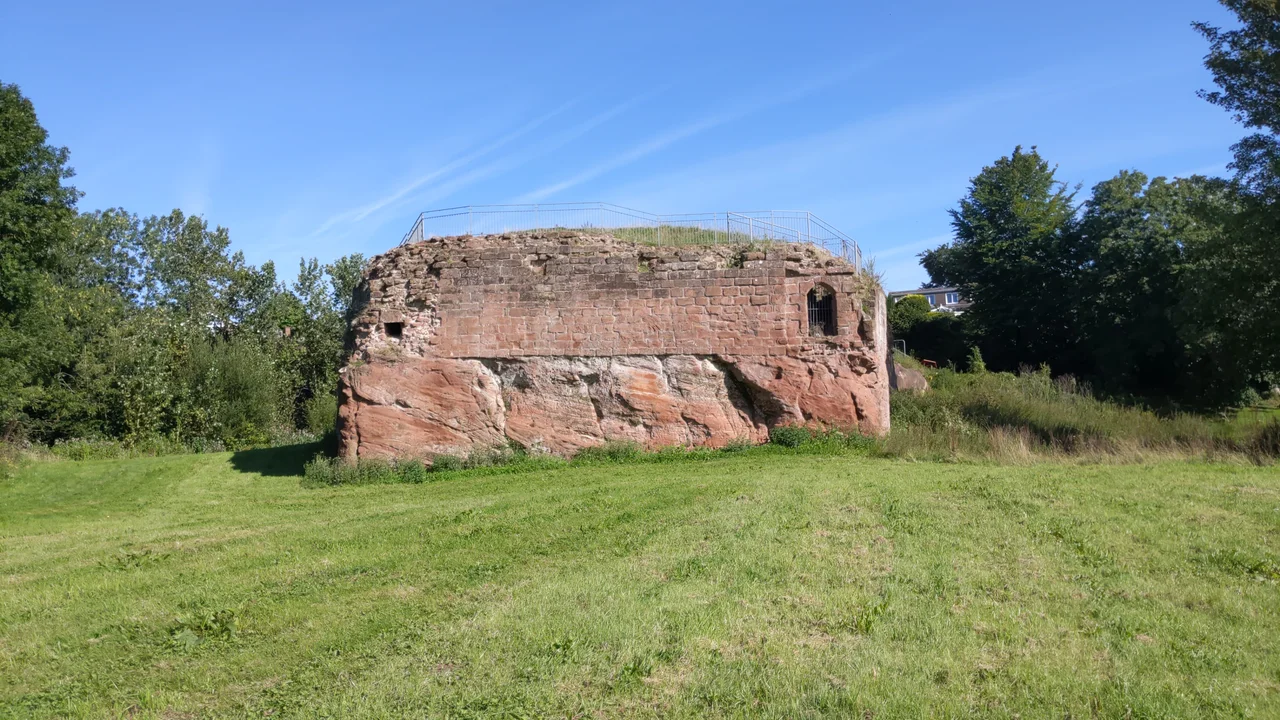
Castle Lyons - that was its medieval name. A lion was carved above the main gate, and for the men who built it on a 12-metre sandstone promontory above the River Dee, the carving meant something specific: this place answered to the English crown. Today, Holt Castle is mostly absent. What remains is the rock it sat on and a few stubs of wall, the pentagon shape just barely traceable in the masonry foundations. The lion is gone. So is most of the stone, taken in barges downstream between 1675 and 1683 to help build Eaton Hall for the Grosvenors of Cheshire. A 300-year-old act of architectural cannibalism explains why a once-formidable fortress now reads like an archaeological diagram.
Edward I's Pentagon on the Dee
Construction began in 1277, the year Edward I launched his first invasion of North Wales, and finished by 1311. In 1282 Edward gave the lands of Bromfield and Yale - the broad swathe of the borderlands in which Holt sits - to John de Warenne, a loyal lord, with instructions to complete the castle. Warenne built a pentagon, a five-sided keep with towers at each corner, designed in the same idiom as the inner wards at Ruthin and Conwy. The towers were built directly against the rock outside the curtain wall, a clever piece of engineering that let the sandstone itself become part of the defence. A barbican, postern gate, inner ward and curtain walls completed the design. A moat fed from the Dee surrounded the whole thing. Outside the walls, Warenne laid out a planned town for English settlers - the kind of military-civilian package Edward used across North Wales to lock down conquered territory.
Glyndwr's Fire and the Civil War Moat
In 1400 Owain Glyndwr's rising swept through North Wales and Welsh forces burnt the English settlement around Holt to the ground. The castle itself held - the lion still over the gate, the sandstone still in place - but the planned town never quite recovered, and by the 16th century the Elizabethan mapmaker John Norden surveyed the building and recorded that it was 'nowe in great decay'. Then the English Civil War found it. For most of the first war it was a Royalist garrison. Parliament took it in 1643. The Royalists retook it in spring 1644 and, after the Parliamentarian defenders surrendered, killed thirteen of them and threw the bodies into the moat. In January 1647, after a nine-month siege, the Royalist governor Sir Richard Lloyd surrendered to Thomas Mytton - and after Holt fell, only Harlech still held out for the king in Wales. Harlech surrendered to Mytton in March. Parliament ordered Holt slighted - deliberately ruined - later that year.
Carried Away in Barges
What Cromwell's order began, Sir Thomas Grosvenor finished. Between 1675 and 1683 the 3rd Baronet of Eaton, head of the family that would eventually become the Dukes of Westminster, methodically dismantled what remained of Holt Castle and floated the stone down the Dee on barges to rebuild Eaton Hall, his country house in Cheshire. By the 18th century all that remained at Holt was part of one tower and a rectangular building. The Dee that had brought sandstone up to build the castle now carried it away. There is a particular kind of historical theft involved when one great house consumes another - the materials of Welsh military power being reassembled as the staircases and gateposts of English landed wealth. Eaton Hall is still there. Most of Holt is not.
What the Sandstone Remembers
Today the only sizeable part of Holt Castle still in place sits perched on its sandstone base above the river, opposite the English village of Farndon across the bridge. Some masonry features are still visible: lower walls of the inner keep, the postern gate, a buttress, a chute exit, the foundations of the outer gate's square tower. In 2015, four years of restoration work were completed - vegetation cleared, steps installed, what remained of the masonry repaired - and archaeological surveys mapped the foundations beneath. You can walk the outline of the pentagon now if you know what you are looking at. The lion is still gone. So is the moat. But the rock the whole thing was built on is the same rock, and from the top you can see the bend in the river where the barges turned downstream, hauling Castle Lyons piece by piece into another county and another century.
From the Air
Holt Castle sits at 53.08N, 2.88W on the Welsh bank of the River Dee, opposite Farndon in Cheshire. The river forms the international border here, and the bridge crossing connects two countries in the space of a few hundred yards. From altitude the sandstone promontory is visible as a small rise above the river bend. Nearest airports are Hawarden (EGNR, ~8nm north) and Liverpool John Lennon (EGGP, ~20nm north). Cruise at 1,500-2,500 ft AGL for the cleanest view of the Dee meandering through pastoral borderland.
Nearby Stories
- Lilleshall Abbey 5 km away
- RAF Hooton Park 5.5 km away
- Gwrych Castle 6.7 km away
- Knutsford 7.5 km away
- Battle of Blore Heath 9.7 km away
- Ysbyty Ifan 14 km away
- Powis Castle 15 km away
- Machynlleth 28 km away