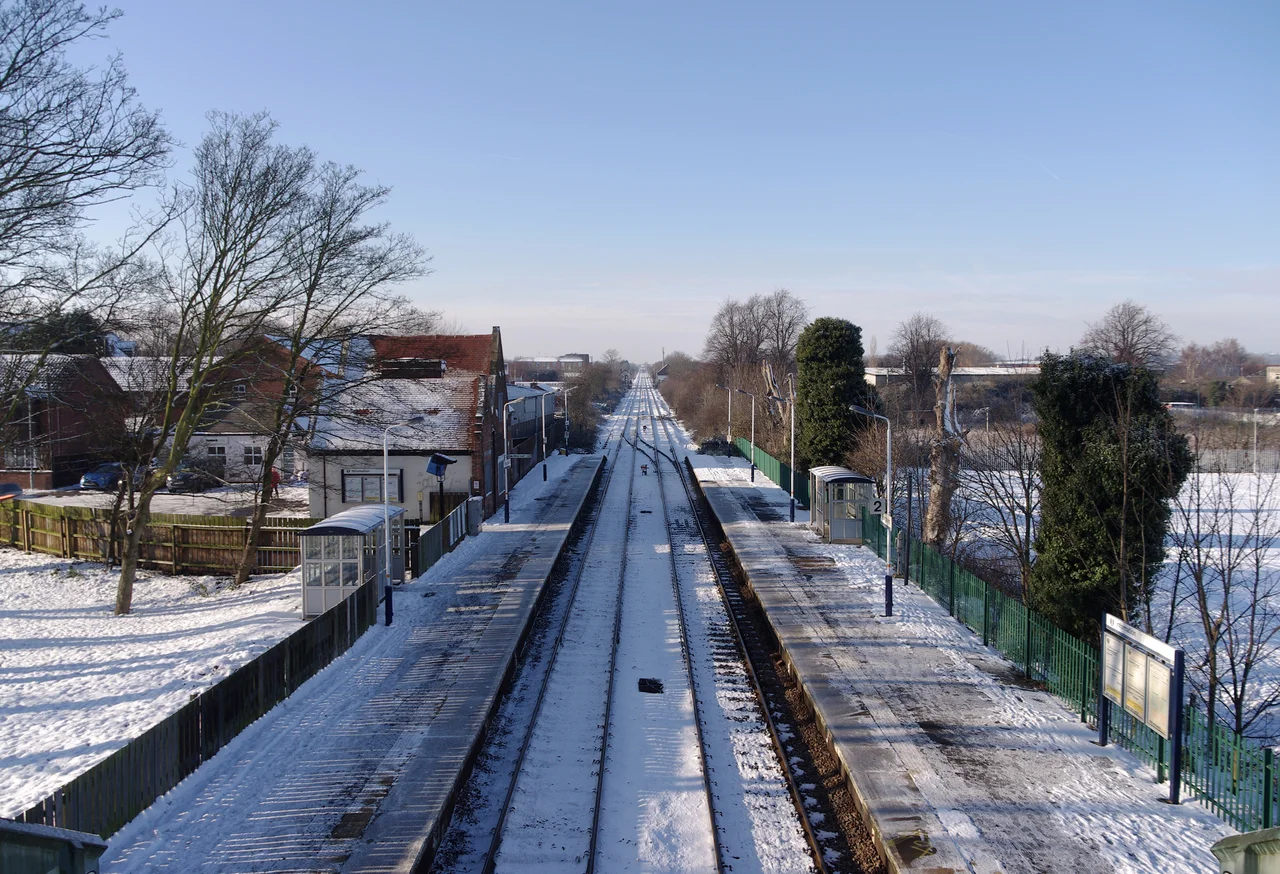

Bingham, Nottinghamshire
Just north of Bingham, in a field beside the modern A46, lies the buried outline of Margidunum, a Roman fort whose name the Coritani tribe almost certainly recognised before the legions arrived. The Britons called the place Marigidun, meaning fort-of-the-king's plain, and the Romans simply latinised what they heard. The town that grew up nearby has carried other names since: Bynnaingham, Bynningaham, Byngeham, and finally Bingham. Each rename is an arrival, a moment when newcomers reshaped the local sounds without quite displacing them. The fields the Romans patrolled, the marshland the Anglo-Saxons drained, and the housing estate called Romans' Quarter that started rising here in 2018 all sit on the same patch of east Nottinghamshire ground, 9 miles east of Nottingham along the Fosse Way.
Layers in the Plain
The Fosse Way ran from Exeter to Lincoln, and Margidunum was one of its waystations, set just north of where Bingham now stands. The Romans built it as a fort and let it grow into a small civilian settlement around the road. After the legions withdrew, Anglo-Saxon settlers led by a chief named Bynna chose a slightly different patch of ground a little to the south. Their oval village was ringed by a ditch and clustered around a marsh that gave reliable water and would later, after centuries of drainage, give exceptionally fertile farmland. The hill above became the meeting place of the Bingehamshou Hundred, where the local court convened in the Moot-House Pit. By the time the Domesday surveyors arrived in 1086, Bingham had about 300 inhabitants and most of its freeholders were Danes, the descendants of the Viking settlers whose suffix -by would forever litter the names of the surrounding villages. The first Norman lord, Roger de Busli, died without an heir within a few years, and Bingham reverted to the Crown, which is why even now much of the parish remains crown land.
Common Land and Five Officers
Medieval Bingham was managed collectively. The Manor Court, which met at the church gate, kept track of the village commons through five elected officers whose titles describe a vanished agricultural world. A foreman of the fields oversaw the arable strips. A hayward kept watch on the common grazing land. A pindar managed the pinfold, the enclosure where stray livestock were impounded until their owners paid the fine. A ringer dealt with hogs and swine. A woodward made sure too many trees were not chopped down for firewood. The system survived for centuries, slowly eroded by enclosure, until the Industrial Revolution drew the workforce away into Nottingham's lace and stocking factories. The railway arrived in 1850, but instead of saving the town it accelerated the decline. Cottage industry could not compete with industrial weaving sheds, and Bingham slid into a long stretch of poverty that did not really lift until after 1945. The Church of St Mary and All Saints, Grade I listed and substantially medieval, came through it all with eight bells in its tower.
The Post-War Rebuilding
After 1945, Bingham Rural District Council inspected more than 2,000 houses in the area to decide which could be saved and which had to go. Stanhope Workhouse came down. The Rectory was demolished. The 1960s and 1970s saw almost constant construction as the post-war population grew and the town shifted its centre of gravity. By 2001 the population was 8,655; by 2011 it had reached 9,131; the 2021 census recorded 10,080. Romans' Quarter, the new development north of the town, is named with deliberate self-awareness for the buried fort beneath the adjacent fields, and its plans run to roughly 1,000 new houses by the time the work is finished. The town's market still trades from the central Market Place on Thursdays, with a farmers' market on the third Saturday of each month, and the Butter Cross still stands where it always did. Bingham is twinned with Wallenfels in Bavaria and runs an annual beer festival as part of the relationship.
People Who Came From Here
Bingham has produced a string of cricketers, several Members of Parliament, and at least one Victoria Cross. Harry Churchill Beet, born at Brackendale Farm near Bingham in 1873, received his VC for valour at Wakkerstroom in the Second Boer War on 22 April 1900. Robert Lowe, born in 1811 into the family of the local rector, became Viscount Sherbrooke and one of the more acid-tongued statesmen of the Victorian era. Mary Joynson, born in Bingham in 1924, ran Barnardo's, the children's charity, from 1973 to 1984. More recently, the rugby player Joe Heyes, born in 1999, came up from Bingham to play for Leicester Tigers. Twenty Four Seven, Shane Meadows' debut feature, was filmed in part on Toot Hill top field and at the local boxing club. The town has a habit of supplying England with people who get on with the work and rarely make a fuss about it, which suits a place where the Romans and the Vikings each tried to do the same and slowly turned into Binghamshire farmers.
From the Air
Located at 52.95°N, 0.95°W on the gently undulating plain east of Nottingham, between the River Trent to the north-west and the Vale of Belvoir to the south-east. Recommended altitude 2,000-4,000 feet to follow the dead-straight line of the A46 / Fosse Way, the surest aerial cue. St Mary's church spire is visible from several miles. Bingham railway station and the modern Romans' Quarter development are clearly read against the older town centre. Nearest airports: Nottingham East Midlands (EGNX) about 19 nm west; RAF Cranwell (EGYD) about 23 nm east.
Nearby Stories
- Heckington Windmill 4.4 km away
- Belper North Mill 6.4 km away
- Beauchief Abbey 10 km away
- Oakham 12 km away
- Murder of Bernadette Walker 14 km away
- Battlefield Line Railway 15 km away
- Battle of Gainsborough 16 km away
- RAF Binbrook 23 km away