_at_Arley.JPG)
Battlefield Line Railway
In December 1902 a special train pulled up at Shackerstone station carrying three royal passengers: King Edward VII, Queen Alexandra, and Princess Victoria. They had come to spend a week at Gopsall Hall, the country house where, according to firm local tradition, Handel had composed parts of his oratorio Messiah a century and a half earlier. The royal carriages they travelled in now sit in the National Railway Museum at York. The track they rode on still survives - or part of it does. The Battlefield Line Railway is what remains of that working Victorian railway, kept alive by volunteers, running five miles of preserved steam and diesel trains between Shackerstone and Shenton, with a station at Market Bosworth in the middle. The line takes its name from the field at its southern end, where Richard III lost his crown and his life in 1485.
How the Line Got Here
The original railway was opened in 1873 as a joint venture between the London and North Western and the Midland - rival companies that found this corner of the country worth co-operating over. The line ran from Moira West Junction to Nuneaton, connecting the coalfields of Leicestershire to the iron towns of the West Midlands. Shackerstone was a junction in its prime, where the main route met a branch that swung off through Coalville toward Loughborough via the Charnwood Forest Railway. Steam trains worked the Ashby-to-Nuneaton run; a small railcar shuttled between Shackerstone and the bluebell-edged Charnwood Forest line, locally nicknamed the Bluebell Line for the spring flowers that lined its cuttings. In the 1923 Grouping the route passed to the LMS. Passenger services dwindled. The last scheduled train ran in 1931, and what followed was three decades of slow decline punctuated by the occasional enthusiast special before British Rail lifted the rails entirely in 1970.
The Society That Refused to Let Go
The Shackerstone Railway Society formed in 1969, at first based at Market Bosworth, but the volunteers quickly realised they needed a yard with a future, and Shackerstone had one. When they arrived in 1970 they found that a single through line had somehow escaped the demolition, still sitting in the long grass where the workmen had left it. Their first task was unglamorous - they laid out sidings, rebuilt the down platform, and connected the new yard to a stretch of line south toward Market Bosworth. In 1973, exactly a hundred years after the railway first opened, they hauled a small train of open wagons down the line in a celebration that turned out to be the beginning of something larger. Negotiations with British Rail followed for years. Eventually they secured a proper run-round loop, then another at the southern end, then more sidings, then locomotives in working order, then carriages.
Richard III's Last Stop
In the 1980s the volunteers launched their most ambitious campaign yet: extending the line south to Shenton. The reasoning was geographical and historical at once - Shenton sits within a short walk of Bosworth Field, the meadow where the Wars of the Roses ended on 22 August 1485 with the death of King Richard III at the hands of Henry Tudor's forces. The battle, immortalised in Shakespeare's play and recently re-emphasised by the discovery of Richard's bones under a Leicester car park in 2012, gave the railway both a name and a destination. The campaign succeeded in 1992. The inaugural service into Shenton was hauled by an 0-6-0 tank engine that the society had named, with appropriate Shakespearean flair, Richard III. Visitors could now ride a steam train to within walking distance of the battlefield where the last Plantagenet king died, and the Bosworth Battlefield Heritage Centre opened its doors a short walk from the new terminus.
Riding the Line
Leaving Shackerstone southbound, the train climbs steadily through a cutting before the gradient eases and the line passes under a road bridge into open Leicestershire farmland. On the left, the signal box at Shackerstone is the oldest Midland Railway type-one box still in operational use - a small wooden survivor of nineteenth-century railway practice. Three miles down the line, Market Bosworth station appears, often with stored locomotives and wagons lined up alongside the platform. South of Market Bosworth the train crosses an aqueduct over the Ashby Canal - a Georgian waterway still navigable today - and slows as it crosses a road bridge between Shenton and Sutton Cheney. The line curves right, and the terminus appears. Beyond the platform, the footpath leads across fields to the heritage centre and the battlefield trail. The railway runs steam and diesel-hauled trains every weekend and bank holiday from March to December, with mid-week diesel railcar services in July, August, and September.
What the Volunteers Have Saved
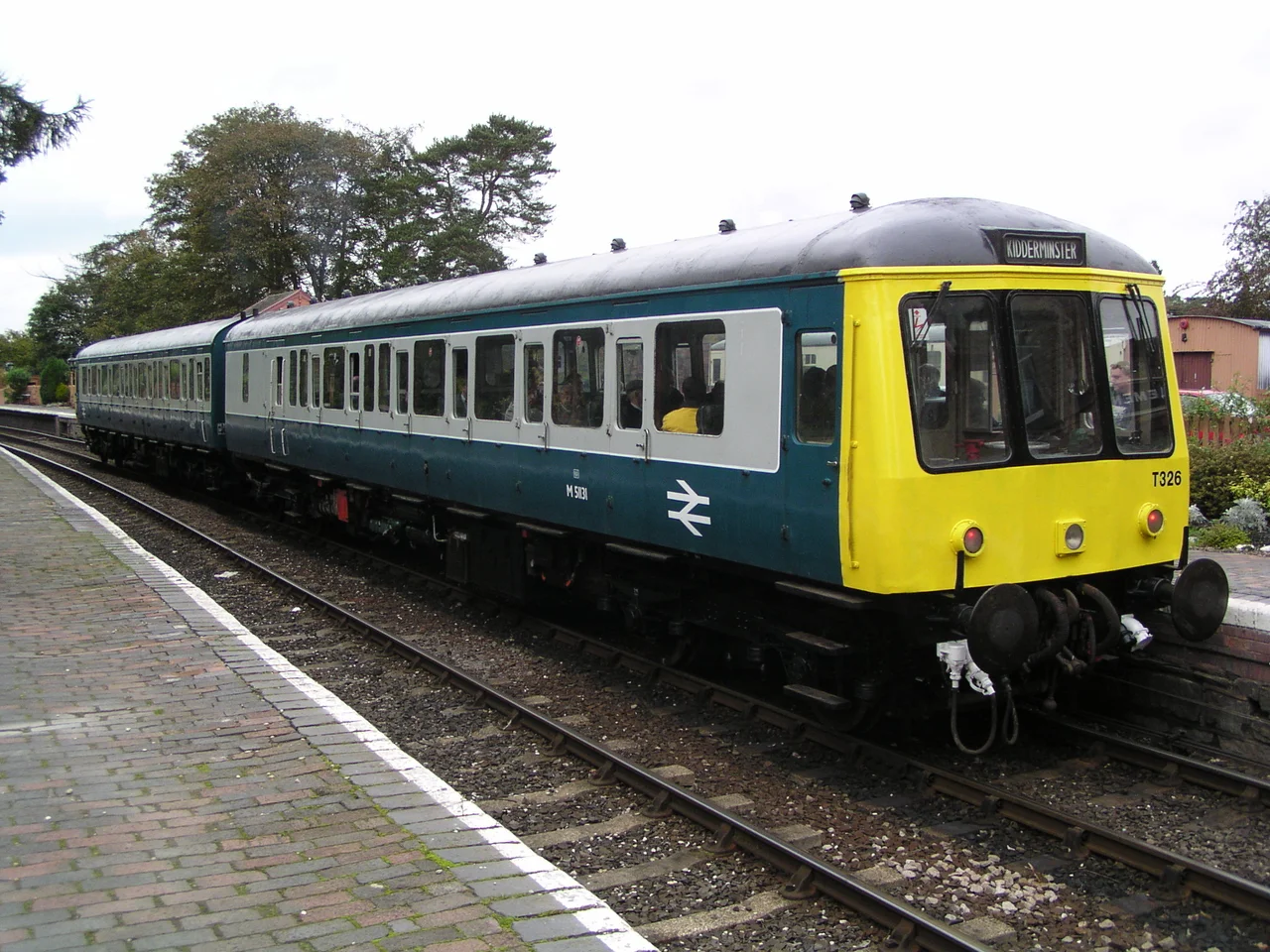
The Battlefield Line is one of around 150 heritage railways still operating in Britain - a network of preserved Victorian and Edwardian infrastructure kept alive almost entirely by unpaid labour. Among the diesel multiple units in service here is the sole surviving Class 118 railcar in the country, undergoing mechanical and bodywork restoration but still on the books. Two Class 116 units remain operational. In 1994 Shackerstone Station featured in an episode of the children's television programme Rosie and Jim, showing how a steam locomotive works, with the Hunslet shunter Glasshoughton Number 4 doing the demonstrating. The line hosts Christmas Santa Specials, autumn steam galas, and the kind of slow-paced summer afternoons that bring families out by the carload. It is not just a museum - it is a living, working railway, doing for pleasure what trains were once paid to do, on the same iron rails that once carried a king of England to listen to Handel.
From the Air
Located at 52.60 N, 1.42 W in southwestern Leicestershire. The Battlefield Line runs roughly south from Shackerstone (north end) to Shenton (south end), a 5-mile single-track corridor through rolling farmland. From altitude, look for the curved line of trees and the parallel Ashby Canal threading through the fields. The Bosworth Battlefield site lies just east of Shenton. Best viewed at 2,000-3,000 feet AGL. Nearest major airports: East Midlands (EGNX) 16 nm north, Birmingham (EGBB) 22 nm southwest, Coventry (EGBE) 14 nm south. Visibility typically good; steam trains produce a visible plume that can be spotted from several miles away when the engine is working hard.
Nearby Stories
- Siege of Kenilworth 3.9 km away
- Wedgwood 5.2 km away
- Wolverhampton Art Gallery 6.7 km away
- Derby Museum and Art Gallery 7 km away
- Bingham, Nottinghamshire 8.1 km away
- Holdenby House 10 km away
- Droitwich Spa 13 km away
- Asfordby Colliery 17 km away