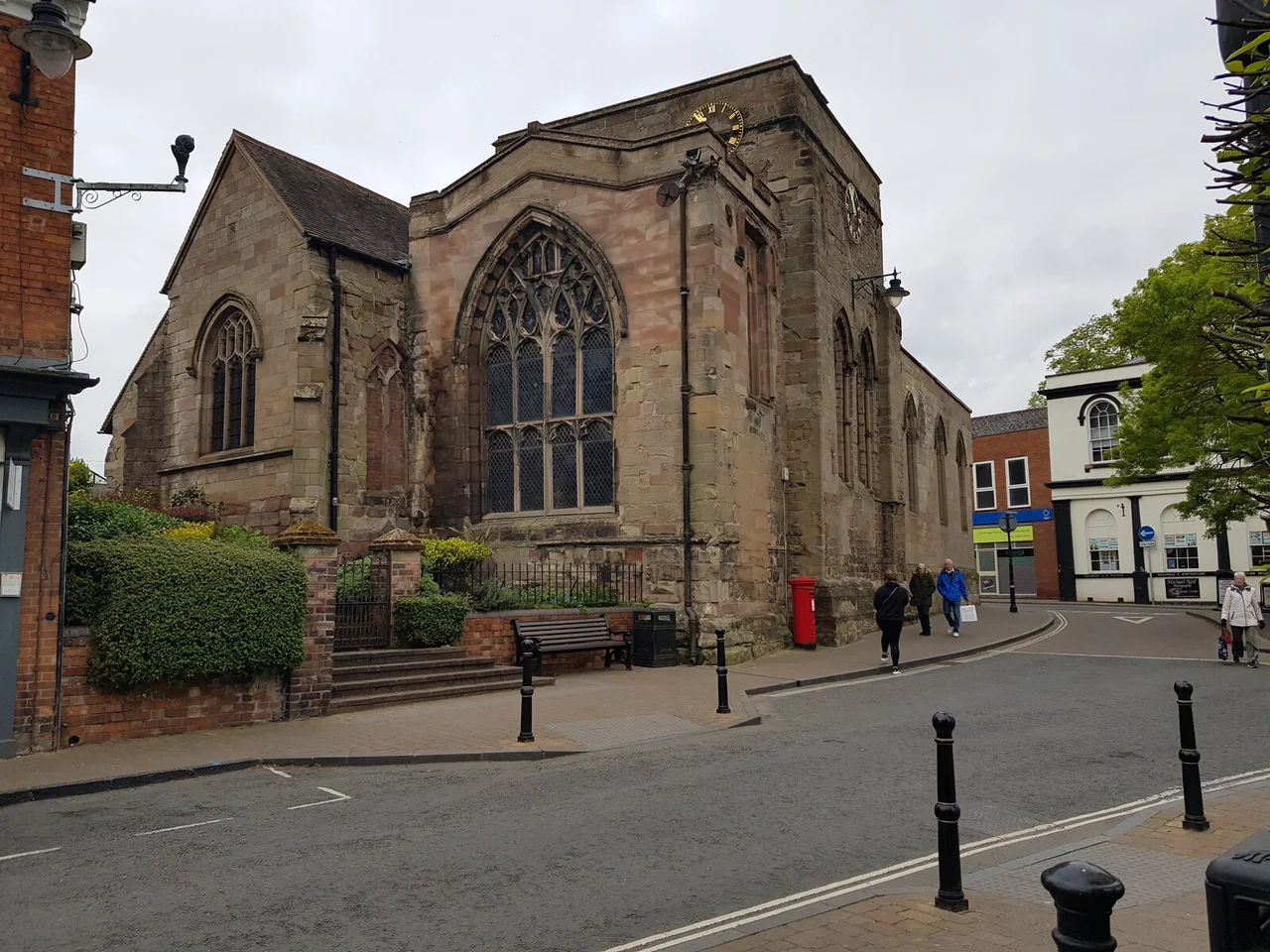

Droitwich Spa
There is salt under Droitwich, vast quantities of it, and for two thousand years that is what defined the place. The natural brine that bubbles up through the River Salwarpe is ten times saltier than seawater, fully saturated with sodium chloride - rivalled only, in the whole world, by the Dead Sea. The Romans set up a town here called Salinae and connected it to half their British road network so the salt could move. The Anglo-Saxons fought over it. King John issued the town's charter on 1 August 1215 - the same tumultuous year he met the rebel barons at Runnymede to seal Magna Carta. And in the 19th century an industrialist named John Corbett turned the brine pits into a fashionable spa where Victorian patients floated in concentrated salt water as if on the Dead Sea itself.
Salinae
The Romans called the place *Salinae* - the salt-works - and they sited it at the crossroads of several Roman roads precisely because the salt had to move. Railway construction in 1847 uncovered Roman mosaic pavements still buried under the town. The name Droitwich is a layered one: Wyche, from the Anglo-Saxon Hwicce kingdom, became Saltwich in the charters, and the prefix Droit (French for "right" or "law") was added when King John granted the charter on 1 August 1215. The 9th-century *Historia Brittonum* records the hot spring as one of the wonders of Britain: "a hot pool, which is in the country of the Hwicce and is surrounded by a wall made of bricks and stone. Men go into it to bathe at all times, and the temperature changes for each of them as they wish." The brine itself is the warmest spa water in the United Kingdom outside Bath, though it does not quite qualify as a hot spring (it never reaches body temperature).
The Brine Pits of Vines Park
Three pits in what is now Vines Park supplied the medieval and early-modern salt trade. Upwich, the deepest at 30 feet, was the most productive. Netherwich was 18 feet deep. Middlewich, between them, fell into disuse because the other two drew its brine. The peculiar property of Droitwich brine was that it rose to the surface naturally and was fully saturated - which meant boiling it produced an enormous yield with very little fuel. By the 1600s a local family named Wintour owned up to 25 salt-evaporating pans in the area. The brine was so valuable it was divided into shares: one share comprised 6,912 imperial gallons and produced 8 long tons of salt annually during the set boiling period. In 1725 boreholes were sunk to access brine in unlimited quantities and the old monopoly collapsed. Production rocketed - and parts of the town began to subside as the underground reservoirs emptied. The High Street still has buildings that lean slightly toward each other, the result of two hundred years of slow ground subsidence.
Corbett's Salt Empire and Floating Cure
John Corbett, the man who industrialised Droitwich's salt, was born in 1817 the son of a canal-boat captain. He worked his way up to ownership of the Stoke Prior Salt Works near Bromsgrove, expanded into Droitwich, and by the 1860s controlled about half of British salt production - earning the nickname "the Salt King." In 1875 he built Chateau Impney on the edge of town as a country house for his Franco-Irish wife - an enormous French-chateau-style pile complete with mansard roofs and turrets, dropped into the Worcestershire countryside like a fragment of the Loire valley. Corbett's other gift to the town was the spa. Brine baths first opened in 1830, but it was Corbett who built them up. The treatment was floating, not drinking: patients lowered themselves into water so dense they could not sink, and reported relief from rheumatism, sciatica, and orthopaedic pain. The Droitwich Spa Lido - an open-air saltwater swimming pool - kept the tradition alive into the late 1990s, closed, and was finally reopened in June 2007.
198 kHz
Three miles north-east of Droitwich, at Wychbold, stands one of the most distinctive radio transmitting stations in the world. The Droitwich transmitter was built in the early 1930s to broadcast the BBC's national longwave service on 200 kHz (now 198 kHz). It was sited here because Droitwich lay close to the centre of UK population, but considerable care was taken to place the two 700-foot masts away from the underground brine cavities - the risk of subsidence under that much steel was real. Anecdotally, engineers reported that the immense block of underground salt actually improved signal grounding. Throughout the 20th century the Droitwich transmitter carried the BBC Home Service, the Light Programme, and from 1967 Radio 4 - the rolling broadcasts that knitted Britain together through war and peace. The Shipping Forecast, the chimes of Big Ben, the announcement of the death of Edward VIII in 1936 and of Princess Diana in 1997 - all went out from Droitwich. In recent years the transmitter has been kept alive partly because of the Radio Teleswitch service it carries for electricity meters; longwave radio in 2026 is a technology of farewells.
Salt Town in the Modern Age
The salt industry is long gone. The last major works closed in 1972; what little salt is still produced in Britain comes from Cheshire. But Droitwich has kept its peculiar identity. The Droitwich Canal, built by James Brindley in 1771 and abandoned in 1939, was painstakingly reopened in 2011 by a volunteer trust. The Saltworkers statue in the town centre by sculptor John McKenna commemorates the boilermen, packers, and barge crews whose trade made the place. St Andrew's Church, where Saint Richard of Chichester was probably baptised in 1197, lost its tower in the 1920s to subsidence. Edward Winslow, born here in 1595, sailed on the *Mayflower* in 1620 and became a governor of Plymouth Colony - a memorial to him stands in St Peter's. Thomas Rainsborough, the New Model Army officer who would later take the surrender of Worcester in 1646 and argue for universal manhood suffrage at the Putney Debates the next year, served as MP for Droitwich in 1647. The town is no longer famous. But the salt is still down there - millions of tons of it, just below the foundations - and the brine still bubbles up at Vines Park, and the Lido is still open, and you can still float in water heavy enough to hold you up like the Dead Sea.
From the Air
Located at 52.267°N, 2.153°W in northern Worcestershire on the River Salwarpe, about 7 miles north-east of Worcester. The most striking aerial landmarks are the Droitwich transmitter masts at Wychbold 3 miles north-east (originally a pair of 700-ft towers). Chateau Impney's French-chateau roofline is visible on the edge of town. Best viewed at 2,000-3,000 ft AGL. Nearest airfields: Wolverhampton (EGBO) 16 nm north, Birmingham (EGBB) 15 nm east, Coventry (EGBE) 25 nm east. The M5 motorway runs north-south just west of the town.
Nearby Stories
- Stratford-upon-Avon Canal 1.7 km away
- Murder of Marie Wilks 4.3 km away
- Wigmore Castle 4.6 km away
- Dore Abbey 9 km away
- RAF Cosford 9.2 km away
- Tamworth Castle 9.2 km away
- Montgomery Castle 23 km away
- Woodstock Palace 34 km away