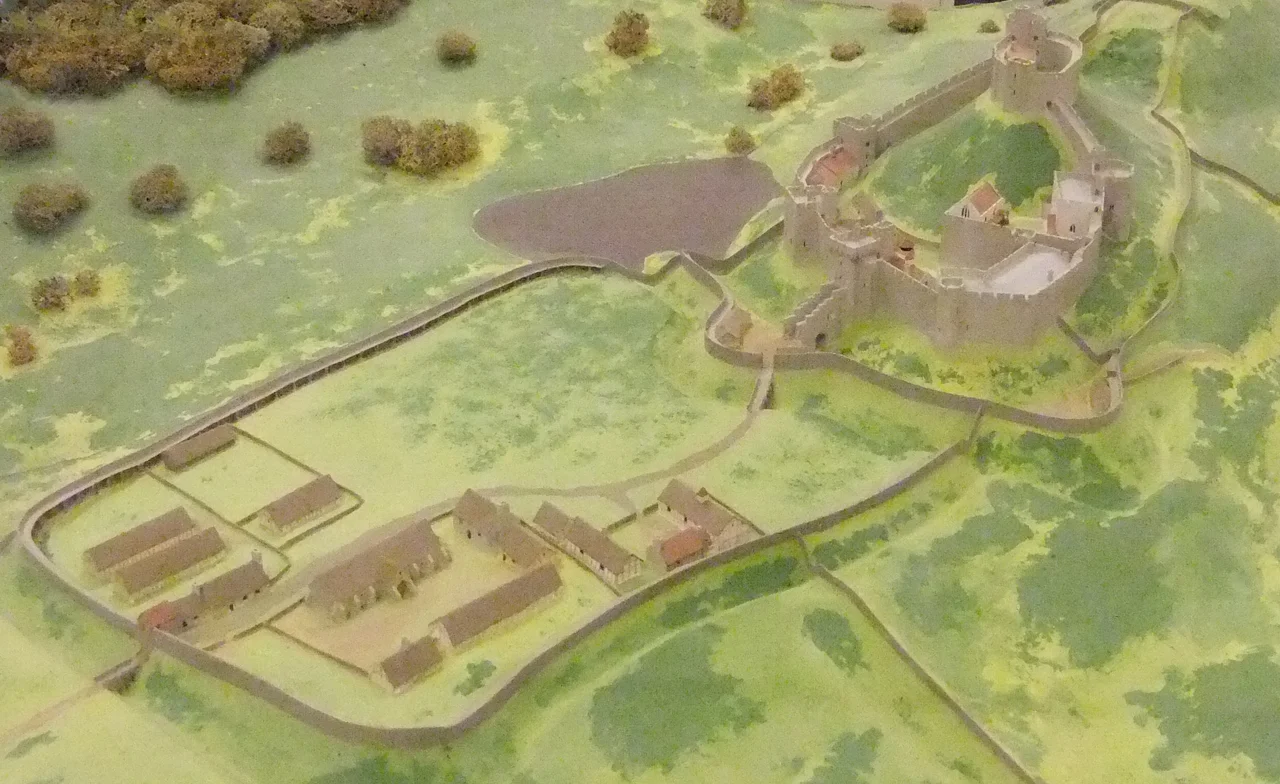

Wigmore Castle
Wigmore Castle is what almost no other major British castle is: untidied. Nature has been allowed to keep most of what it took. Trees grow inside curtain walls. The motte is buried under centuries of leaf-fall and stone slip. The tower stumps emerge from the green like teeth half-pulled from a jawbone. English Heritage took the site in 1995 specifically to preserve it as a romantic ruin rather than a manicured monument, a deliberate refusal to do what Victorians did everywhere else. Walk the ridge above the village of Wigmore in northwest Herefordshire and you walk through the seat of one of the most dangerous families in medieval England, the Mortimers, whose claim to the throne would eventually carry them all the way to it.
A Saxon Mere, a Norman Power
The land was called Merestun, settlement by the mere, when the Anglo-Saxon Gunnfrothr held it before the Conquest. William FitzOsbern, William the Conqueror's closest friend and the first Earl of Hereford, raised the original castle here around 1070 to anchor the new Norman lordships along the Welsh border. FitzOsbern was killed in Flanders the next year. His son joined the Revolt of the Earls in 1075 and lost everything, including Wigmore, which William I handed to a supporter named Ralph de Mortimer. From that day forward Wigmore was Mortimer ground, and the Mortimers would shape British history for three and a half centuries from this ridge.
The Lover Who Ruled England
The Mortimer who matters most is Roger, born in 1287. He inherited Wigmore in 1304, married the heiress Joan de Geneville and acquired Ludlow Castle and vast lands in Ireland with her. By the 1320s he was the most dangerous of Edward II's enemies. He escaped the Tower of London in 1323, fled to France, and became the lover of Edward's estranged queen, Isabella. Together they invaded England in 1326, deposed the king, and probably had him murdered at Berkeley Castle. For four years Roger Mortimer was effectively king of England in all but name, stepfather to the boy Edward III. In 1328 he held a tournament near Wigmore that almost every magnate in the kingdom attended, a deliberate statement of power on his home ground. Edward III tolerated him until he was old enough to act. In 1330 the young king's men seized Mortimer in Nottingham Castle, tried him for treason, and hanged him at Tyburn. His lands were forfeit; the family did not get Wigmore back for twelve years.
A Throne Within Reach
The Mortimers married into royalty after that. Edmund Mortimer married Edward III's granddaughter Philippa, and in 1381 their six-year-old son Roger was declared heir presumptive to the throne should Richard II die childless. That claim, carried through the female line, eventually descended to Richard, Duke of York, through his mother Anne Mortimer. When Anne's grandson Edward of March was based at Wigmore in early 1461, gathering an army from the family heartlands in the Marches, he was operating from the castle of the lineage that gave him his crown. From Wigmore he marched south to fight at Mortimer's Cross, named for these same Mortimers, and ten weeks later he was Edward IV. The wheel had turned: a family that had failed to become kings had instead produced one.
What the Civil War Spared
By the time of the English Civil War, Wigmore had passed through Elizabeth I's hands to the Harleys of Brampton Bryan. Sir Robert Harley sided with Parliament. With her husband away in London, Lady Brilliana Harley made the decisive call: rather than risk Wigmore being seized by Royalists, she had its defences dismantled herself. The castle was left in ruin, vegetation took over, and unusually for a major British site it stayed in private hands through the 19th century, escaping the heavy-handed clearances that scrubbed most other ruins clean. Today the curtain wall still stands at near full height along the east and south sides between the south tower and gatehouse. The keep mound and the inner bailey are wooded. From the air the site reads as an oval crown of green and stone above the village, a ruin still being slowly reclaimed by the country it once helped to rule.
From the Air
Wigmore Castle stands at 52.32 degrees N, 2.87 degrees W on a wooded ridge about 1 km north of Wigmore village, halfway between the rivers Teme and Lugg in northwest Herefordshire. The castle commands the wide vale between the two rivers from roughly 600 ft elevation. Best viewed from 2,500-3,500 ft AGL to pick out the oval ruin from the surrounding tree canopy. Mortimer's Cross battlefield is only 3 nm to the south-southwest. Nearest airfields: Shobdon (EGBS) 4 nm south, Welshpool (EGCW) to the north, Shawbury (EGOS) to the northeast.
Nearby Stories
- Dore Abbey 9.6 km away
- Montgomery Castle 11 km away
- Bewdley 13 km away
- Royal Air Force Museum Midlands 14 km away
- Murder of Marie Wilks 16 km away
- Amgueddfa Cymru – Museum Wales 19 km away
- Machynlleth 23 km away
- Waterfall Country 32 km away