
Royal Air Force Museum Midlands
There are only two surviving prototypes of the BAC TSR-2, the multi-role combat aircraft that the Wilson government cancelled in 1965, and one of them is here in a hangar in Shropshire. Aircrew who never got to fly it still come to look at it. The TSR-2 was meant to be Britain's nuclear strike bomber and tactical reconnaissance aircraft, capable of low-level supersonic penetration on a scale that the Buccaneer and the V-bombers could not match. Three days after the prototype's first test flight, the Treasury found out how much it was going to cost and the project was killed. The airframe at the RAF Museum Midlands is one of the great might-have-beens of British aviation. The museum around it is one of the great free museums of Europe.
How the Midlands Site Began
The Royal Air Force Museum opened its London site at Colindale on 15 November 1972, when Queen Elizabeth II cut the ribbon on a collection of just 36 aircraft. The rest of the eventual collection was scattered around RAF stations across the country, including a large storage and display group at Cosford. On 1 May 1979, the Cosford holdings were opened to the public as a second branch. At first it was simply called the Aerospace Museum; in 1998 it became RAF Museum Cosford, and in March 2022 it was renamed once again as RAF Museum Midlands. The Cosford galleries grew steadily through the 1980s and 1990s. Four new galleries opened on 21 June 1998, and in May 2002 the Michael Beetham Conservation Centre, opened by the Marshal of the Royal Air Force himself, moved from Cardington to Cosford. Today the Midlands site occupies a complex of large modern hangars on the eastern edge of the RAF station.
Test Flight
The Test Flight Collection at the Midlands site is where the museum keeps its experimental and prototype aircraft. Besides the surviving TSR-2 second prototype, you can walk under aircraft that led directly to the English Electric Lightning, the Mach 2 interceptor that defended British skies in the Cold War. There are airframes that explored swing-wing geometry, vertical takeoff, and high-altitude reconnaissance. Some never flew operationally. Some flew a handful of times and were lost. All of them represent decisions and reverses in British aerospace policy from the late 1940s through to the present: a partial record of an industry that once led the world and is now consolidated into a few large prime contractors. The collection is rare, irreplaceable, and free to walk through.
The National Cold War Exhibition
The National Cold War Exhibition opened in February 2007 inside an 8,000-square-metre purpose-built building designed by Feilden Clegg Bradley Studios. The exhibition was conceived and designed by Neal Potter and centres on the unique sight of all three V-bombers, the Vickers Valiant, the Handley Page Victor, and the Avro Vulcan, displayed together in one space. Nowhere else in the world has all three. Around them sit other Cold War aircraft, US and Soviet weapons, missiles and silo theatres that recreate the daily psychological texture of nuclear deterrence. A Lockheed Polaris stands alongside German V-1 and V-2 weapons from the earlier war that preceded the Cold one. The lighting is theatrical and slightly unsettling. The point of the exhibition is not just to display aircraft but to explain what they were for.
What Else is Here
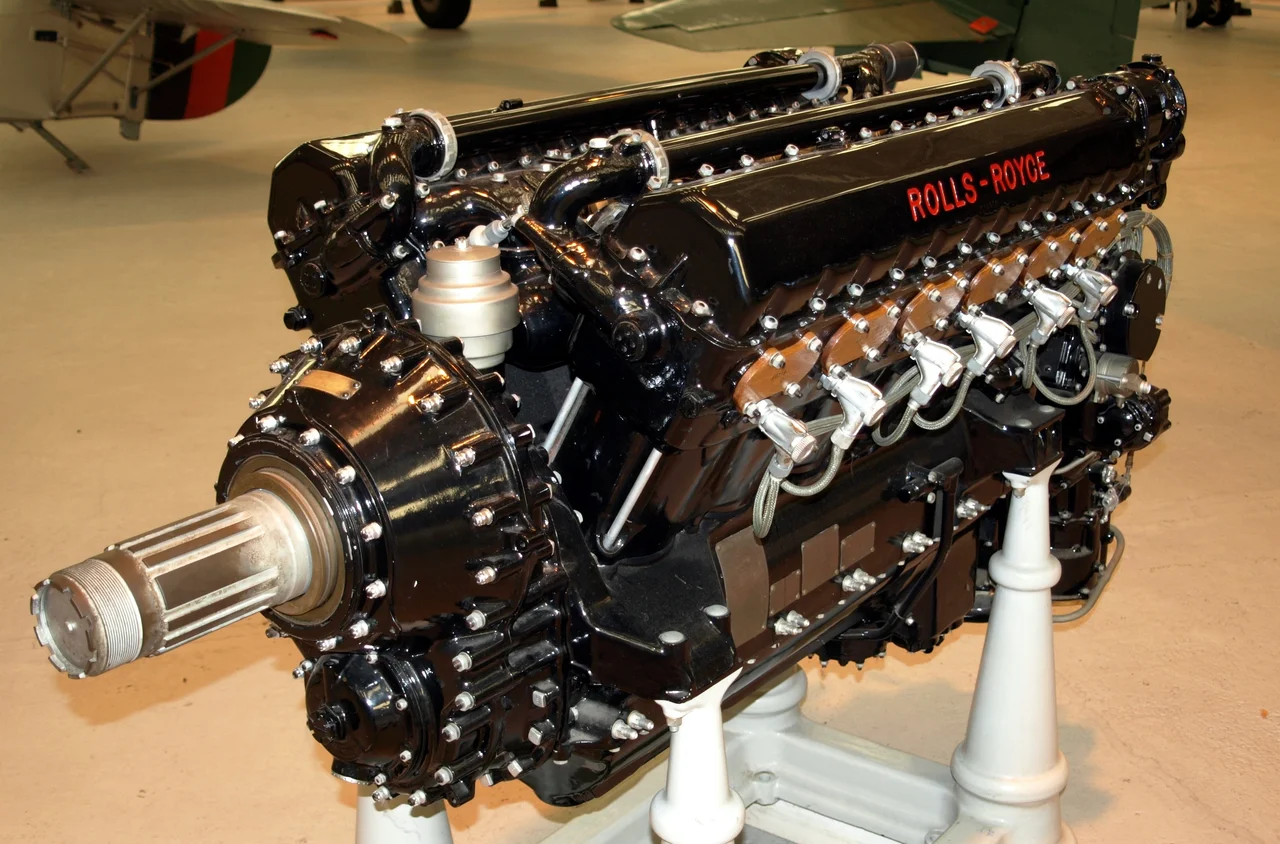
The world's only surviving Boulton Paul Defiant is at Cosford, the unusual British turret-fighter that was a disaster against German fighters in the Battle of Britain and was quickly relegated to night-fighting and target-towing. One of only two surviving Vickers Wellingtons in the world is here, the geodesic-airframe bomber that built so much of Bomber Command's early-war effort. The museum's Hunter T.7, serial XL568, served with No 74 Squadron and three others before retiring to instructional duties. A Hawker Hunter F.6A acts as gate guard at the entrance. Hangar 1 holds an extraordinary collection of around fifty aero engines, from the Bentley BR2 rotary of the First World War to the Rolls-Royce RB.211 turbofan that powered the wide-body airliners. A side room is full of rocket engines, including the de Havilland Spectre and the Walter HWK 109-509 that powered the Messerschmitt Me 163 Komet.
The Conservation Hangar
The Michael Beetham Conservation Centre is the working heart of the museum. It is where airframes are restored, sometimes over decades, before they go on display in either London or Midlands. The Handley Page Hampden, the LVG C.VI, and the Dornier Do 17 are among the long-term restoration projects: a German maritime bomber recovered from the seabed off Goodwin Sands and brought to Cosford in 2013 sits in pieces while volunteers and conservators slowly work out how to stabilise what survives. The work is patient, precise, and unglamorous, but it is what keeps these aircraft in existence at all. Some restoration jobs are so slow that they outlast their lead conservators. A visit to the Beetham Centre, often included on guided tours, shows you the museum that the public galleries hide: the slow accumulation of expertise, hand-tools, and stubborn craft that aviation preservation requires.
Getting There
Cosford railway station is right next to the eastern crash gate of RAF Cosford and the museum entrance. The Wolverhampton-to-Shrewsbury line will deliver you for the price of a regional rail ticket, and from the station you walk perhaps five minutes to the museum. Admission has been free since opening. The Midlands site is open every day of the year except 24, 25 and 26 December and 1 January. It is one of the most generous free museums in Europe and it is run on a tight budget that has lost things over the years: the British Airways Collection that the Cosford site agreed to house in 1980 was broken up after British Airways withdrew funding in 2006, and a Boeing 707, a Vickers VC10, and a Hawker Siddeley Trident, the only preserved examples in the UK, were scrapped. Aviation preservation costs money. The aircraft that remain on display here exist because someone made the case.
From the Air
Located at 52.64 N, 2.31 W, co-located with RAF Cosford (EGWC) on the eastern edge of the airfield in south-east Shropshire. From 2,500 to 4,000 feet the museum hangars are visible as a cluster of large modern roofs beside the station, with the Wolverhampton-Shrewsbury railway running past. Nearest airports: RAF Cosford (EGWC) on site, RAF Shawbury (EGOS) 14 nm north, Wolverhampton Halfpenny Green (EGBO) 5 nm south-east.
Nearby Stories
- Welshampton Rail Crash 1.4 km away
- Knowle and Dorridge Rail Crash 1.4 km away
- Bewdley 2.3 km away
- Tamworth Castle 4.4 km away
- Battle of Mortimer's Cross 8.1 km away
- Wedgwood 8.8 km away
- Derby Museum and Art Gallery 19 km away
- Powis Castle 24 km away