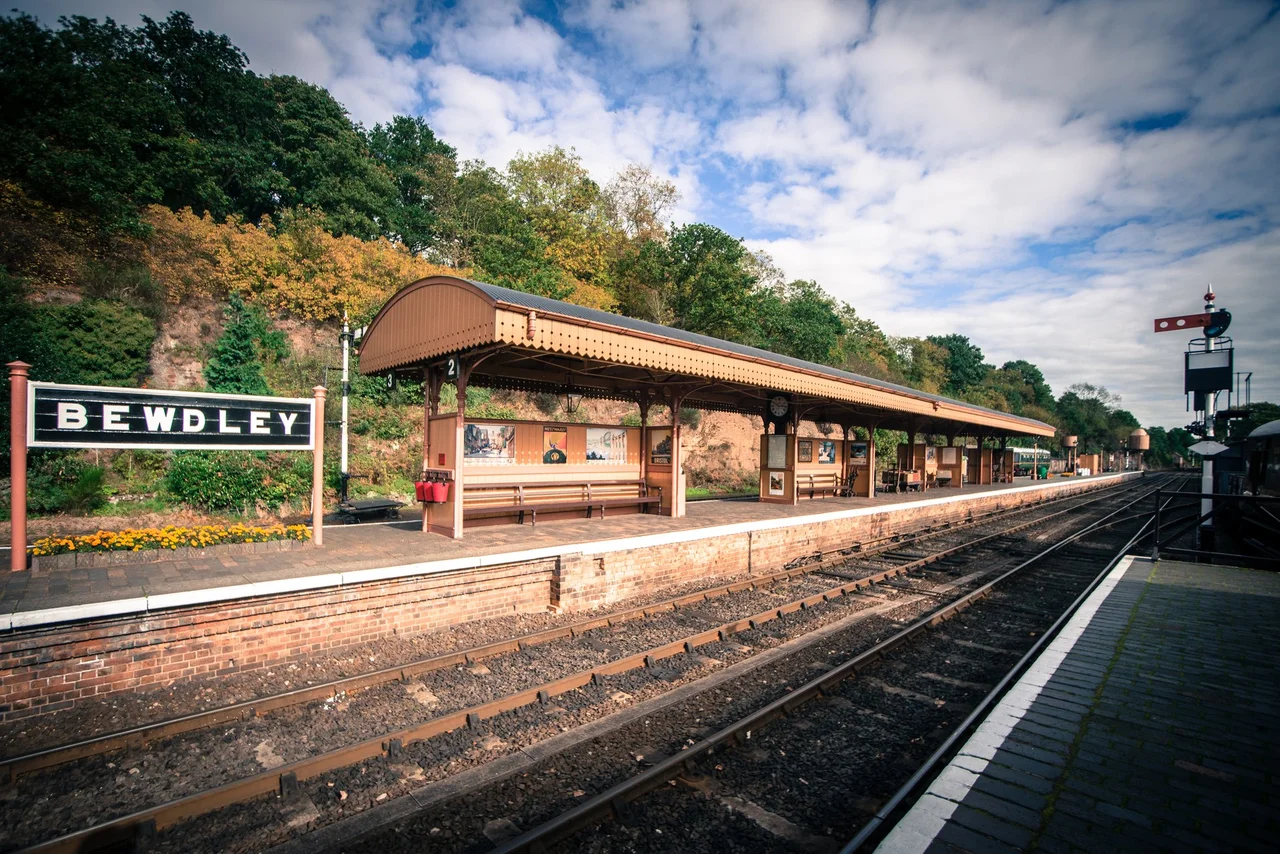

Bewdley
The French got the name right. They called it *Beau lieu* - beautiful place - and by the 14th century the English had wrapped their tongues around it as Bewdley. John Leland, Henry VIII's antiquary, came through in the 16th century and wrote that "a man cannot wish to see a towne better." Stand on Thomas Telford's 1798 bridge today, with the Severn running below and a curve of Georgian townhouses unfolding along the western bank like a stage set, and you can see what they meant. The river makes Bewdley. It has also, repeatedly, almost ended it.
Older Than England
Bewdley likes to call itself a Georgian town, but people have been living here for nine thousand years. Excavations in Wribbenhall, the settlement on the eastern bank that now forms part of Bewdley, turned up 1,400 fragments of flint tools dated to around 6,800 BC - the oldest settlement yet identified in Worcestershire. Pollen evidence shows that crops were already being grown and woodlands cleared at that date, which means the people scratching at the soil here predated the building of Stonehenge by three thousand years. Wribbenhall appears in the Domesday Book of 1086 as part of the manor of Kidderminster. The borough on the western bank received its charter directly from Edward IV in 1472 and held that status for half a millennium until local government reorganisation in 1974.
Telford's Bridge
The bridge you cross now is the third or fourth to stand on this stretch of river. The 1483 medieval bridge was carried off by floods in 1795. Thomas Telford, then in his late thirties and at the start of the career that would build the Caledonian Canal and the Menai Suspension Bridge, designed its replacement. His Bewdley Bridge opened in 1798: three sandstone arches, the central span 60 feet wide, the structure low and elegant against the river. It is the only Telford bridge in Worcestershire and one of his earliest masonry bridges anywhere. The Severn has thrown plenty at it since. Floods in 1947, 1968, and 2000 each damaged the town; the 2000 flood drove the construction of permanent western-bank defences, completed in 2006 at £7 million. Beales Corner on the eastern bank has historically used temporary barriers; permanent defences there began in October 2023, scheduled for completion in autumn 2025. The bridge itself, two and a quarter centuries old, has handled it all.
The Prime Minister and the Lord of Misrule
Stanley Baldwin was born at Lower Park House in Bewdley on 3 August 1867. He served as Conservative Prime Minister three times between 1923 and 1937, presiding over the General Strike, the Abdication Crisis, and a wary, uncertain rearmament that historians have debated for ninety years. He was Bewdley's MP from 1908 to 1937, an exceptional run of constituency loyalty, and in 1937 he took the title Earl Baldwin of Bewdley. He is buried in Worcester Cathedral, twelve miles downstream. The town's other modern celebrity is rather different. Robert Plant - lead singer of Led Zeppelin from 1968 onwards, one of the most influential voices in rock - lives nearby at Upper Arley. He turns up unannounced in Bewdley to perform at the River Rooms, an intimate venue above the Cock and Magpie pub on the riverside, where country, soul, folk, and rock musicians from across Europe and North America come to play to a hundred-odd people in a small upstairs room. Bewdley has a substantial country-music following for a town of nine thousand.
Severn Valley Railway
Bewdley station, just east of the bridge, is the principal intermediate halt on the Severn Valley Railway - a 16-mile heritage line between Kidderminster and Bridgnorth that runs through some of the most beautiful river-gorge scenery in the Midlands. The line opened in 1862, closed under the Beeching cuts in 1963, and was reopened by enthusiasts in 1970. Today it operates steam locomotives - Pannier tanks, GWR Manor-class, BR Standards - on a working timetable, hauling coaches restored to their pre-war condition through a landscape that looks more like 1937 than 2026. The Tenbury and Bewdley Railway, which branched off the Severn Valley line through the Wyre Forest, lost its handsome William Clarke bridge over the Severn at Dowles in 1965 when it was dismantled; the imposing brick and stone pillars still stand a little to the north of town, slowly being colonised by ivy. Bewdley remained the headquarters of the Severn Valley Railway until 2014.
Forest at the Door
Step off the High Street, climb the steep B4190 known as Welch Gate, and within five minutes you are at the gateway of the Wyre Forest - 6,300 acres of broadleaf woodland, one of the largest ancient forests in England. The Forestry Commission visitor centre at Callow Hill, two miles outside town, marks the head of waymarked trails that lead deep into oak, birch, and rowan. Knowles Mill, an 18th-century corn mill on Dowles Brook, is preserved by the National Trust. The forest holds rare invertebrates, dormice, all three British native woodpeckers. Bewdley Museum, behind the Guildhall in the former butchers' shambles, traces the town's history through coracle-making, brass-founding, ropemaking, and the river trade that supported it all. Just outside town is Beaucastle, a Victorian mock-Gothic house built in 1877 to designs partly by John Ruskin himself. Even at its quietest moments - early on a winter morning when the mist comes off the Severn and the swans glide past the Georgian quayside - Bewdley still looks, just as the medieval clerks named it, a beautiful place.
From the Air
Located at 52.375°N, 2.316°W on the River Severn at the eastern edge of the Wyre Forest, about 3.5 miles west of Kidderminster. The Severn winds through the town in a distinctive S-curve crossed by Telford's three-arched sandstone bridge. Best viewed at 2,000-3,000 ft AGL. Nearest airfields: Wolverhampton (EGBO) 13 nm north-east, Birmingham (EGBB) 17 nm east, Shawbury (EGOS) 22 nm north-west. The Severn Valley Railway track is visible as a clear line east of the river running north toward Bridgnorth.
Nearby Stories
- Stratford-upon-Avon Canal 1.7 km away
- Murder of Marie Wilks 4.3 km away
- Wigmore Castle 4.6 km away
- Dore Abbey 9 km away
- RAF Cosford 9.2 km away
- Tamworth Castle 9.2 km away
- Montgomery Castle 23 km away
- Woodstock Palace 34 km away