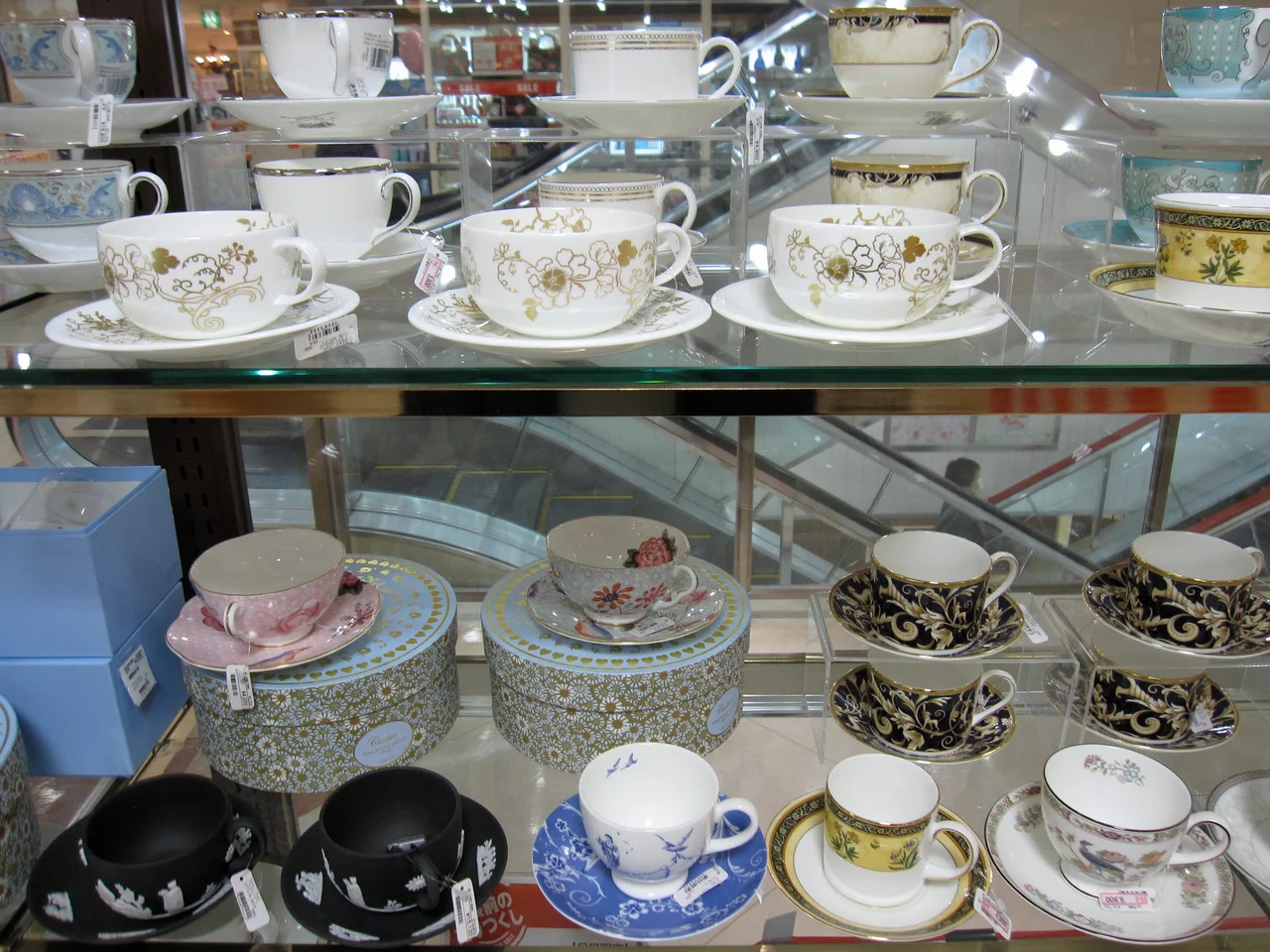

Wedgwood
It took more than three thousand recorded experiments to invent Wedgwood blue. Josiah Wedgwood, a Staffordshire potter from a family of Staffordshire potters, was looking for a stoneware that could imitate the milky-blue ground of ancient Roman cameo glass. He found it eventually, in 1775, after years of mixing and firing and discarding. The colour - somewhere between cornflower and dusk - became one of the most recognisable in commercial design history, and the dry, unglazed jasperware he made with it has been in continuous production since. Wedgwood the firm was founded on 1 May 1759. It has outlived empires, wars, and most of its competitors, and it has spent the last two centuries oscillating between being a luxury maker, a mass producer, and an asset on someone else's balance sheet.
Inventing a Customer
The young Josiah Wedgwood understood something his rivals did not: a cheap product that looked like an expensive one would sell at the expensive price if you could persuade the right people to buy it first. In 1765 he developed a new variety of creamware, a refined glazed earthenware, and supplied Queen Charlotte with a tea service for twelve. She gave him permission to call it Queen's Ware. From that moment, every middle-class English household that aspired upward was buying creamware. It was light, which saved on transport and tariffs, and it sold so well across Europe and America that the makers of European faience and delftware were forced to copy English bodies or go out of business. Wedgwood opened a London showroom in Soho, ran a workshop for enamel painting in Chelsea, and accepted commissions like the Frog Service - 944 pieces of hand-painted creamware for Catherine the Great of Russia, completed in 1774, each piece carrying a small green frog at the empress's request.
The Etruria Works and an Anti-Slavery Token
In 1766 Wedgwood bought a Staffordshire estate, named it Etruria after the ancient Italian civilisation whose pottery he wanted to imitate, and built a new factory on the site. Etruria began production in 1769, the same year he perfected black basalt ware. He went into partnership with Thomas Bentley, a Liverpool merchant and intellectual, who took over the London end of the operation. Their correspondence, which survives, reveals a man who consulted his partner on every artistic question and felt Bentley's death in 1780 keenly. Wedgwood was a religious dissenter, a political radical, and an active abolitionist. In 1787 he produced the jasperware medallion that became one of the most reproduced images of the British abolition movement: a chained kneeling enslaved man above the words 'Am I Not a Man and a Brother?' He distributed it widely, often free, in print and pottery and jewellery, a moral statement embedded in his commercial product.
The Family, the Factory, the Move to Barlaston
Josiah died in 1795. His sons and nephew kept the business running through the Napoleonic Wars and the collapse of American export markets after Waterloo, but the firm's reputation for technical innovation dimmed through the early nineteenth century. Recovery came with Godfrey Wedgwood, the founder's great-grandson, who reintroduced bone china in 1878 and revived design standards. Cecil Wedgwood, Major and 1st Mayor of Stoke-on-Trent, died in battle in 1916. Josiah Wedgwood V took over as managing director in 1930 and made the most consequential decision in the company's twentieth-century history: he moved production from the cramped Etruria works to a modern, purpose-built factory in a rural setting at Barlaston, designed by Keith Murray and built between 1938 and 1940. The Barlaston factory is still where Wedgwood pottery is made when it is made in England, although the majority of production has moved to Jakarta since 2006.
Bought, Merged, Acquired
From 1986 onward Wedgwood ceased to be an independent company. Waterford Glass Group bought the firm that year, forming Waterford Wedgwood plc. In 2009, after a failed share placement during the financial crisis, Waterford Wedgwood went into administration. KPS Capital Partners bought the UK and Irish assets and folded them into WWRD Holdings - Waterford Wedgwood Royal Doulton. In 2015, the Finnish consumer goods firm Fiskars acquired WWRD. Through all of this, the museum collection that Josiah I had wished he had begun in 1774 came under threat: 80,000 works of art, ceramics, manuscripts, and photographs nearly sold off to cover pension debts. The Art Fund, the Heritage Lottery Fund, and various trusts raised the money to save the collection, which was donated to the Victoria and Albert Museum in December 2014 and remains on display at the World of Wedgwood site in Barlaston. Wedgwood the brand is now Finnish-owned, mostly Indonesian-made, and still recognisably itself - the blue jasperware, the cameo medallions, the white reliefs on coloured grounds, all traceable to a young potter's stubborn refusal to stop mixing clay until he had the colour right.
From the Air
The modern Wedgwood factory and World of Wedgwood visitor complex sit at approximately 52.94 N, 2.16 W in Barlaston, about 4 miles south of central Stoke-on-Trent. The original 1769 Etruria works site lay about 4 miles north, near where the Caldon Canal joins the Trent and Mersey Canal. Best aerial reconnaissance at 2,000-3,000 feet shows the Barlaston factory, the V&A Wedgwood Collection building, and the surrounding parkland clearly. The West Coast Main Line runs adjacent. Nearest airport: Manchester (EGCC), 44 miles north. East Midlands (EGNX), 38 miles south-east; Birmingham (EGBB), 40 miles south.
Nearby Stories
- National Memorial Arboretum 2.2 km away
- Stanlow Abbey 4.5 km away
- Alderley Edge 5.6 km away
- Lilleshall Abbey 7.2 km away
- Hope Cement Works 8.4 km away
- 2025 Wrexham National Eisteddfod 9.1 km away
- Tutbury Castle 16 km away
- Powis Castle 25 km away