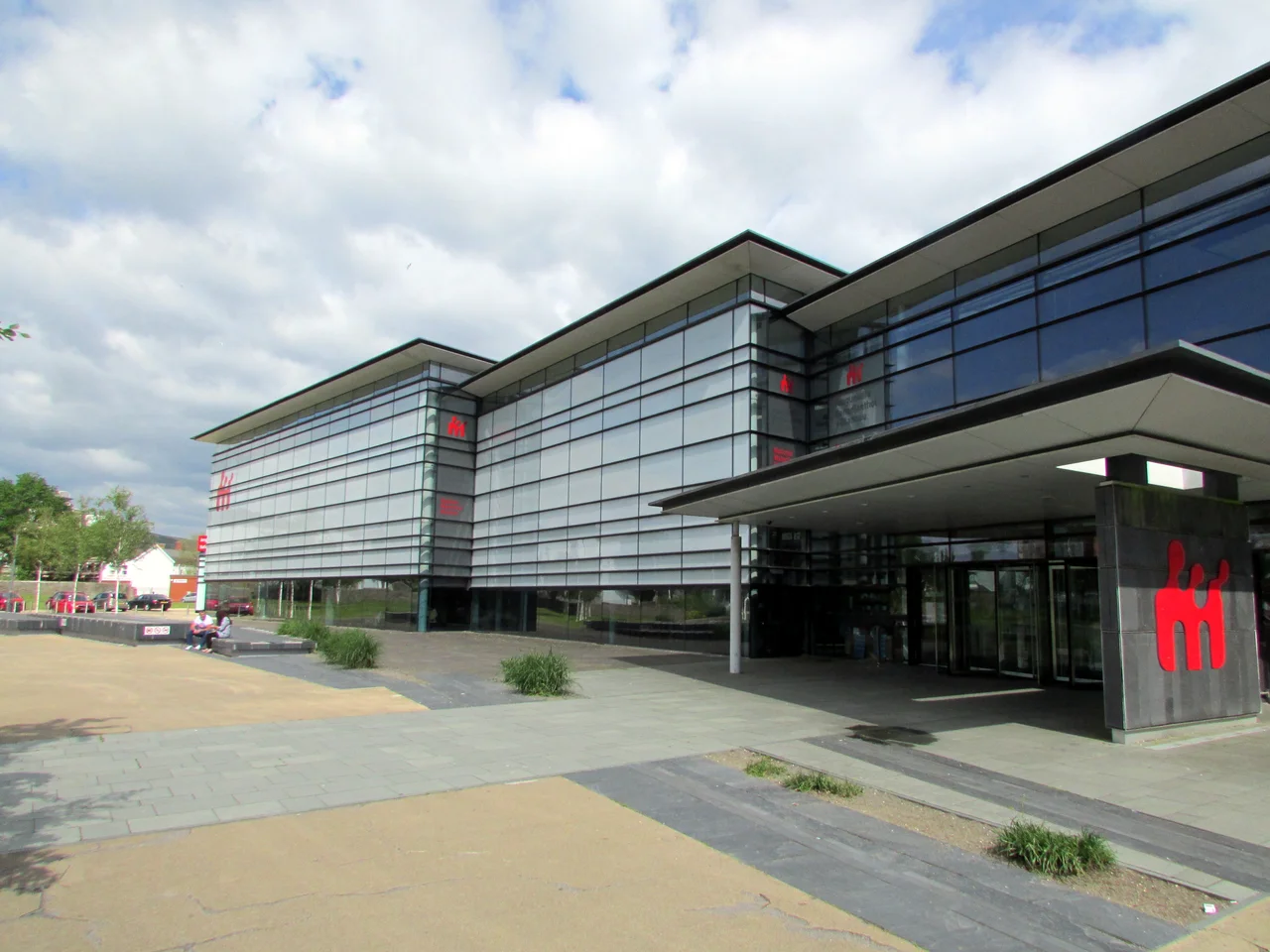

Amgueddfa Cymru – Museum Wales
Walk through the front door of any of the seven museums of Amgueddfa Cymru and they will not ask you for a penny. Free admission has been the policy across the entire network since the Welsh Government took it on in 2001 — a decision that quietly transformed the place of museums in Welsh public life and made Amgueddfa Cymru, among national museum services in the United Kingdom, an outlier in scale, generosity, and ambition. Seven museums spread across Wales, from the National Museum in Cardiff with its Impressionists and its Welsh dinosaurs, to a coal mine you can ride into 90 metres underground at Big Pit in Blaenavon. Free, all of it.
Founded with the National Library
The National Museum of Wales was founded in 1905 and received its Royal Charter from King Edward VII on 19 March 1907 — the same day, by careful design, that the National Library of Wales received its own charter in Aberystwyth. Wales was making a statement about itself. The Charter set out a mission that reads, even now, like a manifesto: the museum was 'to be achieved primarily by the complete illustration of the geology, mineralogy, zoology, botany, ethnography, archaeology, art, history and special industries of Wales.' Cardiff secured the institution partly by donating the existing Cardiff Museum collection in 1912. King George V laid the foundation stone in Cathays Park on 26 June 1912. Then the First World War intervened. The building did not open to the public until 28 October 1922, and the formal opening ceremony waited until 1927.
The Open-Air Idea
The most consequential expansion came in 1946, when the Earl of Plymouth donated St Fagans Castle and its 18-acre grounds to the museum. The castle is a fine seventeenth-century manor house. The grounds, in the hands of the Welsh poet and museum curator Iorwerth Peate, became something else entirely. Peate had visited Skansen in Stockholm — the world's first open-air museum, founded in 1891 by Artur Hazelius, which moved threatened Swedish farmhouses and chapels to a single site on Djurgården island in order to preserve a vernacular architecture that industrialisation was demolishing. Peate proposed to do the same for Wales. St Fagans opened to the public on 1 July 1948 as the Welsh Folk Museum, the first national open-air museum in the United Kingdom. Welsh houses, chapels, schools, tollkeeper's cottages, a Workmen's Institute from a mining valley, an Iron Age village, a Tudor merchant's house from Haverfordwest — all of them dismantled brick by brick from their original sites, transported across Wales, and rebuilt at St Fagans, where you can walk through them on a Sunday afternoon and find the kettle on. In 1987, Peate's vision broadened: ironworkers' cottages from Merthyr Tydfil were relocated to St Fagans, marking the moment the museum's idea of Welsh heritage formally expanded to include the industrial past as well as the rural. A £30 million redevelopment completed in 2018 added new galleries; in 2019, St Fagans was named the Art Fund Museum of the Year.
Seven Sites, Seven Stories
The current network covers most of the country. National Museum Cardiff, the flagship in Cathays Park, holds the art collection — including one of the finest Impressionist collections outside Paris, the gift of the Davies sisters of Llandinam — plus natural history, archaeology, and the fossilised footprints of dinosaurs that walked across what is now Penarth. St Fagans National Museum of History in Cardiff is the open-air museum of vernacular Welsh architecture. Big Pit National Coal Museum at Blaenavon is a real coal mine, open from 1880 to 1980, where former miners give underground tours that take visitors 90 metres down in the original cage — one of the most affecting industrial heritage experiences in Britain. The National Slate Museum at Llanberis preserves the workshops of the Dinorwig slate quarry, which once employed three thousand men. The National Wool Museum at Dre-fach Felindre, in Carmarthenshire, occupies the former Cambrian Mills. The National Roman Legion Museum at Caerleon is built on the parade ground of the Roman fortress of Isca. And the National Waterfront Museum in Swansea tells the story of Welsh industry from Telford's roads to the present. Plus Oriel y Parc, a gallery partnership in St Davids, and the National Collections Centre at Nantgarw, where everything not currently on display is stored.
The Civic Argument
Amgueddfa Cymru rebranded to that Welsh form — Amgueddfa simply meaning 'museum' — in 2022, with a new logo that emphasises the dual-language identity of the institution. The current vision statement is 'Inspiring people, changing lives'. The network draws over 1.89 million visits a year, which makes it one of the most popular cultural attractions in Wales. The Welsh Government has consistently funded it to keep admission free, even through years of austerity that closed museum doors elsewhere in the United Kingdom. The bet is essentially civic: that a country with a small population, a vulnerable language, an industrial heritage that closed within living memory, and a long argument with England about who gets to define its history needs accessible museums more than most. A child from Bridgend who can walk into the National Museum Cardiff for free and stand in front of Monet's Rouen Cathedral, or descend into a real coal mine with a former miner as a guide, is a citizen the system has already begun to educate. That, more than collections policy or visitor numbers, is what Amgueddfa Cymru is for.
Flight Context
The coordinates in the source record (52.30°N, 3.80°W) place the institution at a notional central point in mid-Wales, but the seven sites are scattered across the country. National Museum Cardiff and St Fagans (3 km west) sit in the southern capital. Big Pit at Blaenavon is in the southeast, in the Brecon Beacons foothills. The Slate Museum at Llanberis is in northwest Wales beneath Snowdon. The Roman Legion Museum at Caerleon is just north of Newport. The Waterfront Museum is in central Swansea. The Wool Museum at Dre-fach Felindre is in west Wales. The closest airport to most sites depends on which you fly to — Cardiff (EGFF) for the southern cluster, Anglesey (EGOV) for the Slate Museum, Bristol (EGGD) for the southeast.
From the Air
Notional coordinates 52.30°N, 3.80°W (central Wales reference point — actual sites are scattered). Cardiff Airport (EGFF) serves National Museum Cardiff, St Fagans, Big Pit, and the Roman Legion Museum (all 30–60 km from EGFF). RAF Valley (EGOV) is closest to the Slate Museum in Llanberis. Recommended viewing of any individual site at 2,000–4,000 ft AGL — but check airspace, particularly the Cardiff CTR around EGFF.
Nearby Stories
- Relief of Montgomery Castle 1 km away
- Battle of Bryn Glas 4.7 km away
- Aberarth 5.3 km away
- Machynlleth 11 km away
- Llanthony Priory 13 km away
- Gwili Railway 17 km away
- Talley Abbey 22 km away
- Penrhyn Du Mines 33 km away