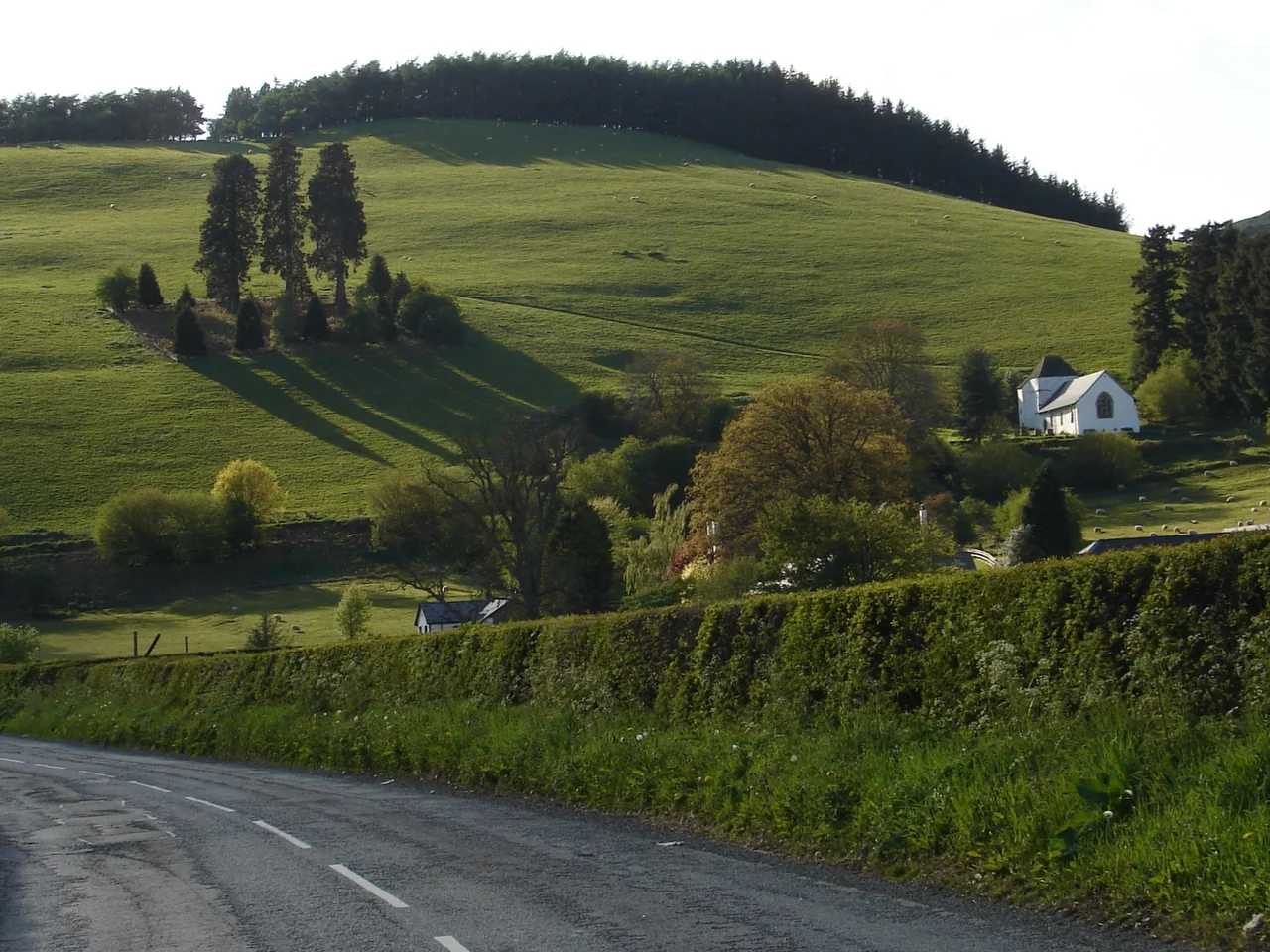

Battle of Bryn Glas
On the morning of 22 June 1402, Sir Edmund Mortimer led his Herefordshire levies up a green hill called Bryn Glas near the village of Pilleth, on the very edge of Wales. Welsh archers waited for him on the slope, plainly visible. They were the target. Mortimer's men advanced uphill into longbow range, men-at-arms shouldering past their own archers to close with the Welsh. They never reached them. From a wooded valley to the left of the hill, Welsh reinforcements emerged - troops that Mortimer had not known were there. At the same moment, contingents of Welsh archers within Mortimer's own army turned, drew bows, and began loosing arrows at the men they had been fighting beside an hour earlier. By midday, Mortimer's army was destroyed. He himself was captured. Within the year he would marry Owain Glyndŵr's daughter, and the strongest claim to the English throne would be joined to the Welsh rebellion.
Background to a Rebellion
Glyndŵr's war began in 1400 against a fragile English monarchy. Richard II had been deposed and murdered the year before by Henry Bolingbroke, who became Henry IV. Wales still held many Ricardian sympathies. When Reginald Grey of Ruthyn, a favourite of the new king, seized some of Glyndŵr's lands and procured false charges of treason against him, Glyndŵr declared himself the true Prince of Wales and raised a rebellion. The first year produced some local successes; a punitive expedition by Henry IV through north Wales appeared to crush it. Then on Good Friday 1401, the Tudor brothers from Anglesey seized Conwy Castle. Glyndŵr won at Mynydd Hyddgen in June. Henry's second punitive expedition that summer achieved nothing, hampered by bad weather. By the spring of 1402 Glyndŵr's men had ambushed and captured Grey of Ruthyn himself and were holding him for ransom. The rebellion was no longer marginal.
Mortimer's Claim and Mortimer's Men
Sir Edmund Mortimer was the brother of the late Roger Mortimer, 4th Earl of March, whom the childless Richard II had publicly named as heir to the throne in 1398. Roger had died the year before Richard was overthrown. Roger's young son, also named Edmund Mortimer (5th Earl of March), still had a clearer hereditary claim to the English crown than Henry IV, but the boy was a child and the nobles had backed Henry. Sir Edmund the uncle had loyally supported Henry IV up to this point, partly because his Welsh-border lands had already suffered raids from Glyndŵr's men. In June 1402 he was at the head of a Herefordshire county levy, sent to bring Glyndŵr to battle near the town of Knighton. Glyndŵr was within twelve miles of Leominster, an important English market town, and he had to be stopped. The force Mortimer commanded was a county muster: county levies, town militia, archers from the Welsh border country, men of mixed loyalty and uncertain motivation.
The Trap
The site of the battle is on a small green hill above the village of Pilleth, just east of Wales near Knighton. St Mary's church on Bryn Glas was already there, with a spring-fed well in its grounds; it had been there long before the Welsh and the English came to fight around it. Glyndŵr divided his army. Part of it, including many longbowmen, was placed visibly on the slopes of the hill in the conventional formation of the period. The rest he concealed in a wooded valley to the left of the hill, hidden by thick foliage. Mortimer's army advanced as expected, uphill, into Welsh arrow range. The Welsh archers on the slope outranged the English archers below them - distance favours height. As Mortimer's men-at-arms tried to push uphill to engage the Welsh longbowmen, the concealed Welsh force emerged from the valley and attacked Mortimer's right flank and rear at the same time. Then the Welsh archers in Mortimer's own army defected, drew on their former comrades, and changed the battle from a fight into a slaughter.
The Dead and the Captured
Among the English dead were Sir Walter Devereux of Weobley; Kinard de la Bere, three times Sheriff of Herefordshire; and Sir Robert Whitney, who was Henry IV's Knight-Marshal. Hundreds more fell on the slope and along the small valleys leading away from it. The English casualties were heavy enough that contemporary accounts spoke of mutilation of the dead afterwards, supposedly by Welsh women camp followers in revenge for English atrocities during Henry IV's earlier punitive expeditions through Wales. Some historians, including Philip Warner, have argued the mutilation stories were English parliamentary propaganda designed to portray the Welsh as savages. Whether they happened or not, the bodies lay unburied for so long that the area was avoided for months. Mortimer himself was captured alive. Glyndŵr took him back to north Wales and held him initially as a hostage. When King Henry refused to ransom him, suspecting Mortimer of having lost the battle deliberately, the prisoner switched sides.
The Tripartite Indenture
By November 1402, Mortimer had married Catherine, Owain Glyndŵr's daughter. He sent a public letter to his English tenants asking them to declare for either his nephew, the young Earl of March, or for Owain Glyndŵr as Prince of Wales. In 1405 he and Glyndŵr signed the Tripartite Indenture with Henry Percy (the late Hotspur's father) to divide England and Wales between them in the event of Henry IV's overthrow. The plan came to nothing. Mortimer died at the siege of Harlech Castle in 1409, fighting for Glyndŵr to the last. His wife and children were captured and taken to the Tower of London, where most of them died. But Bryn Glas had set in motion a sequence of events that destabilised the English monarchy for a generation. Today a stand of Wellingtonia trees, planted in the 19th century, marks where the dead are said to have been buried. The well is still in the churchyard. The hill is still green.
From the Air
Located at 52.31N, 3.10W just inside the Welsh border near the village of Pilleth, between the towns of Knighton and Presteigne in Powys. From the air, look for the small green hill of Bryn Glas standing above the surrounding pasture, with the small St Mary's church visible on its eastern flank. The Lugg valley runs east here toward Leominster. Nearest airports: Hereford/Shobdon (EGBS) approximately 12nm east; Welshpool (EGCW) approximately 18nm north; Birmingham (EGBB) approximately 50nm north-east. Recommended viewing altitude: 1,500-3,000 ft for the battlefield, the church, and the surrounding Marches countryside. Watch for the band of Wellingtonia trees planted on the hill - a memorial visible from the air.
Nearby Stories
- Dore Abbey 9.6 km away
- Montgomery Castle 11 km away
- Bewdley 13 km away
- Royal Air Force Museum Midlands 14 km away
- Murder of Marie Wilks 16 km away
- Amgueddfa Cymru – Museum Wales 19 km away
- Machynlleth 23 km away
- Waterfall Country 32 km away