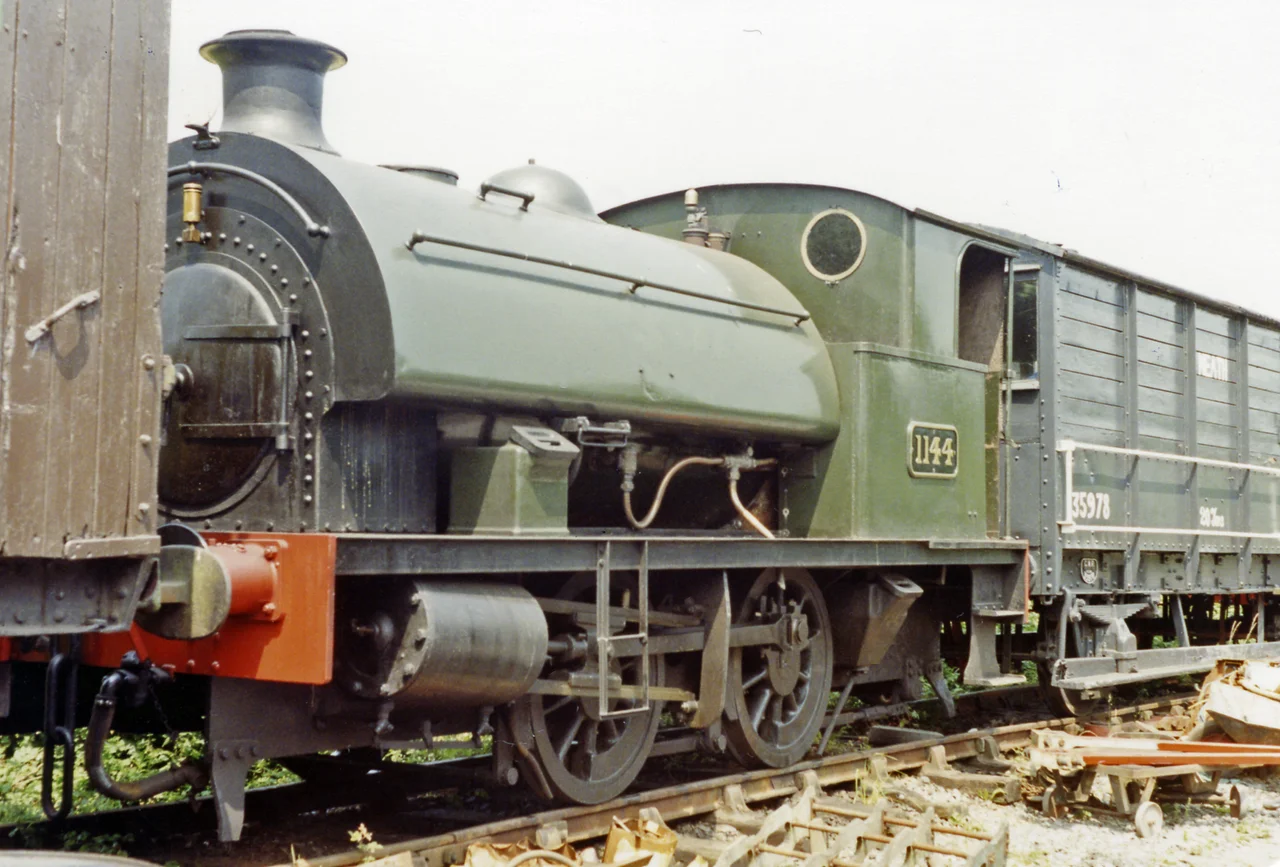

Gwili Railway
In December 1964, a single storm did what the accountants had been threatening to do for years. Floodwater six miles south of Aberystwyth ripped out the track of the old Carmarthen-to-Aberystwyth line. The last passenger train ran two months later, on 22 February 1965, hauled by a pair of Hymek diesels. British Rail looked at the damaged bridges, looked at the passenger figures, and never reopened the line. Track was lifted in the summer of 1975. That should have been the end of it. Instead, a few weeks before the rails came up, a group of volunteers in Carmarthen formed a preservation company and bought eight miles of the trackbed. Half a century later, steam still climbs the Gwili Valley because they did.
The Line That Never Reached Cardigan
The original Carmarthen and Cardigan Railway opened on broad gauge in 1860 from Carmarthen to Conwil, twelve miles short of the town it was named for. Its directors went bankrupt, its tracks were eventually swallowed by the Great Western, and the line, despite the name, never got further north than Newcastle Emlyn. In 1872 it became the last broad-gauge line in Wales to be converted to standard gauge. A connection at Pencader made it possible, eventually, to reach Aberystwyth through Lampeter, but a 56-mile run that took nearly three hours and could be flagged down by farmers' wives crossing the fields to market. The line carried wool, milk, ammunition during the Second World War, the Royal Train on a memorable run in the 1950s, and Butlins specials to the Pwllheli holiday camp. None of it was enough.
The Volunteers
The Gwili Railway Preservation Company was formed in 1975, the same year British Rail began lifting the track. They acquired the eight-mile stretch from Abergwili Junction north to Llanpumsaint and started, at Bronwydd Arms, with the one mile of rail that had not yet been pulled up. In April 1978 they ran their first steam-hauled service, becoming the first standard-gauge heritage railway in Wales. The headquarters station at Bronwydd Arms was rebuilt to look like a Great Western country halt; the signal box, dated 1885, was rescued from Llandybie on the Heart of Wales Line and re-erected here. The platform at Llwyfan Cerrig, the next station up the valley, was originally at Felin Fach on the long-vanished Aberaeron branch; volunteers dismantled it in the early 1990s and put it back together along the Gwili. Stone Platform, the name means in English, marks an old quarrymen's halt.
Climbing the Gwili
The route leaves Abergwili Junction on the northern outskirts of Carmarthen and runs north up the wooded valley of the River Gwili, the little tributary the Towy receives at Abergwili village. The line climbs steadily, with a stiff 1-in-60 gradient just north of Bronwydd Arms where engines work for their tickets. The river is rarely out of sight on one side; the A484 road runs close on the other. Past Bronwydd, the curves tighten and the woods press in. Cwmdwyfran, an old mill, marks the spot where the first preserved line terminated in 1978. The track now reaches Llwyfan Cerrig and the further stop at Danycoed - 'Under the Wood' in Welsh - where a typical GWR rural halt has been recreated. From the platform at Llwyfan Cerrig, a footpath drops to a picnic area on the river where, in summer, kingfishers cut blue lines low across the water and a heron stands in the shallows.
South to Abergwili Junction
Most heritage railways spend decades pushing outward from their original mile. The Gwili has expanded both ways. The northern extension is the harder one: nine bridges between Danycoed and Llanpumsaint, all in poor condition, eight of them over the Gwili. The volunteers got as far as Danycoed in 2001 and have been raising bridge money ever since. The southward extension to Abergwili Junction proved easier, although still slow. Track materials and signal kit from the wound-up Swansea Vale Railway society arrived in 2007. Track laying began in 2011. The Carmarthen East bypass, finished in 1999, sits on the formation south of Abergwili Junction, so the new station is the permanent southern terminus. The extension opened to invited guests on 1 July 2017 and to the public the following day. A Welsh Government feasibility study now imagines reconnecting the two kilometres to Carmarthen station itself, but it would need a new bridge across the Towy, and for now Abergwili Junction is as close as the steam comes.
Iron in the Valley
On the right weekend the locomotive shed yields up an Austerity 0-6-0 saddle tank named Haulwen, built at the Vulcan Foundry in 1945 and rebuilt by Hunslet in 1961, or a Robert Stephenson and Hawthorns industrial named Moorbarrow, finished in light blue. The Welsh Guardsman, a War Department Austerity built in 1944, worked here for years before moving to the Severn Valley Railway in 2020. The Gwili runs on the 'one engine in steam' principle - a single locomotive on the line at a time, the old country branch standard. The site at Abergwili Junction is still growing: two platforms, a carriage shed, a cafe, a booking office. A volunteer guard died here in a coupling accident in July 2006, and the railway has carried that loss with the kind of quiet care heritage operations tend to. The trains still run because of work done, mostly unpaid, by people who would not let the line die.
From the Air
The Gwili Railway runs roughly north-south along the wooded valley of the River Gwili between Abergwili Junction (51.8915°N, 4.30°W) on the northern outskirts of Carmarthen and Danycoed Halt about four miles upstream. The line is paralleled closely by the A484. From the air the trackbed shows as a thin cleared line through the woods following the river; on running days a plume of steam will mark the train. The Towy and Gwili confluence at Abergwili village is just to the south. Nearest civil airfields are Pembrey (EGFP) about 14 nm to the south on Carmarthen Bay, Swansea (EGFH) about 25 nm to the southeast, and Haverfordwest (EGFE) about 25 nm to the west.
Nearby Stories
- New Quay 2.5 km away
- RNAD Trecwn 2.9 km away
- Neath Abbey 3.5 km away
- Castlemartin Training Area 6.7 km away
- Strata Florida Abbey 7.9 km away
- Burry Port Lifeboat Station 10 km away
- Cantre'r Gwaelod 15 km away
- Waterfall Country 29 km away