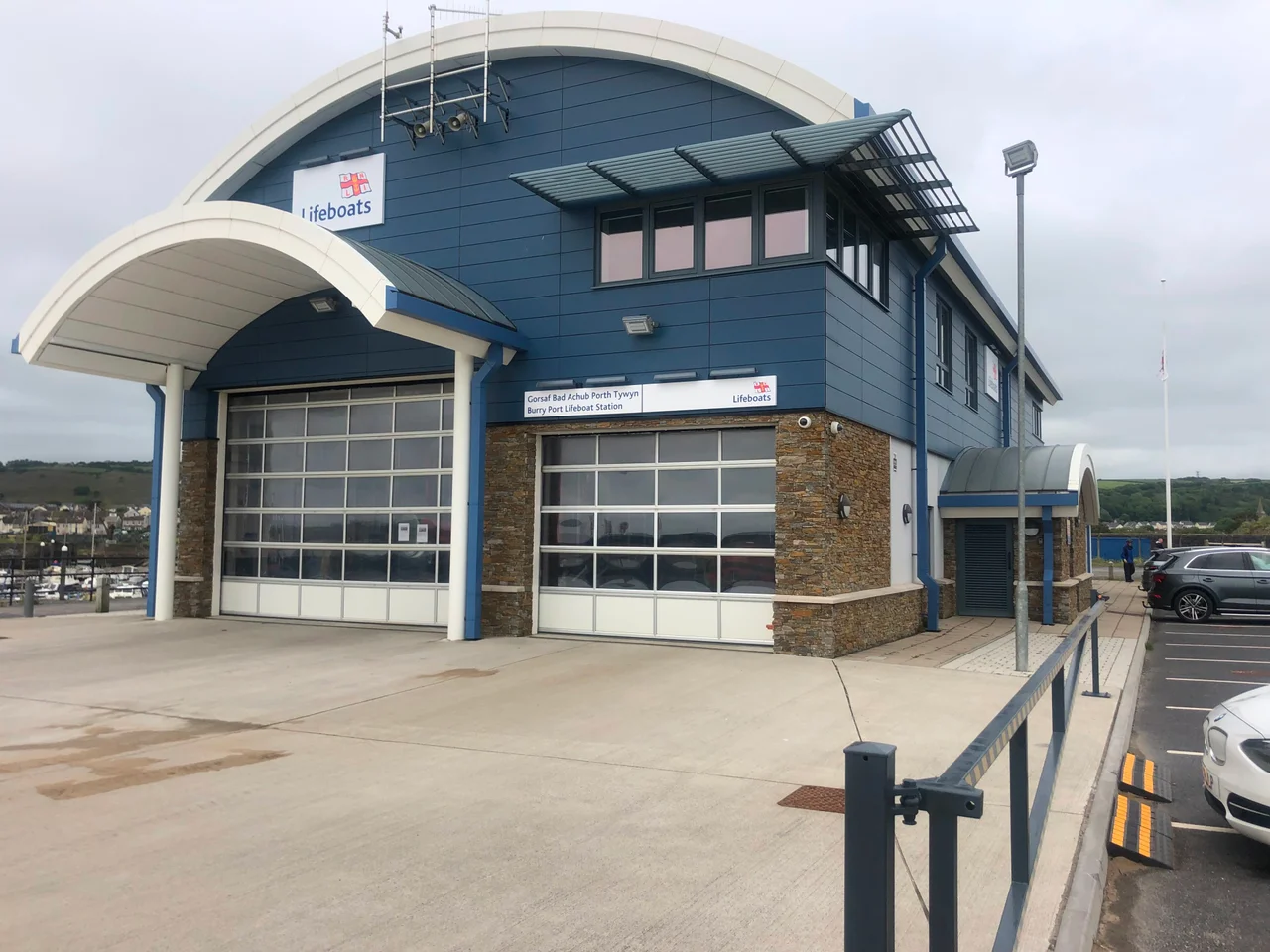

Burry Port Lifeboat Station
On the morning of 18 June 1928, three Americans climbed out of a Fokker tri-motor floatplane in the muddy water of the Burry Inlet, just off Burry Port harbour. They had been airborne for 20 hours and 40 minutes since leaving Newfoundland and they were 135 miles north of where they had planned to be. The pilot was Wilmer Stultz; the mechanic was Louis Gordon; the third passenger, who had not touched the controls during the crossing, was Amelia Earhart - now, by virtue of having been on board, the first woman to cross the Atlantic by air. Within hours, two thousand people had walked out to the harbour to see her. The lifeboat station that watches over that same harbour has its own, less famous, story.
Llanelli, 1852
The Burry Inlet has always wrecked ships. The estuary opens west between the Gower Peninsula and the Carmarthenshire coast, and the entrance is funnel-shaped - a configuration that catches vessels which have mistaken the Welsh coast for the Cornish one and are slow to correct. Once inside, sandbars wait. In 1852 the Shipwrecked Fishermen and Mariners' Royal Benevolent Society placed a 26-foot self-righting lifeboat called Rescue on the davits of the Llanelli Lightship - a vessel permanently moored off the harbour as a navigation aid. Rescue was built by James Beeching of Great Yarmouth and cost £112. Two years later, the SFMRBS handed eight of its stations, Llanelli included, to the new Royal National Lifeboat Institution.
The Burry Wrecks of 1868
On 23 January 1868, after a week of stormy weather, the wind dropped and dozens of ships set out from Llanelli and Burry Port at once - crews eager to make up their schedules, masters anxious about cargoes. The wind died entirely. Vessels found themselves dragging through a heavy groundswell with no power, and at least eighteen of them were wrecked, most with the loss of all hands. The disaster shaped local lifeboat strategy for decades. In 1863 the station had already moved to Pembrey Burrows, with a new 30-foot Pulling and Sailing lifeboat called City of Bath funded by the residents of Bath in Somerset. In 1871 a larger 32-foot boat replaced it - paid for by Stanton Meyrick of Pimlico, who left the legacy specifically requesting that a lifeboat be placed on the Welsh coast.
David Barclay of Tottenham
By 1887 the sand at Pembrey Burrows had become uncrossable. The station moved again, this time to Burry Port itself, and Mrs J. S. Barclay of Tottenham paid for it with a bequest of £3,500 in memory of her late husband. The new boathouse cost £240 and change. The new 37-foot, 12-oared lifeboat was named David Barclay of Tottenham. So were the two that followed it. Across the next twenty-seven years, the three boats that bore that name saved 34 lives - a quiet, useful record - until the RNLI committee decided on 2 April 1914 that the inlet was adequately covered by flanking stations. The David Barclay then on service was sold. The boathouse went silent. For the next fifty-nine years there was no lifeboat at Burry Port.
The Tiverton Swim
By 1973 drowning incidents in Carmarthen Bay had begun to climb - more pleasure craft, more swimmers, more weekend sailors who did not know the bar - and the RNLI decided to reopen the station. The first new boat, D-220, was funded by the Tiverton Swimming Club in Devon through a national sponsored swim. The boat that followed it was named Blue Peter II, paid for by viewers of the BBC children's television programme of the same name. In 2010 a temporary boathouse went up to house an Atlantic 75. On 19 September 2019 a new permanent station opened - designed by Llanelli architects Lewis Partnership, built by Andrew Scott Ltd - and the new Atlantic 85 inshore lifeboat was named The Misses Barrie. The smallest boat in the fleet, Williams & Cole, arrived in 2023.
Friendship at Anchor
Earhart's plane, the Friendship, sat in the Burry Inlet for a full day while the world's press scrambled to Wales. Photographs of the scene survive in the Henry Ford Museum: a high-winged Fokker on pontoons, anchored a few yards from the same eastern shore where the lifeboat station now stands; men in flat caps lining the harbour wall. The crew had originally been bound for Southampton. They had run low on fuel and put down at the first sheltered water they could find. Earhart, who would pilot her own solo Atlantic crossing four years later, said afterwards that she felt like 'a sack of potatoes' on the journey - useful only as ballast. The Burry Port lifeboat that day did not need to launch. The Atlantic, on this occasion, had delivered its passenger intact.
From the Air
Located at 51.6793 N, 4.2486 W on the eastern side of Burry Port Harbour, Carmarthenshire. Recommended viewing altitude 2,500-3,500 feet. The lifeboat station is on the inner harbour, facing south-southwest across the Burry Inlet toward the Gower Peninsula. Look for the harbour breakwater and the small lighthouse at its end; the station building sits at the head of the eastern arm. Nearest airports: EGFP Pembrey (3 nm east) and EGFH Swansea (10 nm east). The shallow Burry Inlet drains dramatically at low water - the sand banks are visible from altitude.
Nearby Stories
- Trinity University College 4.5 km away
- Wolf's Castle 5.7 km away
- Castlemartin Training Area 5.9 km away
- Neath Abbey 8.2 km away
- Exmoor National Park 20 km away
- Ilfracombe Lifeboat Station 23 km away
- HMHS Glenart Castle 25 km away
- Brecon Beacons National Park 32 km away