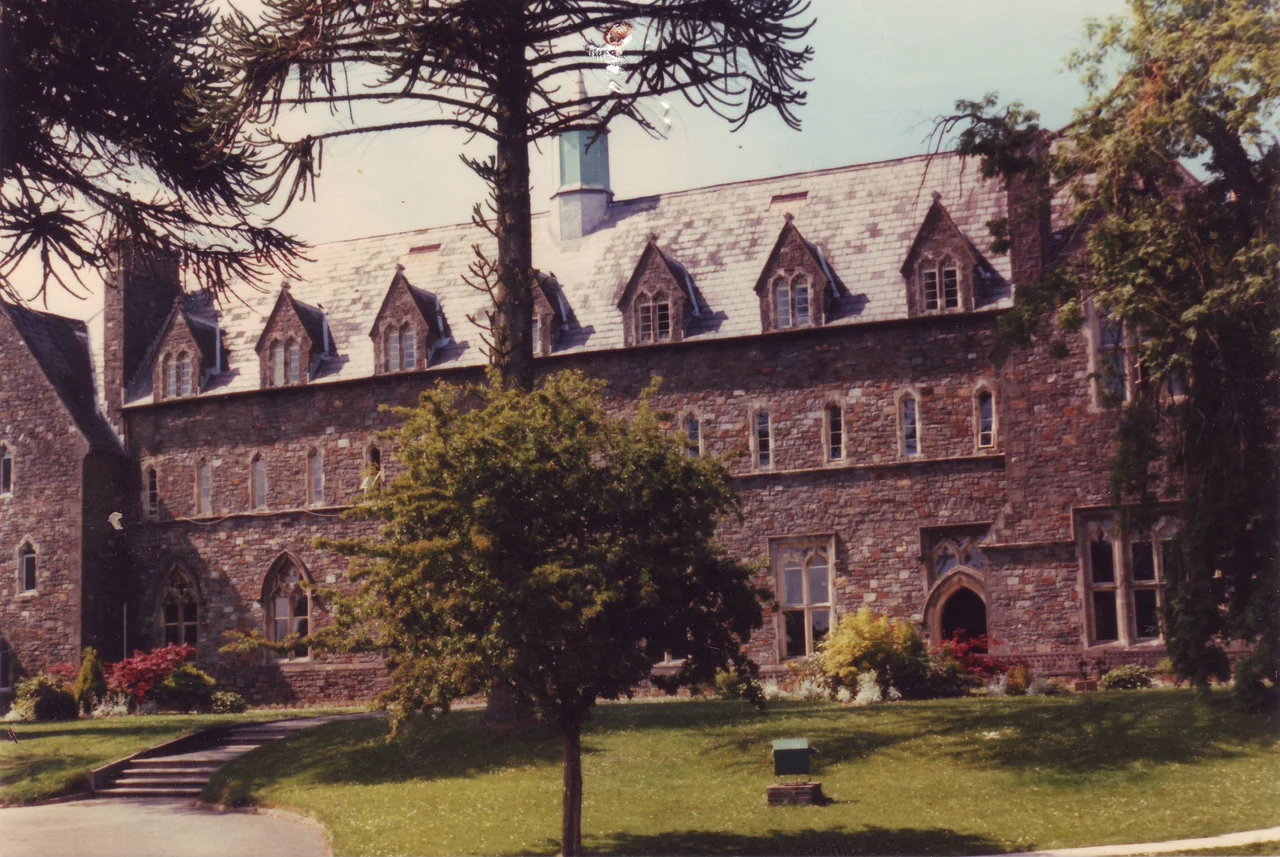

Trinity University College
Twenty-two young men arrived at Carmarthen in 1848 to train as schoolmasters. The Anglican Church had built them a new college on College Road, on the western edge of town, designed by Henry Clutton in a stripped neo-Tudor style, and called it the South Wales and Monmouthshire Training College. Three members of staff taught them. The principal was a man named William Reed. None of the founders could have predicted that the institution would still be sending teachers into Welsh schools 162 years later, when in 2010 it would finally merge with the older University of Wales Lampeter and stop being a college of its own. Trinity does not exist as a separate name on a building any longer. The buildings are still there.
Anglican Discipline
The college was founded by the National Society for the Education of Children, the principal Anglican educational body in Victorian Britain. Its mission was to train men to teach in Church of England elementary schools - the network of primary schools the National Society had built across England and Wales in the decades before state education arrived. Discipline was strict. Students rose early, prayed, ate in hall, and were drilled in arithmetic, grammar, scripture, and pedagogy. They were sent out from Carmarthen into rural Welsh-speaking parishes where, often, they were among the few in the village with formal schooling. The college's original 1848 building, the heart of the campus still, has the look of a small monastery in pale grey stone: a quadrangle, a chapel attached to the main range, lawns and gardens around it. The chapel was extended in 1932; the older 1848 chapel survives as the ante-chapel, now dedicated to students who served in the First World War.
Becoming Trinity
The college changed its name to Trinity College, Carmarthen in 1931. It admitted its first women students in 1957, building Non Hall opposite the older Dewi Hostel for them. Non Hall stayed single-sex until the merger more than half a century later. The campus grew through the postwar decades to handle the surge in teacher training that followed the Education Act 1944: the Halliwell Centre with its theatre, the Dewi Building, the Students' Union with its Attic Bar and the basement venue downstairs called Unity. The Learning Resources Centre, opened in 1995, was dedicated to Raymond Garlick - the English poet who had taught in Trinity's Welsh Department for years, and who was one of the founders of the Anglo-Welsh literary tradition. Buildings were named for principals, lecturers, and Welsh cultural figures: Carwyn James the rugby coach, Norah Isaac the dramatist, Dafydd Rowlands the writer. The college kept teacher training at its core but spread outward into theology, drama, sport science, archaeology, business, and creative writing.
The Old Building and the Cwad
If you walk College Road today and turn into the main entrance, you come first to the Old Building - the 1848 quadrangle, now called the Cwad in Welsh-medium signage. The original university quadrangle has been glazed in places and turned into a study space. The Old Library is now a coffee shop. The Archbishop Childs Hall, named for the Archbishop of Wales who served as principal from 1965 to 1987 and died shortly after retirement, still has a grand piano and a carved crest of the Bishops of Wales on its outer wall. Many of the original dormitory rooms are now lecture theatres or seminar rooms for the schools of theology, religious studies, Islamic studies, and justice and social inclusion. The chapel is still in use. The Dewi Hostel - built in 1925 as an extension wing for student accommodation, where one student complained in writing about washing in cold rainwater caught from the roof - was refurbished in 2010 into office space.
The Merger
By the late 2000s, Welsh higher education was consolidating. On 14 December 2008, Trinity announced that it was in merger talks with the University of Wales, Lampeter - which, founded in 1822, was the second-oldest higher-education institution in England and Wales after Oxford and Cambridge. The Welsh Assembly Government promised £14.03 million of investment. The merger was approved in April 2009 and formally completed in July 2010. The new institution was named the University of Wales Trinity Saint David. The Carmarthen campus survived intact, as did Lampeter and the other sites that joined later, but Trinity College ceased to exist as an independent name. UWTSD is now the body that hosts Canolfan S4C Yr Egin on the same eastern outskirts of Carmarthen, and that owns the land Yr Egin was built on. The college that trained Welsh schoolteachers for 162 years now sits inside a multi-campus federation.
Who Came Through
Trinity's alumni list is a fair survey of twentieth-century Welsh public life. Barry John, the great Welsh rugby fly-half who toured with the British Lions in 1971 and was nicknamed 'The King,' studied here. Dewi Bebb, the winger who scored Wales's only try in their 1965 victory over the All Blacks, was a Trinity student. Carwyn James, the coach who led the Lions to their only series win in New Zealand, lectured at the college. Stuart Burrows, the international tenor, trained here. The dramatist Norah Isaac, who founded the first Welsh-medium primary school in Britain at Aberystwyth in 1939, was a long-serving Trinity lecturer; Raymond Garlick was another. John Hefin, the BBC Wales producer who created the soap opera Pobol y Cwm in 1974, was a Trinity student. A small Anglican teacher training college on the edge of a market town gave Welsh sport, literature, theatre, music, and broadcasting a steady supply of practitioners, and many of the schools their teachers, for the better part of two centuries.
From the Air
Trinity's old Carmarthen campus, now part of the University of Wales Trinity Saint David, sits at roughly 51.86°N, 4.33°W on College Road and Job's Well Road on the western outskirts of the town. The Old Building of 1848 is the most prominent feature - a stone quadrangle in late Tudor revival style with the chapel attached to its south range. The campus is bordered by playing fields and the gardens of the Robert Hunter building. From the air the campus reads as a small group of stone and brick buildings set in lawns just inland from the broad bend of the River Towy. Nearest civil airfields are Pembrey (EGFP) about 14 nm south on Carmarthen Bay, Swansea (EGFH) about 25 nm to the southeast, and Haverfordwest (EGFE) about 25 nm to the west.
Nearby Stories
- New Quay 2.5 km away
- RNAD Trecwn 2.9 km away
- Neath Abbey 3.5 km away
- Castlemartin Training Area 6.7 km away
- Strata Florida Abbey 7.9 km away
- Burry Port Lifeboat Station 10 km away
- Cantre'r Gwaelod 15 km away
- Waterfall Country 29 km away