
Cantre'r Gwaelod
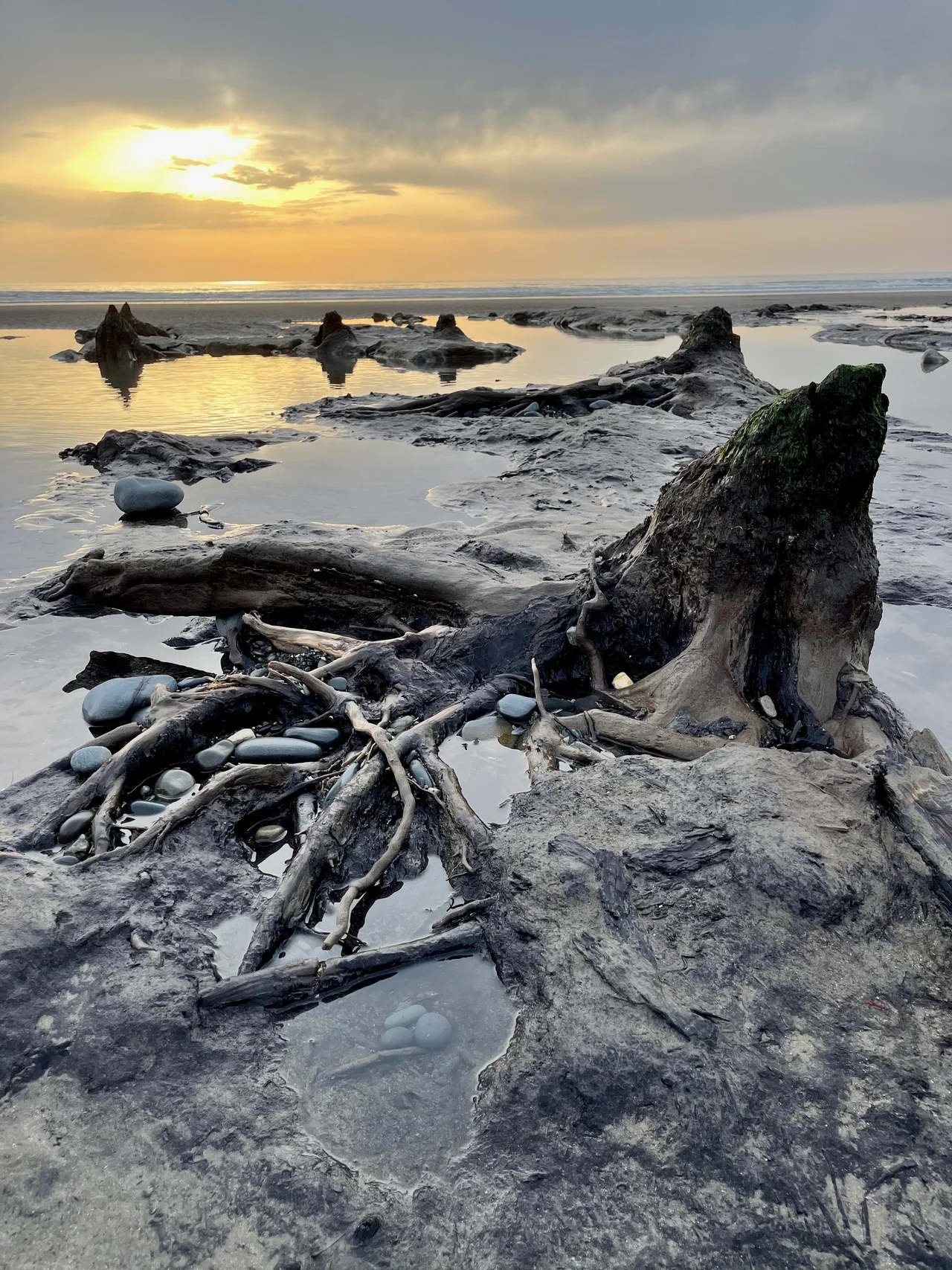
At certain low tides, after the right kind of storm, a forest emerges from the sand at Borth on the Ceredigion coast. The stumps are five thousand years old, blackened with age, their roots still gripped in the peat where the trees once grew. Walk among them and the boundary between Welsh myth and physical evidence thins to nothing. This, the people of Cardigan Bay have said for at least eight hundred years, is what is left of Cantre'r Gwaelod — the Hundred of the Bottom Lands, the drowned kingdom of Wales.
The Story Welsh Children Are Told
Cantre'r Gwaelod was a low-lying kingdom of sixteen cities, fertile and prosperous, west of the present-day Welsh coast in what is now Cardigan Bay. It was protected from the sea by a system of dykes and sluice gates — a Welsh polder, centuries ahead of the Dutch. The man in charge of the gates was called Seithennin. On the night the kingdom drowned, Seithennin was drunk. There had been a feast in the palace of King Gwyddno Garanhir, and Seithennin, who should have been at his station closing the sluices against the rising tide, was in the hall instead. The sea came over the walls. The cities went under. Sixteen towns disappeared in a single night, and the boundary of Wales retreated to where it stands today. In a different and earlier telling — preserved in the Black Book of Carmarthen, the oldest surviving manuscript in the Welsh language, copied around 1250 — the cause is different again: a well-maiden named Mererid neglected her duties, the well overflowed, and the water poured out across the kingdom until it was gone.
The Welsh Atlantis
Drowned-kingdom stories cluster around the Celtic coasts of northwest Europe: Ys off Brittany, Lyonesse off Cornwall, Llys Helig in the Conwy estuary on the Welsh north coast. All of them share the basic shape — a prosperous land lost to the sea through human folly or supernatural punishment — and folklorists since Rachel Bromwich in the mid-twentieth century have argued that these stories likely have a common origin, separately localised. What makes Cantre'r Gwaelod different is the persistence of the physical anchor at Borth. The kingdom is described in detail in the medieval Welsh Triads. Teithi Hen ap Gwynnan, one of the men at King Arthur's court in the tale of Culhwch and Olwen, is named as the survivor of an inundated land. The poet Thomas Love Peacock built his 1829 novel The Misfortunes of Elphin around the legend, with a satirical Seithennin as the drunken keeper. The story has been continuously alive in Welsh culture for a thousand years.
The Bells in the Water
Around Cardigan Bay people will tell you that on quiet nights, with the wind in the right direction, you can hear the bells of the drowned churches ringing under the water. Aberdyfi, the small fishing town across the bay from Borth, has a particular tradition of these submerged bells, and a famous Welsh folk song — "Clychau Aberdyfi", The Bells of Aberdovey — celebrates them. In 2010 the sculptor Marcus Vergette installed a Time and Tide Bell in the Dyfi estuary at Aberdyfi, hung so that the rising tide would ring it. The piece is part of a series Vergette is installing around the British coast; at Aberdyfi it joins a thirteen-hundred-year-old conversation. The bells you hear may or may not be real. The fact that people have been listening for them since the Black Book was copied is what makes the kingdom feel real.
The Forest at Borth
The forest is real. Cardigan Bay was dry land during the last ice age, and as the glaciers retreated and sea levels rose between 6000 and 4000 BCE, the bay flooded. Trees that had grown on what was once a coastal plain were drowned, preserved by burial in peat, and have remained largely intact under the sand and mud ever since. Storms occasionally strip the covering away and expose them. The great storm of January 2014 revealed a wattle walkway built around 4500 years ago — wooden hurdles laid down by Neolithic or Bronze Age people who lived on the surviving fringe of the drowning land. In August 2022 a research team at Jesus College, Oxford, published a paper arguing that an old map in the Sawley Abbey collection might preserve a memory of land that once existed off the Ceredigion coast. The medieval Welsh, in other words, may have been telling a true story dressed up as a legend: people did live on the land that the bay covered, and the land did vanish under rising water. They just got the timeline wrong by several thousand years.
Standing at Low Tide
To stand at Borth at low tide, on a day when the storms have done their work, is to look at the slow disaster the legend remembers. The stumps stretch in lines that suggest old hedgerows. The peat between them yields footprints, hoof prints, hazelnuts, and worked wood when the sand pulls back. There is no city beneath your feet. There never was a Seithennin. But there were people here, and the place where they lived is gone, and the rising sea did it. Cardigan Bay's response was to write a song. The song is still being sung. The bells, sometimes, are still being listened for.
From the Air
Coordinates 52.314°N, 5.062°W mark the approximate centre of Cardigan Bay, the body of water on the west coast of Wales that the legendary Cantre'r Gwaelod is said to lie beneath. The submerged forest at Borth is visible from approximately 52.495°N, 4.058°W at very low tides. Best viewed from 1,500-3,000 ft AGL along the Ceredigion coast between Aberystwyth and the Dyfi estuary. Nearest airport: Aberporth (EGFA, civil use limited) on the south Ceredigion coast; Welshpool (EGCW) approximately 35 nm east-northeast inland.
Nearby Stories
- Strumble Head Lighthouse 1.6 km away
- Cardigan Bay Special Area of Conservation 5.6 km away
- Great Western Railway in West Wales 23 km away
- HMS Tyler 23 km away
- Penrhyn Du Mines 28 km away
- Avoca, County Wicklow 51 km away
- Johnstown Castle 60 km away
- SS Folia (1907) 135 km away