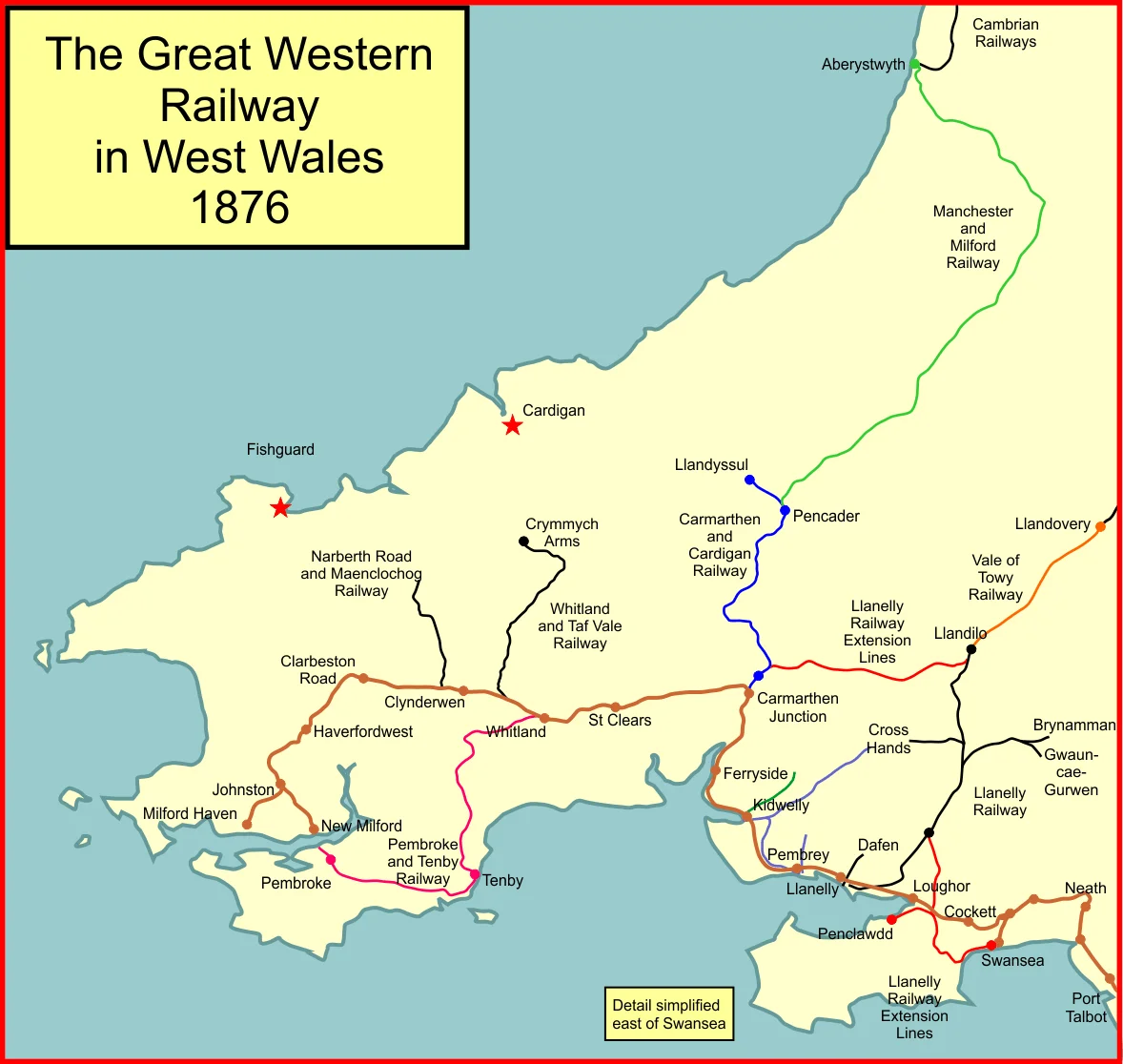

Great Western Railway in West Wales
On the night of Tuesday 30 April 1872, every broad-gauge rail in West Wales was scheduled to be ripped up. The Great Western Railway had decided to abandon Isambard Kingdom Brunel's seven-foot gauge - the wide, fast, ambitious track that had defined the line since it opened from Swansea to Neyland twenty years earlier - and bring its Welsh network onto the four-foot-eight-and-a-half-inch standard used by the rest of Britain. The work took twelve days. Up line first, then down. Single-line working at reduced speed in between. Sidings narrowed in advance so passenger trains could be shunted past each other while the crossing loops were rebuilt. By 22 May the down line was complete. By 23 May a skeleton service was running on standard gauge across the whole of West Wales. The most ambitious railway gauge ever built in Britain had been erased from the region in less than two weeks.
Mineral Lines and Coal Carts
Before the main line came, West Wales already had a tangle of small mineral railways serving the coal pits and limestone quarries north of Llanelly and around Saundersfoot. The first stretch of the Carmarthenshire Railway - a plateway tramroad connecting coal pits to a quay at Llanelly - opened in 1803. By 1805 it reached Cross Hands high on Mynydd Mawr, bringing good Welsh anthracite down to the sea. The Kidwelly and Llanelly Canal and Tramroad Company was authorised in 1812, building a canal with feeder waggonways serving the pits. Horse-operated tramways of roughly four-foot-two-inch gauge ran to Burry Port harbour from 1832. These were not really railways in the modern sense; they were industrial appliances built to do one job for one customer, and they generally did it badly enough that the next generation had to start again.
The Seven-Foot Gauge
The South Wales Railway was authorised by Parliament in 1845, with a route running from Standish south of Gloucester through Chepstow, Newport, Cardiff, Neath, near Swansea and Carmarthen, ultimately to Fishguard - an ambitious aim that included a branch from Whitland to Pembroke. The engineer was Brunel, naturally; the gauge was his beloved seven feet, naturally. In 1846 a Parliamentary Gauge Commission concluded that the future of British railways had to be on standard gauge and no further broad gauge lines should be built. The Board of Trade then promptly modified the conclusion to permit the already-authorised South Wales Railway to proceed on the broad gauge anyway, on the grounds that it was too late to change. Brunel built what he wanted: a seven-foot main line, viaducts at Loughor and Kidwelly with opening sections for shipping, Cockett Tunnel 789 yards long west of Swansea, and Barlow rail - a cheap broad-base rail laid directly in ballast without sleepers - as the bargain-basement track choice.
Opening, Slowly
Construction of the first section between Chepstow and Swansea opened on 18 June 1850. The crossing of the River Wye at Chepstow was not ready, so for two years the line was isolated from the rest of the network until Brunel's tubular bridge opened on 19 July 1852. The Carmarthen station of the period sat south of today's triangle, close to the road from Pensarn to Cwmffrwd. The Barlow rail proved unsatisfactory and the early sections had to be progressively relaid with the more conventional longitudinal-timber track. The line was eventually extended west, eventually reaching the new terminus at what would become Neyland in 1856 - a town invented from nothing because the Royal Navy had abandoned Milford Haven a few miles up the coast and Brunel needed deep water for the Irish ferry. Wexford had been the original Irish target; harbour silting had ended that plan. The Waterford route ran instead.
The Llanelly Lines
Parallel to the main line, the Llanelly Railway and Dock Company had been pushing its own network of mineral and passenger railways inland. Authorised in 1828, it built a dock at Llanelli and a two-mile line to coal pits at Dafen, then a more ambitious line to Pontardulais in 1839, then extensions east into the Amman Valley and west to Mynydd Mawr. Through the 1860s it built branches to Swansea and Carmarthen, financed by borrowing at crippling rates that left it in financial trouble within a decade. The London and North Western Railway came in as a partner, then took over the New Lines from 1871. The Great Western, alarmed at LNWR access to its territory, took over the Original Lines from 1873. The Llanelly company was finally absorbed entirely by the GWR in 1889. It is a typical 19th-century railway story - bold engineering, hopeful finance, panicked consolidation - and a typical 19th-century Welsh railway story in particular, in which English companies acquired Welsh mineral lines whether the local promoters wanted them to or not.
Burry Port and Gwendraeth
One of the smaller absorbed lines was the Burry Port and Gwendraeth Valley Railway - born as the Kidwelly and Burry Port Railway in 1865, when the operators of the old Kidwelly and Llanelly Canal decided their canal was obsolete and converted it to a railway. By 1866 they had merged with the Burry Port Harbour Company. A spelling error by the company's parliamentary legal advisors - Gwendreath, instead of Gwendraeth - went uncorrected into the official name and stayed there for decades. The line opened to Pontyberem in 1869 with a branch to Carway in 1870 and to Trimsaran's Star Colliery in 1872. There was no passenger service until about 1898, when a workmen's train started running from Burry Port. Like most of the mineral lines, it survived for as long as the pits did and not much longer. The branch lines closed one by one through the 20th century as the South Wales coal trade collapsed.
What Remains
The main line Brunel built - Swansea to Neyland via Carmarthen, Whitland and Haverfordwest - is still in use today, although the gauge is Stephenson's and the trains are diesel. The Pembroke and Tenby branch, built independently in the 1860s and absorbed into the GWR after years of squabbling over gauge conversion at Whitland junction, still runs. The Fishguard extension reached its terminus in 1906 and the boat trains to Rosslare have used it ever since. Most of the mineral branches are gone, their trackbeds visible only on aerial photographs as straight green lines through the valleys. Neyland's docks are largely silted up; the terminus moved to Milford Haven for the oil tankers. The seven-foot gauge survives nowhere in operating form, anywhere in Britain. But the curve Brunel laid through the West Wales hills - the alignments, the embankments, the tunnels - remains underfoot whenever you board a train at Carmarthen or Pembrey for the West.
From the Air
The GWR West Wales main line runs roughly along 51.7-51.85N from Swansea through Llanelli, Pembrey, Kidwelly, Ferryside, Carmarthen, St Clears, Whitland and on to Haverfordwest and Milford Haven. The article coordinate at 51.83N, 4.5W places you near St Clears, on the line. EGFP Pembrey, EGFH Swansea and EGFE Haverfordwest are all close to the route. Best viewed from 3,000 to 5,000 feet to follow the alignment along the coast.
Nearby Stories
- Teifi Valley Railway 1.2 km away
- Haverfordwest 5.1 km away
- Mumbles Lifeboat Disaster 8.1 km away
- Neath and Tennant Canal 12 km away
- Strata Florida Abbey 27 km away
- HMS H47 31 km away
- Ilfracombe Lifeboat Station 38 km away
- HMHS Glenart Castle 44 km away