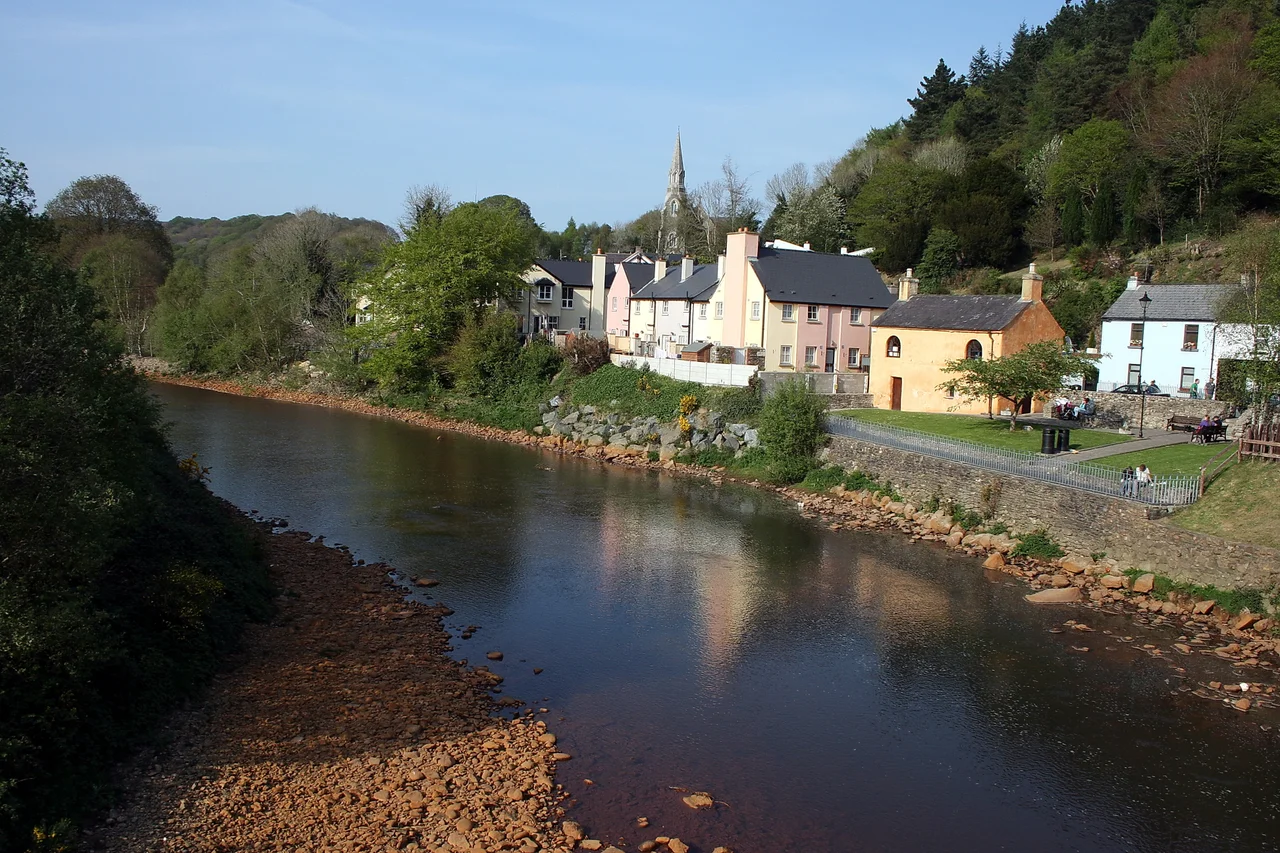

Avoca, County Wicklow
There is no spot in this wide world I love half so much as the Meeting of the Waters - so Thomas Moore wrote in 1808, sitting (the local story goes) beneath a tree at the place where the Avonmore and Avonbeg rivers join to become the Avoca. The stump of that tree is still there. So is the village three kilometres downstream, on the river he made famous, in a Wicklow valley where copper has been mined since 1720 and a brief but bloody gold rush erupted in 1795 on the mountain just above. In the 1990s the BBC drama Ballykissangel turned Avoca's main street into the most-watched fictional Irish village of the decade. Red kites, reintroduced to Ireland in the 2000s, now circle overhead. A small place, a long story.
Ptolemy Knew This River
Ptolemy, working in Alexandria in the second century, drew a map of Ireland that included a river he called Oboka. He never visited; he was working from sailors' reports. The river he named is almost certainly the Avoca, which means his map preserves the oldest written name for a place in the village. Local names have layered ever since. The village itself was once Newbridge, then Ovoca, then in Victorian times Avoca - the same anglicisation Thomas Moore had already used in his song. The Irish name is now Abhoca. None of the other names are in current use. The Avoca railway station opened on 18 July 1863 on the Dublin-to-Rosslare line and closed to passenger services on 3 March 1964, a hundred years and 230 days later. Local political pressure to reopen it has waxed and waned ever since.
Copper for Two and a Half Centuries
The pits of East Avoca and their underlying workings supported copper and sulphur production from 1720, and by the 1770s the Avoca mines were shipping more than a hundred tons of copper ore annually from Wicklow harbour. At their peak this was one of the richest copper-mining districts in Europe, and the workings grew into the most extensive mining operation in Ireland - a status they kept until 1960, when the last shaft finally closed. The geology that made the mines so productive also gave Wicklow its famous brief gold rush in 1795, when a piece of gold the size of a half-ounce nugget was found in the roots of an uprooted tree on the estate of Lord Carysfort near Woodenbridge, just south of the village. Within a month a thousand prospectors were panning the Goldmines River. Within another month the army had taken control. The copper miners, characteristically, kept working through the whole excitement.
Ballykissangel and the Visitors
From 1996 to 2001 the BBC filmed six series of Ballykissangel in Avoca, transforming the village street into the fictional Ballykissangel and bringing a flood of visitors. Fitzgerald's pub became Ballykissangel's main pub on screen. The church and the small bridges featured in episode after episode. The drama spawned tourist coaches from Britain and beyond, and many of them are still running. Other productions followed. Vikings, the History Channel and MGM drama that ran from 2013 to 2020, used the ruined Avoca mines as a backdrop. The 1967 film Jules Verne's Rocket to the Moon shot scenes here. The 2010 comedy Zonad set its story in the village. Avoca Handweavers, founded in 1723 and the oldest working mill in Ireland, anchors a different sort of fame: their tweeds and throws are sold around the world from a shop and cafe in the village.
A Village of Notable Residents
For a small Wicklow village, Avoca has attracted strange company. George Barret, the eighteenth-century Irish landscape painter, worked here. Oliver Byrne, the nineteenth-century civil engineer who produced a remarkable colour-illustrated edition of Euclid's Elements, was born in the Vale of Avoca in 1810. The Irish-Australian bushranger Lawrence Kavenagh was born in the village or nearby Rathdrum around 1810. Harry Harrison, the American science fiction author best known for the Stainless Steel Rat novels, lived in the area in the 1970s. Chris Pontius of Jackass fame moved here from 2004 to 2008. Most surprising of all: Gunther Schutz, a German citizen who worked for the Abwehr - Nazi military intelligence - during the Second World War, retired to Avoca after the war and died here in 1991. Red kites, reintroduced to Ireland by the Golden Eagle Trust, now soar over a valley shaped by Bronze Age gold workers, Victorian copper miners and a fictional priest named Father Peter Clifford.
From the Air
Located at 52.85°N, 6.22°W on the River Avoca in southern County Wicklow, about 50 km south-south-east of Dublin. Best viewed at 2,000-4,000 ft AGL; the village sits in a sheltered river valley with the spoil heaps and ruined buildings of the historic copper mines visible to the south-east. Nearest airports: Dublin (EIDW) 55 km to the north, Waterford (EIWF) 100 km to the south-west.
Nearby Stories
- Kilcullen 6.6 km away
- Powerscourt Waterfall 7.7 km away
- County Carlow 20 km away
- HMS Tyler 24 km away
- Thomastown, County Kilkenny 31 km away
- German Submarine U-1302 32 km away
- County Wexford 35 km away
- Minesto 60 km away