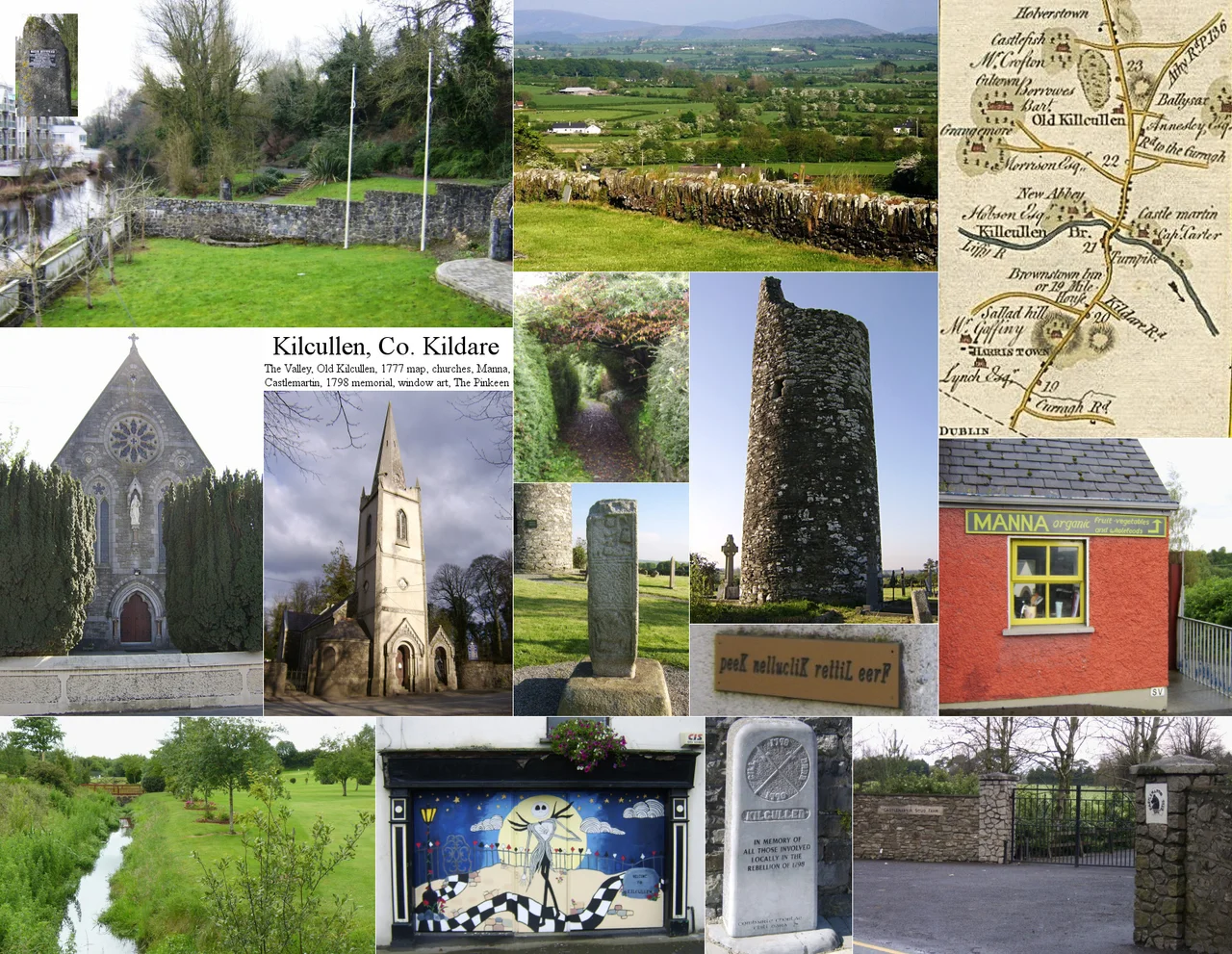

Kilcullen
On 2 July 1903, motor cars raced through Kilcullen at speeds Ireland had never seen before. The Gordon Bennett Cup was the first international motor race held anywhere in the United Kingdom of Great Britain and Ireland, run in Kildare because racing on British public roads was illegal at the time. The British team, paying a compliment to their Irish hosts, chose to race in shamrock green - which thereafter became known as British racing green. The Belgian Camille Jenatzy won, driving a Mercedes over 328 miles of looping country roads. Kilcullen, a small town on the Liffey halfway between Dublin and Carlow, was on the route. Modern signs still mark it.
The Bridge That Made the Town
Kilcullen is formally called Kilcullen Bridge, and the name is not arbitrary. The town was founded after 1319, when a canon of Kildare Cathedral named Maurice Jakis built a great bridge across the River Liffey at this point. The original settlement, now called Old Kilcullen, sat on a hilltop a few kilometres south - a monastic site founded in the mid-5th century that became an Anglo-Norman walled town with seven gates and as many roads. Vikings raided Old Kilcullen at least twice, in 936 and 944, landing at what would later become the bridge site. Little of Old Kilcullen remains visible now beyond a damaged round tower and a churchyard. The current six-arch bridge, last reconstructed around 1850 and widened in the early 1970s, still spans the Liffey on the line of Jakis's original 14th-century crossing. Viewed from downstream, the historic style remains visible. The upstream face is modern.
Dun Ailinne and the Old Kings
On a low hill near Kilcullen sits Dun Ailinne, a ceremonial earthwork associated with the kings of Leinster. The site precedes the monastic settlement at Old Kilcullen and may have served as a royal inauguration place. In 2009 it was announced that Dun Ailinne might join other 'royal sites' across Ireland in a bid for UNESCO World Heritage Site status. To the west of the modern town lies Castlemartin Estate - now owned by American billionaire John Malone, previously the home of Tony O'Reilly, and before that the seat of branches of the Eustace family for centuries. The estate contains the restored 12th-century St Mary's Church, a dependent chapel of Kilcullen Church that was a ruin for centuries before its 1979-1980 restoration. Outside the town, the New Abbey was commenced in 1486 by Rowland FitzEustace, 1st Baron Portlester, and Lord Chancellor of Ireland. Lord Portlester is buried there. So is his daughter Lady Kildare.
Battle, Race, and Trout
The Battle of Kilcullen was an early skirmish in the 1798 Rebellion, and Castlemartin became the headquarters of British forces in Kildare under Ralph Dundas. A century later, the Gordon Bennett Cup brought motor racing through the town for the first time. Today, the M9 motorway from Dublin to Waterford bypasses Kilcullen to the east; before 1995 the main road from Dublin to Carlow, Kilkenny, and Waterford ran straight through. The town sits 40 kilometres from the centre of Dublin and just 6 kilometres from Newbridge and the Curragh - the centre of Ireland's horse racing industry. Kilcullen is home to the Aga Khan's Gilltown Stud and to several other stud farms. The Liffey at Kilcullen is known for trout angling. The North Kildare TSAA manages fishing rights from Harristown through to the town centre. And Kilcullen Canoe Club, established in 1957 by Paddy Maloney, is the oldest canoe club in Ireland - home to Olympic and international kayak athletes.
From the Air
Kilcullen sits on the River Liffey at 53.13N, 6.75W, just off the M9 motorway. Cruise 2,000-3,000 ft to take in the Liffey valley, the Curragh plain to the west, and Castlemartin Estate west of town. The bridge over the Liffey is a clear visual landmark; one bridge in town, three more to the south and east. Nearest international airport is Dublin (EIDW), about 45 km northeast. Casement Aerodrome (EIME) is closer to the west.
Nearby Stories
- River Liffey 3.3 km away
- Swords 7.6 km away
- Avoca, County Wicklow 10 km away
- Clonard Abbey 10 km away
- County Westmeath 10 km away
- County Offaly 12 km away
- Templemore 19 km away
- Kilcooly Abbey 30 km away