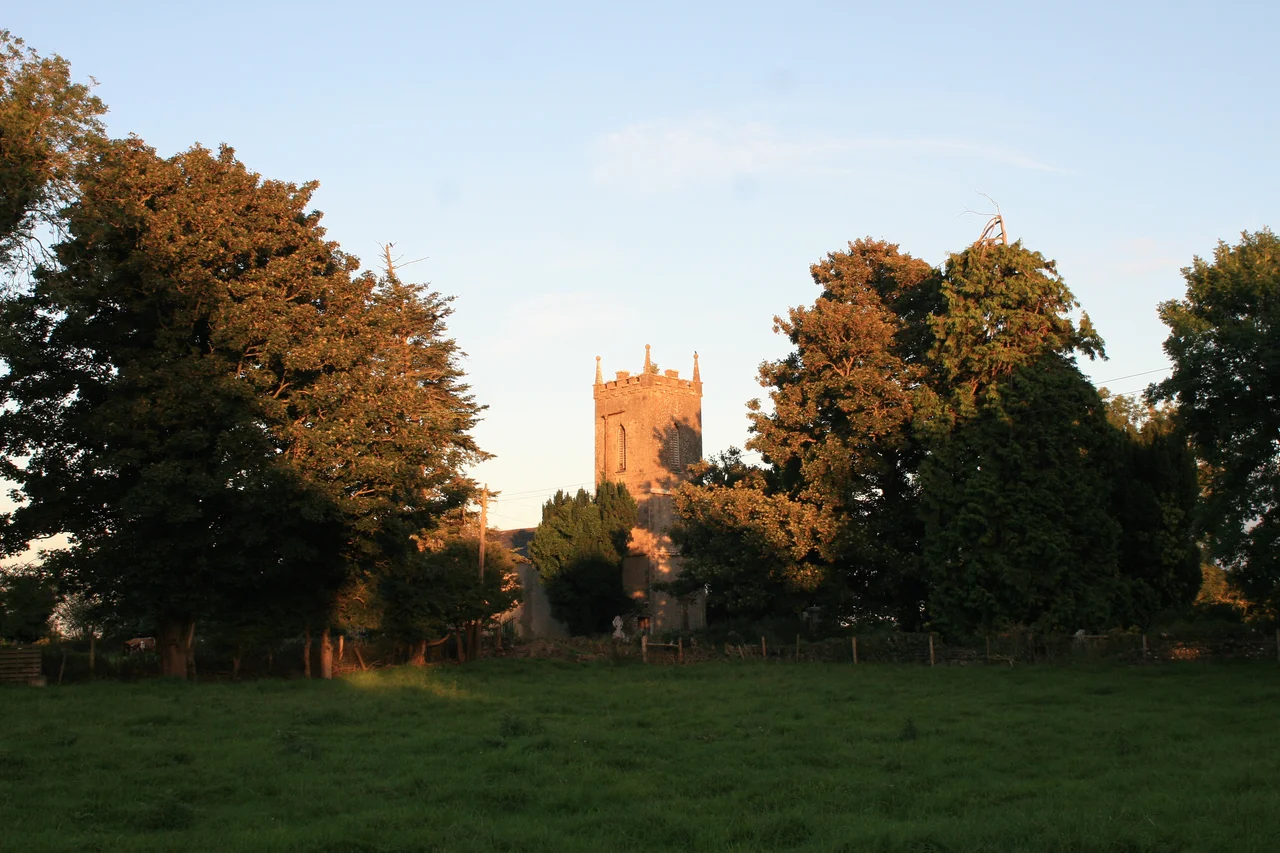

Clonard Abbey
An angel told Saint Finnian where to build. The site was a stretch of meadow on the south bank of the Boyne in what is now County Meath, and the angel said this would be the place of his resurrection. Finnian arrived around the year 520, put up a single cell, and stayed. Within his lifetime, a hymn written in his honour claimed that 3,000 pupils were studying at Clonard at any given time. Most of what remains today is visible only from the air - a faint geometry of vanished walls in the green field, marking where one of the great monastic schools of Christian Europe used to be.
The Saint and His School
Finnian was well-travelled before he came to the Boyne. He had studied at Tours in France, the great centre of Western monasticism, and at Llancarfan in Wales. He brought both traditions home with him - a continental discipline laid over a Welsh emphasis on learning - and built Clonard on the model of what he had seen. The school taught Latin, Greek, Scripture, and the early monastic rules. Among those said to have studied there in the sixth century were Brendan the Navigator, Columba of Iona, Ciaran of Clonmacnoise, and the others later remembered as the Twelve Apostles of Ireland. They went on to found monasteries from Donegal to the western islands of Scotland. Clonard was the wellspring. Finnian died in about 549 - tradition says of the plague that swept Ireland that year - and was buried on the site, fulfilling the angel's promise.
On the Esker Riada
The location was not random. Clonard sat on the Esker Riada, a ridge of gravel left by the retreating glaciers and used since prehistoric times as Ireland's main east-west road. Travellers heading from Dublin to Galway, or from the kingdom of Leinster to the kingdom of Connacht, passed within sight of the monastery. That brought students, pilgrims, and trade. It also brought trouble. Clonard sat on the boundary between Leinster and Meath, two kingdoms that fought one another often. From the eighth century onward, the abbacy passed through the hands of competing dynasties, and the monastery became as much a political prize as a religious centre. Then came the Vikings.
Burnt, Rebuilt, Burnt Again
Part of Finnian's abbey burned in 764, before the raiders had even arrived. In 838 the Danes destroyed the place outright and put the surviving clergy to the sword. They returned in 888 to do it again. In 939, Ceallachan, King of Cashel, came up from the south with Danish allies from Waterford and plundered what had been rebuilt. In 970, a Meath prince named Donell burnt it once more. The pattern continued for two centuries. An accidental fire in 1143 consumed a great part of the abbey and the entire library - centuries of irreplaceable manuscripts, gone in a night. In 1170, Diarmait Mac Murchada, the king who had invited the Normans to Ireland, returned with Strongbow's English knights and despoiled the place again. They burned it once more in 1175. Walter de Lacy then rebuilt the site as an Augustinian monastery on the old foundations. In 1202, the Norman bishop Simon de Rochfort transferred the diocesan seat from Clonard to Trim, eight miles east. The school never recovered.
What the Field Remembers
Today, if you drive the N4 west out of Dublin and turn off near the village of Clonard, you reach a quiet stretch of road, a parish church, and a field that looks like any other field in Meath. From the air, the outlines of long-vanished walls and earthworks are still visible as cropmarks in the grass. The Catholic church here is dedicated to Saint Finnian, and inside is the abbey's old baptismal font, a heavy stone bowl carved with biblical scenes that William Wilde - the father of Oscar Wilde - sketched in 1849 when he was cataloguing Irish antiquities. The font survived the Vikings, the Normans, the fires, and the slow erasure that came after. It sits now under fluorescent lights in a quiet parish church, a thousand years older than anything else in the building, still in use for the purpose it was carved for.
From the Air
Clonard Abbey ruins are at 53.45 degrees north, 7.01 degrees west, on the River Boyne about 35 miles west of Dublin in County Meath. Nearest airport is Dublin (EIDW) about 40 miles east; smaller Weston Airport (EIWT) is closer at 25 miles east. From 2,000-4,000 feet in clear weather, the Boyne loops south of the village, and aerial photographs have long revealed the outline of monastic earthworks in the fields. The Esker Riada ridge runs east-west through this stretch of Meath. Weather in the Irish midlands tends toward overcast and damp; spring mornings often offer the best visibility.
Nearby Stories
- County Offaly 7.9 km away
- County Westmeath 8.2 km away
- Irish Military Intelligence Service 8.8 km away
- Swords 10 km away
- Carrickmines Castle 10 km away
- Cabra Castle 15 km away
- Killeshandra 27 km away
- Carlingford 30 km away