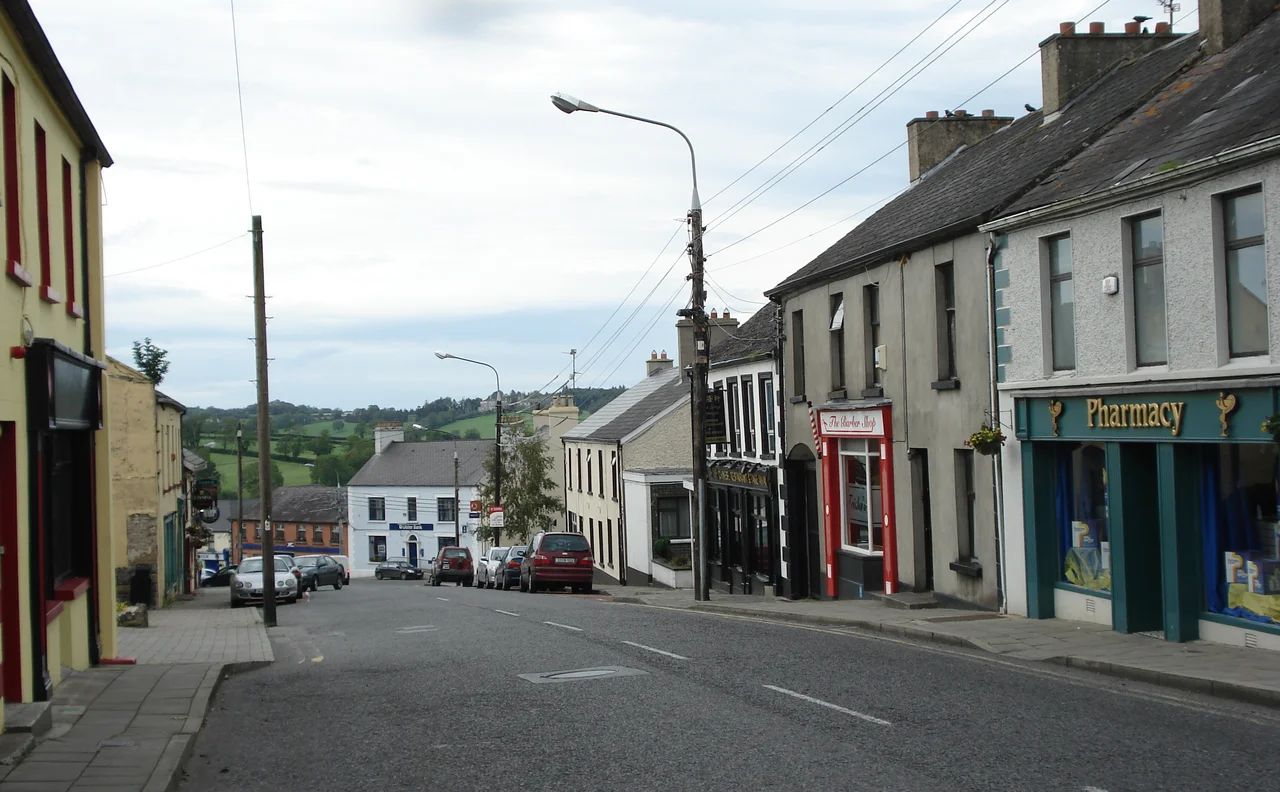

Killeshandra
Pigot's Directory of 1824 called Killeshandra "the greatest linen market in the county." The whole town was at the loom or the flax pit — almost everyone within five miles of the place was involved in some way in the linen trade. Forty years later it was finished. The local landlords would not invest in the machinery that the bigger Ulster towns were buying; the cottage weavers could not compete; the market collapsed; the population emptied out. What Killeshandra has today instead is dairy. The same town that lost the linen race in the 1860s built the dairy co-operative in the 1890s that is now Lakeland Dairies — Ireland's second-largest dairy co-operative, with annual revenue exceeding €1.9 billion, headquartered in Killeshandra still.
The Church of the Old Rath
The town's name in Irish is *Cill na Seanrátha*, "the church of the old ringfort," and that is exactly what was here when Christianity arrived — a pre-Christian ringfort with a church built on top of it. The medieval church belonged to the Augustinian priory at Drumlane. In July 1610, as part of the Plantation of Ulster, the lands were granted to Sir Alexander Hamilton of Innerwick Castle in East Lothian, Scotland, with instructions to build a bawn and bring in Protestant settlers. He built. The 1641 rebellion swept the Hamiltons out — they surrendered to the Cavan O'Reilly rebels and lost their lands temporarily — but after the Restoration in 1660, Sir Francis Hamilton (1st Baron of Castle Hamilton) regained the area and began building the new market town in earnest, importing Scottish settlers and French Huguenot exiles whose expertise in linen weaving would shape Killeshandra's economy for the next two centuries.
The Best Restoration Building in Ulster
What survives today of that effort, in ruins, is a remarkable church. The Pevsner Guide to South Ulster calls it "arguably the finest Restoration building in Ulster — a handsome evocation of the improving architectural eloquence of the age." It is T-shaped, with a south-facing transept added in 1688 by Sir Francis Hamilton (the third baron) as a memorial to his parents. The transept is Renaissance neo-classical; the east window is Gothic; the whole sits in a graveyard ringed by enclosure walls and gate piers, with the heraldic Hamilton coat of arms carved into the stonework. The family motto — "THROUGH," set above an image of an oak tree and a woodcutters' cross-saw — still reads cleanly on the pillars. Sir Francis himself was buried in his Montgomery wife's vault in County Down. His second wife Lady Anna ended up in Westminster Abbey. The crypt beneath the transept is believed to hold Sir Charles Hamilton (the second baron) and his wife Catherine Semple.
Flax, Linen, and the Killeshandra Nuns
The town's prosperity peaked around 1790, the year a wealthy widow named Nicola Ann Jackson — heiress of the Hamilton estate, married into a County Armagh family — built a Market House for the town. It served as the commercial heart of the linen trade and later as a courthouse. Killeshandra's 1841 census, one of the few that survived the burning of the Dublin Public Records Office in 1922, recorded a parish population of 8,440 people, most of them in some way involved in flax and linen. By the 2022 census, that figure was 248 in the town and around 1,141 in the wider district. The decline is one of the steepest in Cavan. In 1924 the Missionary Sisters of the Holy Rosary founded their convent in Killeshandra — the "Killeshandra Nuns," as they were known across Ireland for the next four decades. The convent was eventually demolished and its lands taken over by Lakeland Dairies.
The Cows That Saved the Town
On 23 September 1896 a small group of local farmers formed the Drummully Co-operative Society. Within eighteen months they had committed milk from 987 cows to a new creamery in Killeshandra, and in March 1898 the operation took the name Killeshandra Co-operative Agricultural Society. It worked. The co-op won prizes for butter at agricultural shows in Ireland and abroad. By the time it celebrated its centenary in 1996, it was handling milk from over 4,000 farmer suppliers. Through a series of mergers it became Lakeland Dairies — now the second largest dairy co-op in Ireland, supplying butter, milk powder, cheese and food ingredients to customers across more than ninety countries. In October 2013 the company bought the former Ulster Bank premises next door to its headquarters. The town and the co-op now occupy more or less the same footprint.
Twelve Long Miles Around the Lake
Killeshandra has a side life in Irish folk music. The folk song "Cavan Girl" — written by William Greenway, an American poet — has the narrator walking "the road from Killeshandra, twelve long miles around the lake to get to Cavan town." The lake is Lough Oughter, the long convoluted body of water that defines this part of Cavan, and the road still runs the way the song says. The Cuilcagh Lakelands Geopark — a UNESCO Global Geopark — uses Killeshandra as one of its gateways, and the Killykeen Forest Park around Lough Oughter is the easiest place to take in the lake-and-drumlin landscape that makes the area distinctive. The town also produced George Richardson, who won a Victoria Cross during the Indian Mutiny, and Michael Donohoe, a former US Democratic Representative from Pennsylvania — small contributions to wider histories, the kind a Cavan market town quietly accumulates over centuries.
From the Air
Killeshandra sits at approximately 54.02°N, 7.53°W in western County Cavan, about 20 kilometres west of Cavan town. From cruise altitudes of 3,000–5,000 ft, the town's compact pattern is visible alongside Lough Oughter to the east — a sprawling, lake-dotted Special Protected Area of national importance for wildlife. The Lakeland Dairies factory occupies a prominent industrial site on the edge of town. The nearest controlled airspace is Belfast (EGAA), about 110 km northeast; Dublin (EIDW) lies south. Knock (EIKN) is to the west. Conditions are typically marginal VFR. Clear days show one of Ireland's most distinctive lake landscapes, with Lough Oughter's complicated shoreline running away to the southeast.
Nearby Stories
- Clonfin Ambush 3.5 km away
- Lisgoole Abbey 4.7 km away
- Tulsk 11 km away
- Carrick-on-Shannon 12 km away
- Abbey of Kells 12 km away
- Bailieborough Castle 14 km away
- Belleek, County Fermanagh 18 km away
- City Status in Ireland 24 km away