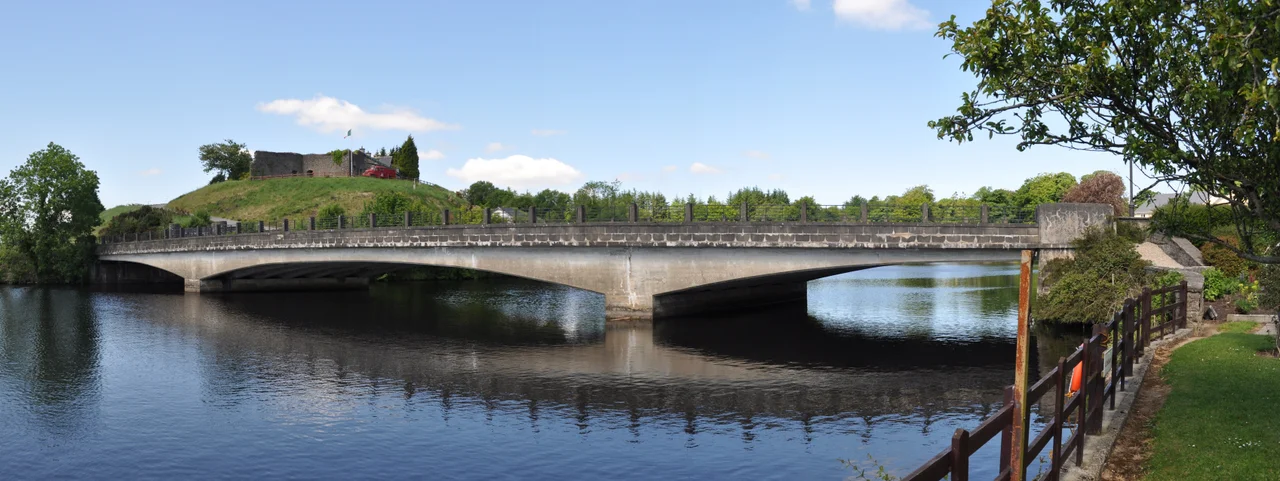

Belleek, County Fermanagh
It is barely a village. Belleek's population in 2011 was 904 people, scattered along the River Erne where it tumbles out of Lough Erne and curves across the international border into County Donegal. But hold one of its eggshell-thin baskets up to a window and the light passes through it, picking out the translucent parian china that Belleek Pottery has been producing since 1857. Seventy per cent of the output is exported. The visitor centre attracts 150,000 guests a year. And the village itself holds another, geographical distinction: it is the most westerly settlement in Northern Ireland, and therefore the most westerly settlement in the entire United Kingdom.
Fionn's Flagstone
Long before the pottery, Belleek was a ford. Neolithic settlers worked these riverbanks, and Irish legend has it that Fionn mac Cumhail's warrior band, the Fianna, used to sharpen their swords on a great limestone rock at Belleek Falls. The flagstone gave its name to the place: Beal Leice in Irish means 'the mouth of the flagstone.' Drainage works in the 1880s destroyed both the falls and the flagstone, an act of progress that would now be considered vandalism. The Battle of Belleek in 1593, also called the Battle of the Erne Fords, took place here as part of the buildup to the Nine Years' War, when Hugh O'Donnell's Gaelic forces clashed with English forces along the river. Even before its pottery, this ford controlled the route between Connacht and Ulster, and was worth fighting for.
The Pottery
In 1857, three men with very different backgrounds came together in a Fermanagh village that should have been too small and too remote for what they had in mind. John Caldwell Bloomfield was the local landowner. Robert Williams Armstrong was an architect and ceramics expert who would manage the works. David McBirney, a Dublin businessman, provided the finance. All three were members of the Church of Ireland, and three stained glass windows commemorating them were unveiled at Belleek Church of Ireland in May 2009. Bloomfield had inherited the surrounding estate from his father in 1849, and a geological survey had identified the right ingredients in the local clay, water and feldspar for fine porcelain manufacture. The pottery they founded still operates from the same site today, producing parian china by methods substantially unchanged since 1857.
The Battle of Belleek, 1922
Belleek's most violent twentieth-century episode came in the summer of 1922, just months after the partition of Ireland. Elements of the Irish Republican Army crossed into the village and the neighbouring border village of Pettigo, occupied the area, and threatened to undermine the new boundary entirely. The Secretary of State for the Colonies, Winston Churchill, sent in two companies of regular British Army troops with artillery to dislodge them. The Battle of Belleek used artillery against IRA positions in the town and the Battery fort overlooking it from the Donegal side of the border. The British Army remained at the fort until August 1924. Belleek was one of several Catholic border villages in Fermanagh that, according to the report of the Irish Boundary Commission in 1925, should have been transferred to the Irish Free State. The transfer was never enacted. The village stayed in Northern Ireland, its character determined by a line on a map drawn far away.
The Troubles and the River
During the Troubles, Belleek's location on the border put it on the front line. Eight people died in incidents in the village between 1972 and 1992. The river itself became a sometime route for smuggling and a sometime route for British and Irish security operations. In 1976 Northern Ireland's all-time high temperature record was 30.8 degrees Celsius, recorded at Knockarevan in County Fermanagh, an inland record that stood until 31.4 degrees was recorded at Armagh during the heatwave of July 2021. Belleek's climate is mild and wet, with the loughs and the Atlantic both influencing local weather. The village had a railway station from 1868 until 1957, served by the Enniskillen and Bundoran Railway, which crossed the border twice on its short route. The nearest railway station today is Sligo, an hour or so south.
Daly and Horne
Belleek has produced two figures whose lives took very different paths from the parian china factory. Dr Edward Daly, born in Belleek in 1933, became Roman Catholic Bishop of Derry from 1974 to 1993. His brother Tom Daly was an SDLP politician. Edward Daly is the man in the famous photograph from Bloody Sunday in Derry in January 1972, holding a bloodstained white handkerchief as he leads a group carrying the dying Jackie Duddy through the line of fire. Samuel B. Horne, born in Belleek on 3 March 1843, emigrated to America and won the Medal of Honor for valour at the Battle of Cold Harbor during the American Civil War. The village that produces the world's most delicate porcelain has, in its own quiet way, also produced moments of remarkable moral and physical courage. Castle Caldwell Forest Walk, four miles outside Belleek at the western end of Lower Lough Erne, marks the site of a castle originally built in 1612. The wildlife reserves protect sandwich terns, curlews, lapwings, redshanks and snipe along the lake's complicated archipelago. The river still runs. The pottery still glows.
From the Air
Belleek sits at 54.48°N, 8.09°W at the western end of Lower Lough Erne where the River Erne exits the lough and flows toward the Atlantic. The international border crosses the village itself, with part lying in County Donegal in the Republic of Ireland. Ballyshannon is 7 km west across the border. Nearest commercial airports are Donegal Airport (EIDL) about 35 km northwest, City of Derry (EGAE) about 60 km north, and Knock (EIKN) about 85 km southwest. The pottery's distinctive whitewashed building on the river's south bank is the most visible landmark. Lower Lough Erne stretches to the northeast, dotted with wooded islands. Best viewing altitude 1,500-3,500 ft to take in the lough, the river, and the border crossing at once.
Nearby Stories
- 39th G8 Summit 2.8 km away
- Bawnboy 4.3 km away
- Castlederg 10 km away
- Carrowkeel Megalithic Cemetery 12 km away
- Aclare 14 km away
- Easky 17 km away
- Gweebarra Bay 25 km away
- RMS Empress of Britain (1930) 94 km away