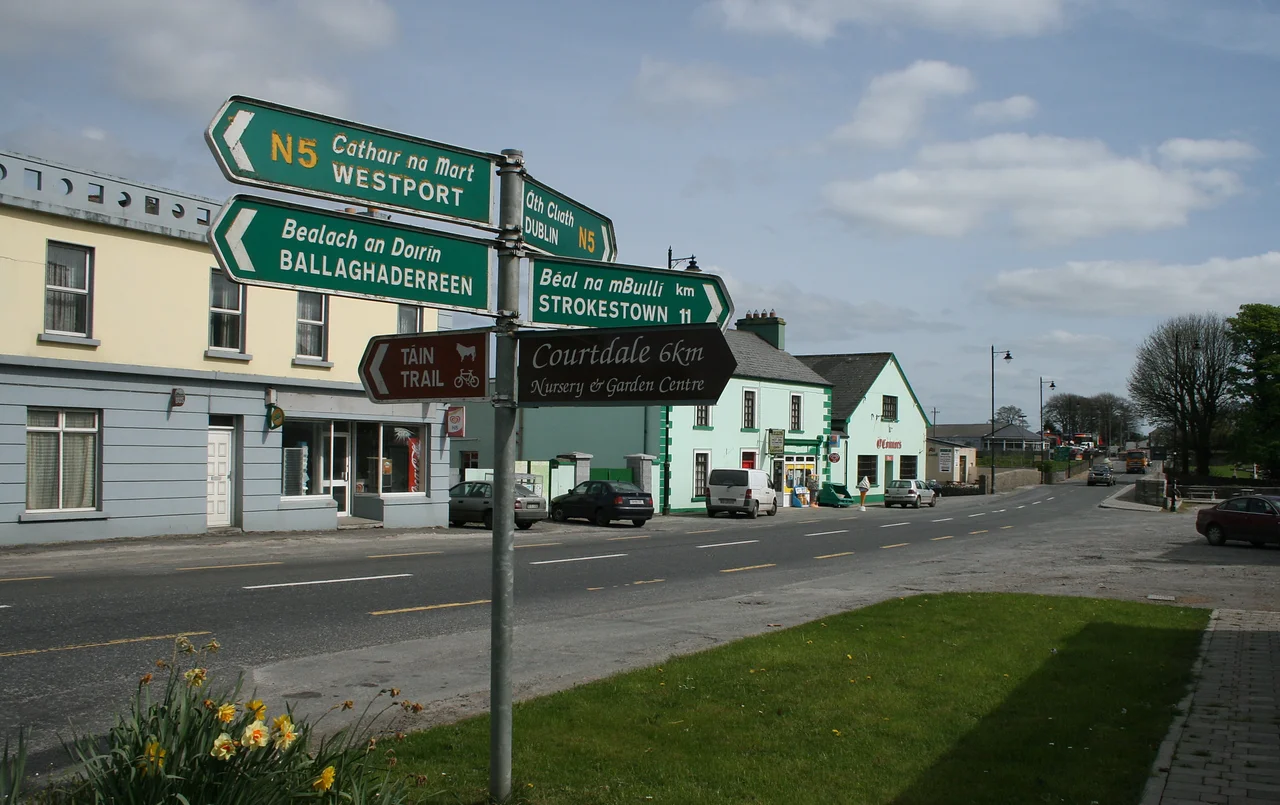

Tulsk
The Christian monks who mapped the Irish countryside drew a careful note in their margins beside one particular cave near Tulsk. Oweynagat, the Cave of the Cats - or in Irish tradition, the entrance to the Otherworld. The monks called it Hell. Modern Irish folksinger Christy Moore wrote that Tulsk itself was like hell, on the title track of his Welcome to the Cabaret album, after a gig there ended in a brawl. The villagers prefer the older association. Tulsk sits on the edge of Rathcroghan - Cruachan - the Iron Age royal complex where Queen Medb launched the Cattle Raid of Cooley, where the kings of Connacht were inaugurated, and where 60 National Monuments still mark the ground where Irish kingship was made.
Where the Kings Were Made
Cruachan was a working royal seat for at least a thousand years - from the Iron Age to the Norman invasion. The Tain Bo Cuailnge, Ireland's great epic, opens here with Queen Medb of Connacht and her husband Ailill arguing in bed over whose herd is finer. Medb sends raiders into Ulster to steal the great brown bull of Cooley, and the war that follows is Ireland's Iliad. Archaeologists from the Discovery Programme - Ireland's research institute funded by the Heritage Council - have spent two decades surveying the site. John Waddell of NUI Galway, with Joe Fenwick and Kevin Barton, published the definitive volume: Rathcroghan, Co Roscommon: an archaeological and geophysical survey in a ritual landscape. Sixty National Monuments, mounds and ringforts and a complex of ceremonial spaces, mark a landscape used and remembered for at least two and a half millennia.
Bingham's Garrison
Tulsk village grew up around a ringfort that has revealed extraordinary layers of history. Excavations between 2003 and 2009 found Mesolithic remains beneath everything - hunter-gatherer activity from before the time of Irish farming. Above that, the ringfort. Above the ringfort, a medieval castle built by the O'Conor Roe lords - the senior branch of the O'Connor kings of Connacht. Above the castle, an Elizabethan garrison fortification associated with Sir Richard Bingham, who served as Lord President of Connacht from 1584 to 1596 and was nicknamed by his Irish enemies 'the Flail of Connacht' for his brutal suppressions. The mound was raised, the ramparts thickened, the medieval tower incorporated into a Tudor military post. The archaeologists found pottery, weapons, the residue of an Elizabethan kitchen.
May Day at Rathcroghan
In 1779 the artist Gabriel Beranger travelled Ireland to paint its antiquities for the Hibernian Antiquarian Society. He passed through Tulsk on May Day and recorded a scene 'peculiar to this locality.' The local people drove all their black cattle from the surrounding plains to Rathcroghan Mound, bled them - a small incision in the neck, the blood drained into vessels - and cooked the blood mixed with oaten meal over turf fires in the open, adding onions or scallions when they could be had. This was an ancient practice: bleeding cattle for the blood's protein without killing them, mixing with oats to make a substantial food. That it was being done at Rathcroghan, on the ancient inauguration mound of the kings of Connacht, on May Day - Bealtaine, the great Celtic festival - tells you how thinly the old religion still ran beneath the Christian surface in late 18th-century rural Ireland.
Famine and Departure
In 1841 Tulsk parish had 11,101 people. Ten years later it had 6,955. By 1861 it was 5,539. By 1903, when John Redmond came to address a vast outdoor 'National Meeting' for Home Rule, the population had dropped to 3,275. The 1837 description in Samuel Lewis's Topographical Dictionary had already called the place 'an insignificant village, consisting only of a few straggling cottages and one shop' - and that was before An Gorta Mor. The famine took thousands. Emigration took thousands more. The Bianconi horse-drawn coach service stopped in Tulsk on its way between Ballina and Longford, picking up passengers heading for the coffin ships at Cobh and Galway. What travellers saw from the coach windows in those years is largely unrecorded. The locals were too busy surviving or leaving to write it down.
The Black and Tans
On 14 November 1920, during the War of Independence, the Tulsk shopkeeper George Kelly drove his truck to Roscommon town to collect goods. He was arrested at Roscommon and his vehicle taken. That night the same truck appeared at Four Mile House in the possession of RIC officers and Black and Tans. In the townland of Rathconnor, John Conry was marched from his house and shot twice in the head, twice in the chest, once in the stomach. The killing was a reprisal for the Four Mile House ambush three weeks before. Conry was one of 58 fatalities in County Roscommon between 1917 and 1921, recorded by historian Eunan O'Halpin. The RIC barracks at Tulsk had been evacuated earlier that year and burned by IRA volunteers after Easter 1920. Thomas Brady, intelligence officer of the 2nd Battalion North Roscommon Brigade, recorded laconically that 'We had no trouble in destroying it.' The Cruachan complex outside the village had been there for two and a half thousand years. The Tulsk that gathered around its rim kept making history of its own.
From the Air
Tulsk lies at 53.78°N, 8.25°W, in County Roscommon, on the N5 road halfway between Dublin and Westport, 19 km north of Roscommon town. Recommended viewing altitude 2,500-4,000 ft to take in the Cruachan/Rathcroghan archaeological landscape - the great mound is clearly visible from the air, surrounded by satellite ringforts and earthworks. Nearest airport: Ireland West Airport Knock (EIKN), 50 km west-northwest. Roscommon and Carrick-on-Shannon railway stations are each 20-30 km away.
Nearby Stories
- Boyle Abbey 2.5 km away
- Holywell ambush 5 km away
- Ahascragh 6.3 km away
- Aclare 11 km away
- Clonfin Ambush 12 km away
- Killeshandra 14 km away
- Kilbeggan Distillery 17 km away
- Annaghdown 20 km away