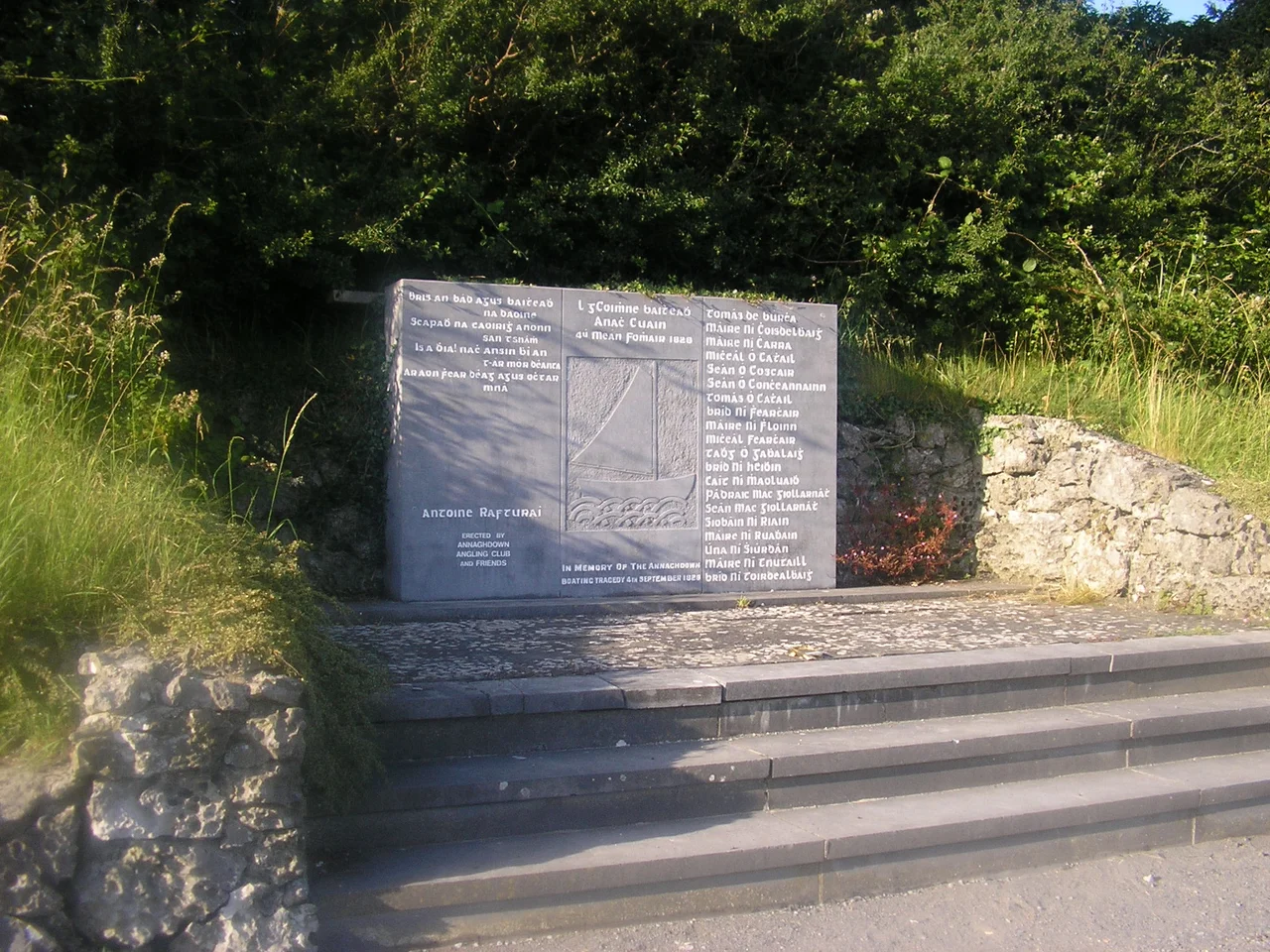

Annaghdown
On Thursday, 4 September 1828, a rotten rowing boat called the Caislean Nua set out from Annaghdown Pier on Lough Corrib carrying about thirty-one people, ten sheep, and a quantity of lumber, bound for the fair in Galway. Two miles short of the city, a sheep put its hoof through one of the planks. A passenger jammed his greatcoat against the leak and stamped on it with his foot. The plank gave way entirely. The boat sank. Twelve people were rescued. Twenty drowned. The blind poet Antoine O Raifteiri composed a lament for them - Eanach Dhuin - that is still sung at funerals in Connacht two centuries later.
Marsh of the Fort
The Irish name Eanach Dhuin means marsh of the dun or fort - the dun being the principal dwelling of a local chieftain in early Ireland. The marshlands around the chieftain's fort of Maigh Seola would have been granted as a church site sometime in the early medieval period. The earliest reliable reference is to one Ciaran of Annaghdown - distinct from Ciaran of Clonmacnoise - in a text called Comainmniguid Noem nErenn. Two later sources claim that St Brendan the Navigator was granted the site by King Aed mac Echach of Connacht, but the historian Francis Byrne argued this was unlikely given that Aed's territory of the Ui Briuin Aoi lay far away in Roscommon and the grant of distant land was not in his power. The Brendan tradition probably reflects a later attempt by the monastery at Clonfert to assert its claim on the Annaghdown church.
Cathedral and Castle
By the late twelfth century Annaghdown had a bishop's palace and a cathedral. The title Bishop of Annaghdown is documented from around 1189, when Conn O Mellaigh was one of three Irish bishops attending the coronation of King Richard I at Westminster. The O Meallaig family were the traditional hereditary churchmen of the place. Annaghdown attracted two Continental monastic orders in the early thirteenth century - the Arrouaisians and the Premonstratensians, both of whom built religious houses on the site. The cathedral's bishopric survived for centuries despite repeated attempts by the Archbishop of Tuam to absorb it. In 1485 a Papal decree formally united Annaghdown with Tuam, but the title Bishop of Eanach Duin still exists today - currently held since 2006 by Octavio Cisneros, Auxiliary Bishop of New York. The ruins of the abbey and the fifteenth-century cathedral now stand as a National Monument. Annaghdown Castle, built by the O'Flahertys in the late fourteenth century on the east shore of Lough Corrib, has been restored and still stands.
September the Fourth, 1828
The Connacht Journal reported that the Caislean Nua was 'in such an unsound state as to render her unfit for the passage.' The Galway fair was on, and the boat was overloaded for the journey down Lough Corrib. The sheep, the lumber, the thirty-one people - and a plank already weakened. When the sheep's hoof went through, a passenger named only as 'one of the passengers' tried to stop the leak with his greatcoat, an act of practical desperation. His stamp finished the job. The boat went down opposite Bushy Park, within sight of Galway. Eighteen bodies were taken from the lake that day. Two more were found later. Major Dickson and a party of the 64th Regiment rendered every humane assistance. An inquest before John Blakeney, Coroner, with James O'Hara MP and Mayor J. H. Burke in attendance, returned a verdict of accidental drowning.
John Cosgrove's House
John Cosgrove was a lime-burner by trade. When the Caislean Nua went down he saved two women from the water. Trying to save a third, he was drowned. The remains of his house - Teach Chosgardha - can still be seen on what was once the Blake estate. The Connacht Journal listed the dead by name, which is worth doing again: Bridget Farragher, Mary Costello, Judith Ryan, Bridget Hynes, Mary Newell, Winifred Jourdan, Mary Flynn, Bridget Curley, Catherine Mulloy, Mary Carr, Michael Farragher, Michael Cahill, John Cosgrove, John Concannon, Thomas Burke, Patrick Forde, John Forde, Timothy Goaley. Thomas Cahill and Mary Ruane were found later. Twenty in total. Raifteiri's poem counted nineteen, an error of one. A memorial stone was erected at Annaghdown Pier in 1978 by the Annaghdown Anglers Club, on the 150th anniversary.
The Lament
Antoine O Raifteiri - blind poet, traditionally called the last of the wandering Gaelic bards - composed Eanach Dhuin as a keen for the dead. The poem survives in oral tradition and in printed collections. Its rhythm is the rhythm of an Irish lament, slow and circling, naming the dead and asking how God could permit it. It is still sung. Dick Farrelly, the Irish songwriter best remembered for 'Isle of Innisfree' from the John Ford film The Quiet Man, also wrote a song called 'Annaghdown.' The Annals of Inisfallen note in 1044 that Aed the anchorite rested in Enach Duin. The Annals of the Four Masters record in 1411 that the monastery was burned. Eight hundred years of names in the annals; twenty more names added on a September morning when a sheep put its foot through a plank.
From the Air
Annaghdown sits at 53.39 N, 9.07 W on the east shore of Lough Corrib in County Galway, about 12 km north of Galway city. Galway Airport (EICM) is roughly 8 km south-east; Shannon (EINN) about 65 km south. The dominant visual feature is Lough Corrib itself - the second-largest lake in Ireland, stretching north-west from Galway city. Annaghdown lies on a bay along its eastern shore. The cathedral and abbey ruins, with the restored castle on the lakeshore, are visible features in good light. Best viewed in clear westerly conditions; the lake often holds mist.
Nearby Stories
- Inis Oirr 3.9 km away
- Milltown, County Galway 4.2 km away
- Kilmacduagh Monastery 6.4 km away
- Ahascragh 8.9 km away
- Acadamh na hOllscolaíochta Gaeilge 12 km away
- Roscommon 17 km away
- Croagh Patrick 20 km away
- Lorrha 21 km away