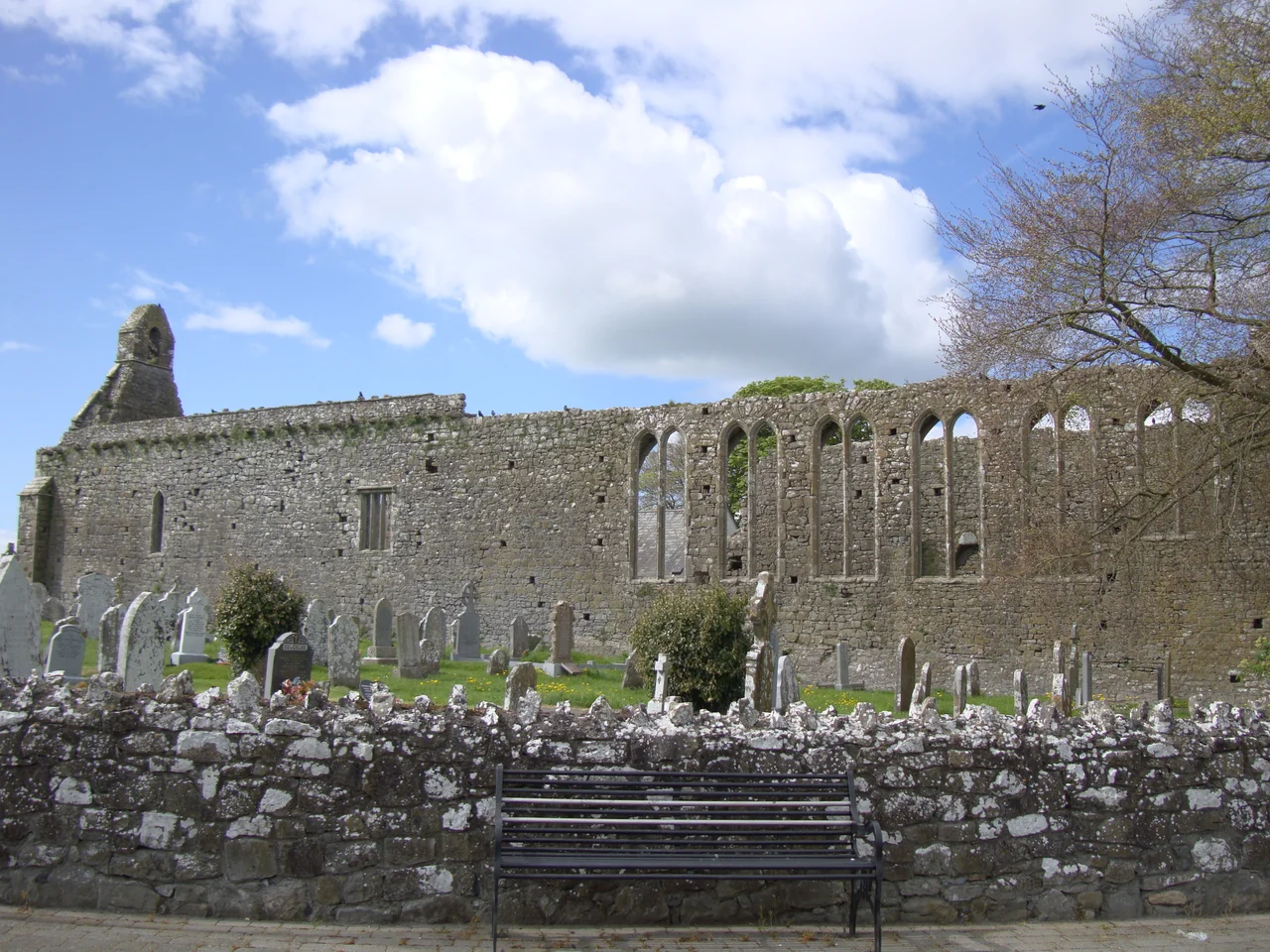

Lorrha
In an alcove of a stone wall in Lackeen Castle, a Norman keep just outside the small Tipperary village of Lorrha, a manuscript lay hidden for centuries. It was an early medieval missal - a book containing the prayers and chants of the Mass - written in Latin and Old Irish, illuminated in the spare confident style of ninth-century Irish monks, and at some point during the religious turmoil of the seventeenth century walled up by the Kennedys of Lackeen for safekeeping. In the eighteenth century it was found again. It is now called the Stowe Missal and is the oldest surviving complete Latin liturgy from Ireland, perhaps from anywhere in the Latin West. It was made at Lorrha.
The kingdom of the deer
Long before the Stowe Missal was written, Lorrha was a monastic settlement of the kingdom of Síol Anmchadha. The monastery was founded in the sixth century by Ruadhán of Lorrha - born Ruadán mac Fergusa Birn, later canonised - one of the so-called Twelve Apostles of Ireland trained at Clonard Abbey under St Finian. Ruadhán's monastery lasted; the Annals of Inisfallen record the deaths of its abbots through three centuries: Colmán in 707, Dúngal in 747, Ailill in 780, Coibdenach the learned in 809. The 1015 entry, the vacating of Imlech Ibuir, and the invasion of Lothra, marks the kind of upheaval that the annalists noted in clipped Latin and never explained. Two eighth-century high crosses still stand in the churchyard - weather-worn now, their original carvings only just legible - on the site where Ruadhán's first wooden church once stood.
843: Turgesius comes upstream
In 843 a Norse expedition led by Turgesius - or Turgéis in the Norse, Thorgest probably in his original tongue - raided Lorrha and the neighbouring monastery at Terryglass. Turgesius had come up the Shannon system with his ships, exploiting the fact that the great Irish river was navigable far inland, and had begun systematically attacking the monasteries that clustered along its banks. The wealth in those monasteries - gold and silver liturgical vessels, illuminated books, the worked metalwork of the early Irish church - was famous and portable. What the Norse stole from Lorrha and Terryglass that year is lost; what survived survived by being hidden. The Stowe Missal, made in this monastery around the time of the Norse raids, may have been carried away into hiding to escape just this kind of expedition.
Walter de Burgh, the Dominicans, and the Augustinians
In the thirteenth century, after the Anglo-Norman invasion, Walter de Burgh, Earl of Ulster, founded a Dominican Friary on the south side of Lorrha. Its ruined nave, 120 feet long and 24 wide, still stands - the west gable's Gothic window held up to a considerable height above the original roofline, the east gable mostly fallen. A nearby Augustinian Abbey, also twelfth century, founded by the Order of Canons Regular, lies to the north of the village, with a carved head over its door thought to represent Walter de Burgh's wife. The Augustinians took their drinking water from St Ruadhan's well, which still flows south of the road past the Church of Ireland cemetery. Two religious orders, one small village, both of them in ruins now but legibly so.
What Cromwell may have done
Local tradition holds that Cromwell's army visited Lorrha in 1650 and committed sacrilegious acts in the abbey - that broken crosses still standing in the churchyard date from that visit, that the abbey was unroofed and burned, that the abbey's silver bell-clapper was carried away to a neighbouring gentleman's house for safekeeping where it was somehow replaced with one of baser metal. The historian who recorded this in the nineteenth century was sceptical: the abbey shows fire damage on its east end, he noted, but the building must already have been roofless before Cromwell's time, because tradition would not so quickly have forgotten when it was destroyed. The Cromwellian story, like much of Irish memory about that decade, may be more legend than fact - but the bell-clapper detail, with its mournful specificity, has the weight of something that happened to someone in the year it happened. Cromwell's reputation in rural Ireland was earned, but not every burning church can be blamed on him personally.
Martin O'Meara of Sharragh
On 9 August 1916, near Pozières on the Somme, Sergeant Martin O'Meara of the 16th Battalion, Australian Imperial Force, was awarded the Victoria Cross for repeatedly going out under fire to bring in wounded soldiers and ammunition over four consecutive days. O'Meara had been born in 1885 in Sharragh, a townland of Lorrha, and had emigrated to Western Australia some years before the war. He survived the action, survived the war, returned to Australia in 1918 - and was admitted to Claremont Hospital for the Insane on his return with what would now be called severe post-traumatic stress disorder. He never recovered and died in 1935, having spent the last seventeen years of his life institutionalised. The Victoria Cross he won is held by the Army Museum of Western Australia in Fremantle. A small Tipperary village produced him; an Australian battle nearly killed him; an Australian asylum eventually outlived him.
What you see today
Lorrha is small - a handful of houses, two churches (Roman Catholic and Church of Ireland), a pub, a national school. The Roman Catholic Church of St Ruadhan, dating from around 1912, sits on the main road. The Church of Ireland church stands on the site of an earlier church built around 1000 AD on the site of St Ruadhan's original abbey. The Dominican Friary ruins, the Augustinian Abbey ruins, the two high crosses, the holy well, the Norman Lorrha Castle, and Lackeen Castle in the same parish - where the Stowe Missal was hidden - are all within a few minutes' walk or drive. The village lies five kilometres from where the River Shannon enters Lough Derg, and the Ormond Way long-distance walking route, part of the Beara-Breifne Way from County Cork to County Cavan, passes through here. It is one of the most concentrated sites of early medieval Christianity in Ireland, in a village most people drive past without stopping.
From the Air
Lorrha sits at 53.083°N, 8.117°W in the northern tip of County Tipperary near the borders of Galway and Offaly. Best cruise altitude 2,000-3,500 ft. The Shannon River and Lough Derg are 5 km west; the M6 motorway is further north. The village is small but identifiable by its two churches and the surrounding abbey ruins. Portumna Bridge (1911) crosses the Shannon nearby. Nearest airports: Shannon (EINN) ~50 km southwest, Birr (private) ~20 km east, Knock (EIKN) ~80 km north. The Shannon-Lough Derg corridor is the dominant landscape feature.
Nearby Stories
- Siege of Bunratty 4.2 km away
- St Stanislaus College 4.8 km away
- Gort 7.7 km away
- Newport, County Tipperary 10 km away
- Kinnitty Castle 12 km away
- Kilcooly Abbey 13 km away
- Durrow Abbey 16 km away
- 126 Artist-run Gallery 17 km away