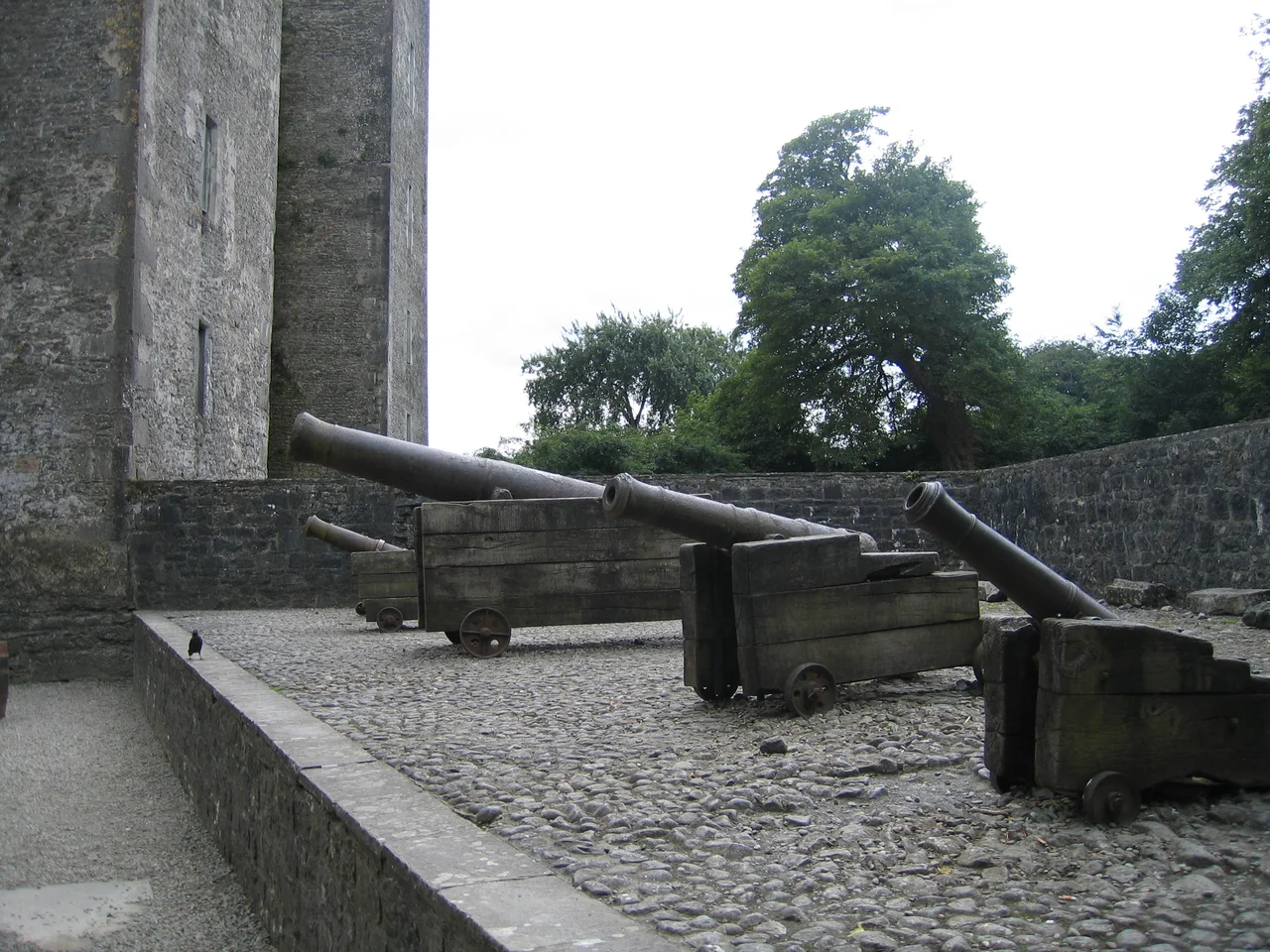

Siege of Bunratty
Cardinal Rinuccini, the papal nuncio sent to bolster Catholic Ireland's war effort, called Bunratty Castle 'the loveliest of any place of any kind that I have yet seen in Ireland, worthy of a king, with gardens the likes of which put Italy's to shame.' He was not exaggerating to flatter his hosts. In 1646 the Norman tower that still stands on the Shannon Estuary was surrounded by formal gardens, salt marsh, and ornamental ponds, and held by one of the wealthiest men in Ireland. Within months of Rinuccini's admiring note, the same gardens would be cratered by demi-culverin fire, the same castle bristling with English Parliamentary musketeers, and a Confederate Catholic army of thousands camped on the hill above. The siege of Bunratty turned a private paradise into a battlefield of the Irish Confederate Wars - and reshaped, briefly, the strategic calculus of the entire Wars of the Three Kingdoms.
An Earl Caught in the Middle
Sir Barnabas O'Brien, 6th Earl of Thomond, owned Bunratty in 1646 and held more than 120,000 acres besides. Educated at Oxford, raised under the eye of Queen Elizabeth I, married to an English noblewoman, he was a Protestant in a Catholic country and an Irish lord in an English court. When rebellion broke out in 1641 he tried, almost impossibly, to remain neutral. He refused to sign the Catholic Confederates' Oath of Association, which alienated his Catholic relatives, including his powerful nephew Donough McCarthy, Viscount Muskerry. Yet he also failed to arm his Protestant tenants, which alienated his Protestant allies. By spring 1646 his cousin Murrough O'Brien - Lord Inchiquin, now Parliament's President of Munster - and his English wife persuaded him to hand Bunratty over to an English Parliamentary garrison. He could be neutral no longer. The castle changed hands without a battle, and the war came to find it.
Penn's Fleet on the Estuary
On 11 March 1646, seven English Parliamentary frigates and a heavy barge anchored in the Shannon Estuary off Bunratty. They carried 700 soldiers and were commanded at sea by William Penn - father of the William Penn who would later found Pennsylvania - and on land by Colonel John MacAdam. The strategic logic was sharp. The Confederate Catholic Council at Kilkenny was assembling 6,000 troops to send to England in support of King Charles I, who was losing the English Civil War. Threatening Limerick from a forward base at Bunratty would force the Confederates to divert those troops away from the king and toward the defence of Munster. The Parliamentarian Lord Broghill noted with satisfaction that 'the progress of our designs in the River of Lymerick have not only diverted a supply of six thousand from going to the King, and ready to be shipped at Waterford, but also ruined their projects upon us.' The siege of Bunratty was, in part, a feint - but a feint that grew teeth.
Spring and Early Summer
The Confederate response came quickly and clumsily. On 1 April 1646 the Earl of Glamorgan's forces - 120 horse, 300 foot - rode up to Bunratty, set fire to some houses on the edge of the village, and were promptly routed by an English cavalry sortie under Captain Vauclier. Eighty Irish soldiers died on the spot; Captain McGrath was captured alive. That afternoon Penn's troops marched on the Confederate camp at Sixmilebridge, drove 1,400 men out of their works, and returned with 250 barrels of oatmeal that fed the garrison for six weeks. It was an embarrassing opening for the Confederates. By 22 May, more disciplined Irish troops under Viscount Muskerry had taken the hill north of the castle and crept their saps - using fascines for cover - to within carbine range. The English sallied out on 24 May, briefly captured the position, then were driven back by Irish cavalry. Trench warfare in slow motion, with cannon fire on both sides.
The Summer the Walls Closed In
Through June the siege tightened. The level ground north of the castle initially favored the English cavalry, and Muskerry, short of money, came close to dispersing his army. But the relief operations that were supposed to break the siege failed one by one. Sir Charles Coote attempted to march from Connacht to relieve Bunratty but turned back, contenting himself with burning crops around Portumna and Loughrea. Lord Inchiquin raided into County Limerick to draw Muskerry off, but Confederate forces under Castlehaven shadowed him and held him in check. On 1 July, while Irish cannon hammered the little outwork called Jefford's House, Colonel MacAdam - the English land commander - was killed. A Welsh deserter carried the news to the Irish lines. According to Penn, the besiegers shouted across to the English defenders, telling them to 'get a better commander.' On 6 July the Irish stormed Jefford's House, were thrown back, and dug in for another assault.
The Surrender
By mid-July the geometry had changed. Irish cannon, now firing from the shore, were striking the English ships at anchor. Penn's flagship was holed. The fleet had to drop down the estuary, beyond cannon range - and once the fleet went, the castle could not hold. Inside the walls roughly 300 serviceable men remained, the rest killed or maimed in three months of fighting. On 13 July 1646 the Parliamentary garrison surrendered. Penn called the terms 'so mean, and so far beneath the honour of a soldier, that I should never have consented thereunto.' But there was nothing else to do. The English marched out with their officers' swords and their lives, leaving cannon, horses, arms, ammunition and provisions behind. The captured English banners were carried in triumph to Limerick and displayed alongside those captured from the Scots at Benburb a month earlier. The loveliest castle in Ireland was Irish again.
What Remained
The siege was a Confederate Catholic victory, but the war that contained it was already turning against them. Within four years Cromwell's New Model Army would be in Ireland, and the cycle of Irish dispossession would reach a new and terrible peak. Bunratty Castle survived, fell into ruin, and was magnificently restored in the 1950s by Lord Gort, who filled it with medieval furniture and surrounded it with a folk park. Tourists today walk the great hall where Rinuccini was entertained, climb the spiral stairs to the battlements, and see the broad estuary where Penn's frigates anchored almost four centuries ago. The salt marsh and the river are still there. The cannon are gone.
From the Air
Bunratty Castle stands at 52.70 degrees north, 8.81 degrees west on the north shore of the Shannon Estuary, roughly 13 km east of Shannon Airport (EINN) and 14 km west of Limerick. The castle is clearly visible from low-altitude approaches along the estuary - the river Ralty meets the Shannon at its base, and the salt marsh that protected it in 1646 is still distinguishable in winter. The Cliffs of Moher are 70 km northwest; Galway Bay opens 60 km north.
Nearby Stories
- Abbey of Woney 1.4 km away
- Dysert O'Dea Monastery 6.1 km away
- Siege of Carrigafoyle Castle 8.6 km away
- Kilflynn 9.7 km away
- Carrigeenamronety Hill 9.8 km away
- Inis Beag 17 km away
- Charleville 19 km away
- Borrisokane 23 km away