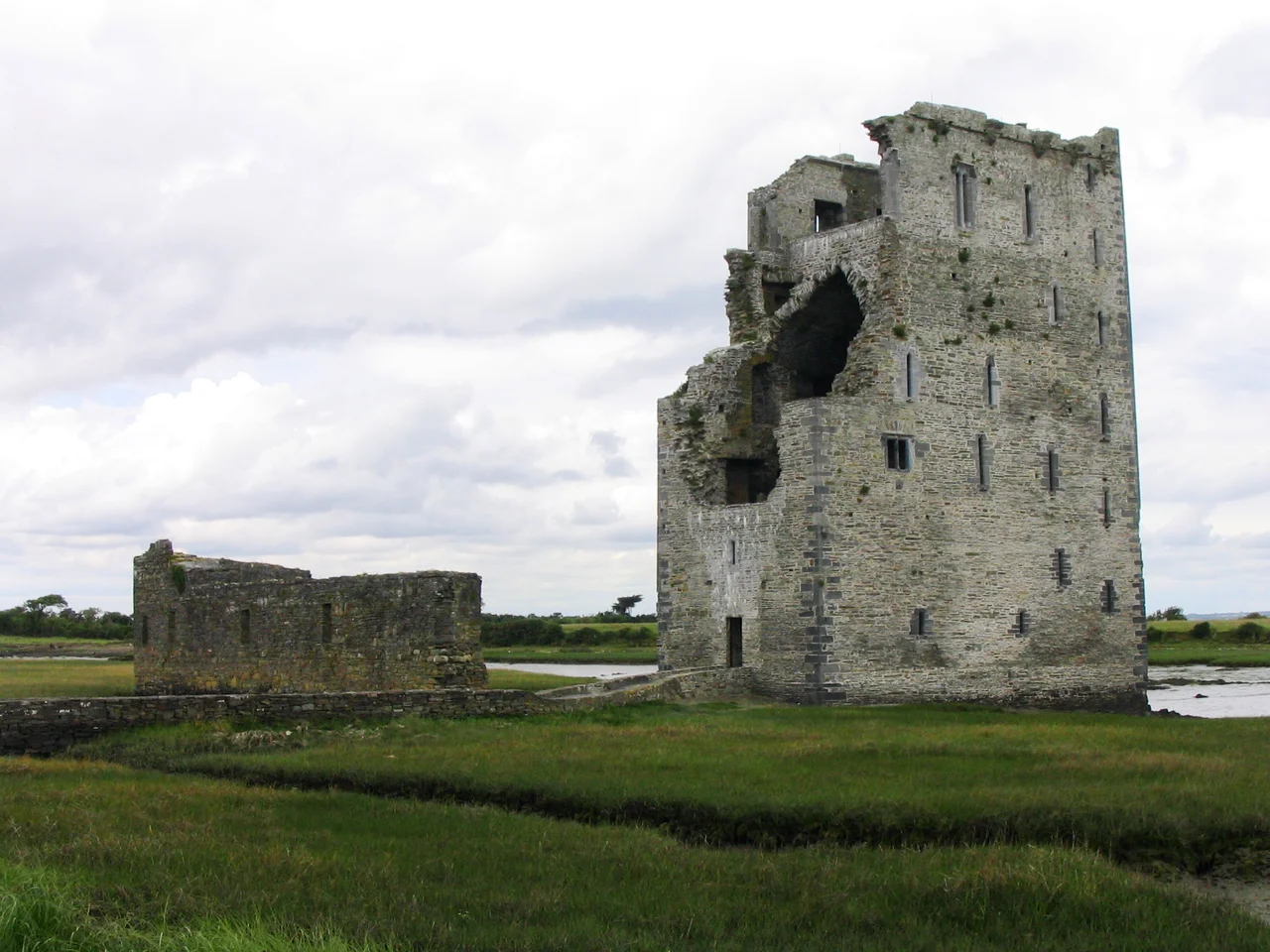

Siege of Carrigafoyle Castle
It was Holy Week 1580 when the largest army Ireland had ever seen in its west camped at the foot of a small fortress on the Shannon estuary. Carrigafoyle Castle - 'the rock of the hole', in Irish - was known as the guardian of the Shannon, the tower that controlled the shipping lanes feeding Limerick twenty miles upriver. It was held that Easter by fifty Irish soldiers, sixteen Spanish halberdiers, an Italian engineer named Julian who was still finishing the defences, and an unspecified number of women and children sheltering inside its walls. Two days of bombardment later, almost none of them were alive. The siege of Carrigafoyle is remembered today as one of the most brutal episodes of a brutal war, and the ruins of the tower - smashed open on its west side as if struck by lightning - still stand on the bay where they fell.
The Tower
Conor Liath O'Connor-Kerry built Carrigafoyle in the 1490s and it was, for its time, an extraordinary piece of military engineering. The tower-keep stood 86 feet high on a rock in a small bay shielded from the Shannon estuary by a wooded island. The castle was surrounded by a double defensive wall, with an inner enclosure called a bawn and an outer moat covered on three sides by another wall - a moat large enough at high tide to hold a 100-ton ship. The sides of the rock itself had been faced with brick and mortar to make them unscalable. By any reasonable medieval standard, it was nearly impregnable. The 16th century, unfortunately for the people inside, was not a medieval standard. Naval cannon had become heavy enough to crack stone walls. The age of the impregnable tower was ending, and the people inside Carrigafoyle were about to find out.
Why Easter 1580
Carrigafoyle was held for Gerald FitzGerald, the 14th Earl of Desmond - the man whose rebellion against Elizabeth I had set Munster on fire. The Second Desmond Rebellion was a Catholic uprising against the Protestant English crown, supported by Spain and the Pope. In 1579, a small force of Spanish and Italian soldiers had landed at Smerwick on the Dingle Peninsula under the auspices of a Papal expedition, intending to support Desmond. Sixteen of those soldiers ended up garrisoning Carrigafoyle. The Earl of Desmond's wife, Eleanor, had personally directed the strengthening of the castle's defences, hiring an Italian military engineer named Julian to perfect the works. By Easter 1580, Eleanor had withdrawn to her husband forty miles away at Castleisland. Julian stayed behind. He would die for it.
The Largest Army
Sir William Pelham, the English Lord Justice of Ireland, marched into Munster with Sir George Carew and an army that grew, by the time it reached Carrigafoyle, to roughly 700 men - the largest force the west of Ireland had ever seen. Sir William Winter, the Tudor naval commander, brought three three-masted warships into the Shannon estuary and anchored offshore. The fleet supplied Pelham with three demi-cannon and a culverin - a huge naval gun firing relatively small shot with high velocity. Naval gunners, expert at the close-quarters destruction of ships, manned the guns. The English camped to the southwest of the castle and ranged their cannon along a low wall a hundred yards from the outer wall of Carrigafoyle. A company of foot soldiers with lances was stationed at the northern end of the wall to cut down anyone fleeing through the water.
Palm Sunday
The bombardment began on Palm Sunday and continued for six hours. The Spanish halberdiers - professional infantry from continental Europe, named for the polearm they carried - held the walls. When Pelham ordered an assault party against the sea-wall, the attackers were pinned down by gunfire from the battlements and pelted with boulders dropped from above. They threw up assault ladders. The Spaniards pushed them away. The contemporary observer Thomas Butler, 10th Earl of Ormond - an Anglo-Irish lord fighting for the crown - described seeing the sea-channel filling with wreckage as the rock face of the castle became slippery with the blood of attackers and defenders alike. A ricocheting shot hit Pelham himself. The defenders on the walls jeered at him from above. The English commander did not pause the guns. The cannon kept firing for six hours, and the second day was coming.
The Wall Falls
On Easter Monday, Pelham reinforced his troops with men from Winter's ships and ordered a final assault against the part of the tower furthest from the cannon, where the surviving defenders had retreated. After two or three more shots, the great west wall of Carrigafoyle cracked at its foundations and collapsed inward. Many of the people inside - soldiers, women, children, perhaps Julian's apprentices - were crushed under the falling masonry. The survivors fled out into the shallow waters of the bay. Most were shot or run through by the waiting lancers as they tried to wade away. The rest, including one woman whose name was not recorded by the English, were taken back to the English camp and hanged from trees. Captain Julian, the Italian engineer who had built the defences he died defending, was hanged three days later. The Annals of the Four Masters, the great Irish chronicle compiled in the 1630s, recorded these deaths in language that pulled no punches: no quarter was given, and a Catholic stronghold had been turned into a slaughterhouse over a long weekend in spring.
The Castles That Surrendered Themselves
Word of Carrigafoyle travelled at the speed of horses, and the speed of horses was fast enough. The Desmond castle at Askeaton was abandoned within days; its Spanish defenders blew up the walls rather than face Pelham's guns. The garrisons at Newcastle West, Balliloghan, Rathkeale, and Ballyduff slipped away into the countryside. The defensive geometry of Munster - the network of tower houses that had held the country for the Geraldines for two centuries - effectively dissolved in a fortnight. The rebellion did not end. The Earl of Desmond and his surviving followers shifted to guerrilla warfare in the hills and bogs, and the war ground on for three more years. Desmond himself was finally killed at Glanageenty in the Slieve Mish Mountains near Tralee in November 1583, hunted down by men from a rival Irish family. The crown's victory was total. So was the destruction. Most of Munster lay devastated by the war's end, with famine following the armies through the burned countryside.
What Remains
Carrigafoyle Castle was never repaired. The English saw no reason to rebuild what they had spent so much effort to destroy; the Irish had no Earl of Desmond left to spend resources on it. The tower stood through four hundred years of weather and indifference, the gash in its west wall slowly weathering into something that looks almost like a natural feature of the landscape. The west wall has been partially reconstructed in modern times to the height of the first floor for safety reasons, but the rest of the tower is genuinely as the English cannon left it. The outer defensive walls survive. The moat survives. From the upper windows the Shannon estuary still opens westward toward the Atlantic. Ballylongford lies a kilometre or so inland. The people who died here - Irish, Spanish, Italian, men and women and children, military and not - are not individually named in most accounts, but they were people, and they died because they had taken refuge in a building they had reason to believe was safe. It wasn't.
From the Air
Carrigafoyle Castle stands at 52.569°N, 9.495°W on a small inlet of the Shannon estuary about 1.5 km north of Ballylongford in north Kerry. From the air, look for the prominent tower-house ruin on its rocky base, with the broad sweep of the Shannon estuary opening to the north and west. Kerry Airport (EIKY) is 35 km south. Shannon Airport (EINN) is 25 km northeast across the estuary. The mouth of the Shannon at Loop Head is 25 km west. Best viewing altitude is 2,000-3,500 feet to take in the castle ruin, the wooded island that once shielded the bay, and the estuary itself. The land around is flat agricultural country with small fields and the village of Ballylongford to the south.
Nearby Stories
- Abbeydorney 3.8 km away
- Dysert O'Dea Monastery 5.7 km away
- Burren and Cliffs of Moher Geopark 14 km away
- 1961 President Airlines Douglas DC-6 crash 14 km away
- Ballynavenooragh 19 km away
- Dromagh Castle 30 km away
- RMS Carinthia (1925) 46 km away
- Conor Pass 52 km away