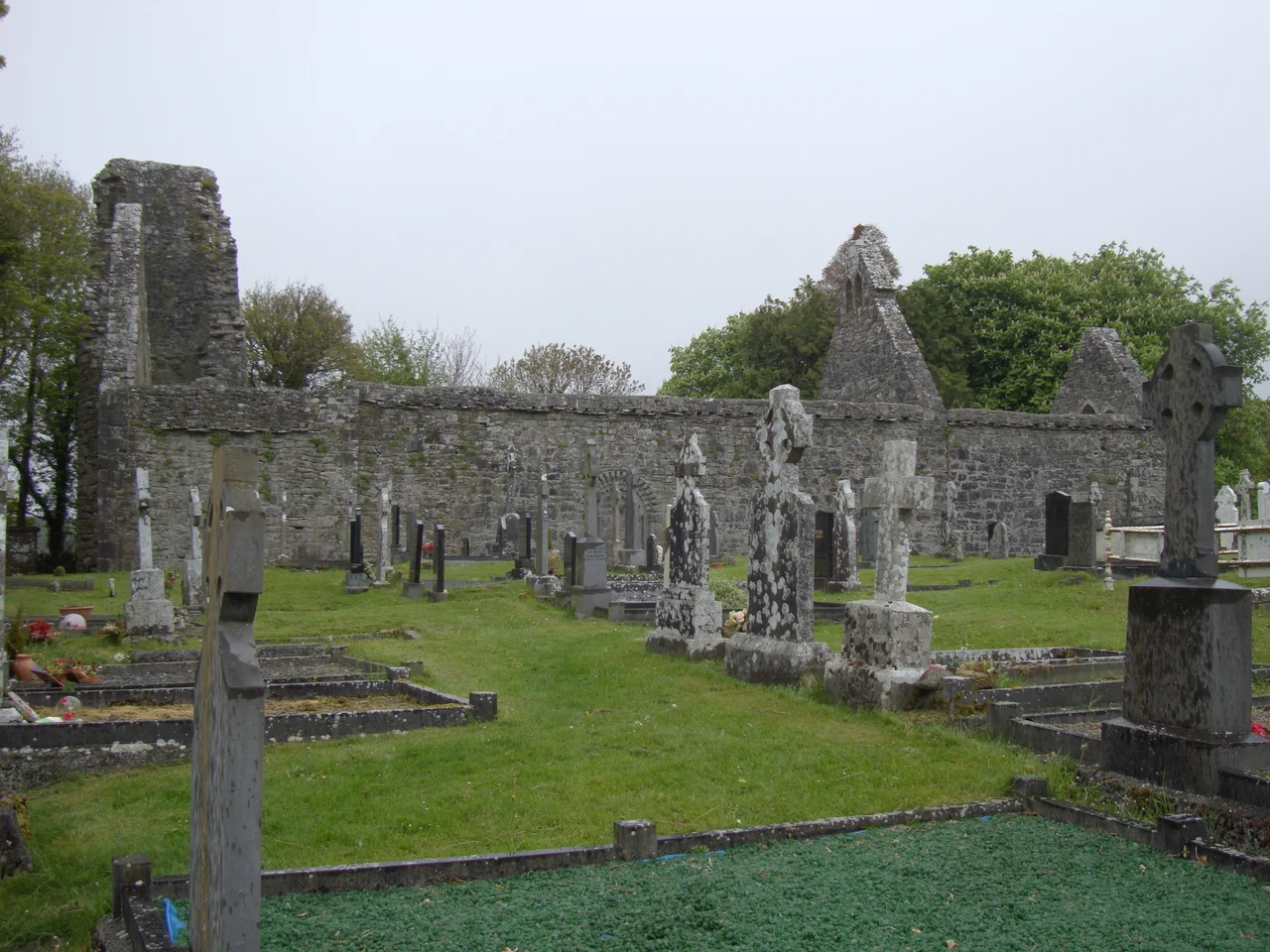

Dysert O'Dea Monastery
In 1651, a Cromwellian artillery crew set up cannons within range of a tower they did not understand, and opened fire. The round tower at Dysert O'Dea - built in the late 11th century, originally about thirty metres tall - had been converted into a fortification a century earlier by some now-unknown defender. The cannon fire shattered most of it. Only the lower third still stands today, a stump of fitted limestone next to the ruined church it once announced from across the surrounding plain. The Cromwellians had no particular grudge against the hermitage of an 8th-century saint named Tola. They simply objected to any tower that looked defensible.
The Hermitage of Tola
Dysert O'Dea - from the Irish Díseart Uí Dheá, "the hermitage of Deá" - lies near Corofin in County Clare. The site is thought to have been founded in the 8th century by St. Tola, an Irish monk who established a small religious community here in the centuries when Irish monasticism was the most vital intellectual movement in Western Europe. "Dysert" comes from the Latin desertum - the desert places where early Christian hermits withdrew to pray. The Irish disert was the same idea adapted to a wetter geography: an isolated spot a day's walk from the nearest village, where a holy man could live simply and a small community could grow around him. By the 12th century, Tola's hermitage had become a properly established monastery.
The Romanesque Church
Most of what survives at Dysert O'Dea above the foundations is 12th-century work. The ruined church measures over 30 metres long and is built in the Romanesque style that swept Ireland in the 12th century as the country reformed its monastic structures along continental European lines. The most striking feature is the south doorway: a Romanesque arch carrying twelve human heads and seven animal heads carved into the surrounding stone. The faces stare out at every angle, and no two are quite the same. The early 13th century added lancet windows to the east gable. Inside the church is the grave of Joan O'Dea, wife of the last clan chieftain Michael O'Dea, with a stone dating to 1684. By the time Michael O'Dea buried his wife here, the church was already centuries out of use.
St. Tola's Cross
Beside the church stands St. Tola's High Cross, a 12th-century carved limestone cross that ranks among the finest medieval Irish high crosses. Cromwellian soldiers knocked it over during the 1651 campaign. Michael O'Dea repaired it in 1683. Because he used stones from the church to build a new pedestal, scholars have inferred that the church itself must already have fallen into disuse by then - O'Dea would not have cannibalised a working building. The Synge family, local landlords through the 19th century, restored the cross again in 1871. In 1960 the cross was dismantled temporarily and shipped to Barcelona for an exhibition on Irish art - a fragile thousand-year-old monument crossing the Bay of Biscay so that Spanish gallery-goers could see what the Atlantic edge of medieval Christendom had produced.
The Battle of 1318
Not far from the monastery, in May 1318, the Battle of Dysert O'Dea reshaped Irish history. The Anglo-Norman knight Richard de Clare led a force from the de Clare colony in Thomond against Conor O'Dea and his Gaelic allies, principally the Uí Briain dynasty under Murtagh O'Brien. The Irish prepared an ambush. De Clare's army was destroyed; Richard de Clare himself was killed. The defeat broke Anglo-Norman power in Thomond effectively for two and a half centuries, until the Tudor reconquests finally pushed the Gaelic order out in the 16th century. The Dysert O'Dea Archaeological Trail today links the monastery to the battle site, to the O'Dea Castle (also known as Dysert O'Dea Castle), to two ring forts, to a fulacht fiadh cooking pit, and to the ruins of Synge's Lodge - the Victorian guest house whose Synge coat of arms and motto Caelesta canimes still survive over the doorway, even though the house itself has fallen in.
The Bell That Bought a Bell
In 1790, someone discovered an old bronze bell at Dysert O'Dea. The bell - a medieval Irish hand bell of the type that monks once rang from the round tower at canonical hours - was taken to Corofin, sold, and the proceeds used to buy a new bell for the parish church. There is something perfectly Irish about this transaction. A millennium of liturgical use ends not in a museum but in a small commercial exchange between one parish and another. The Synge family undertook various repairs to the round tower in the 1850s. The site has been designated a National Monument of Ireland and is open to visitors year-round, though the gate is sometimes ajar and sometimes shut depending on the season. The hermitage Tola founded in the 8th century still does what monasteries were always good at doing: outlasting the people who tried to destroy them.
From the Air
Coordinates 52.91°N, 9.06°W. Dysert O'Dea sits in open Clare countryside near Corofin, 13 km north of Ennis. Shannon Airport (EINN) is 28 km south. From altitude the site appears as a small cluster of stone ruins - the partly demolished round tower, the roofless church, the high cross, and the nearby O'Dea Castle (a separate complete tower house 1 km away) - set in green pastoral fields. The Burren limestone country begins a few kilometres north, marked by paler exposed rock. Best viewed from 1,000-2,000 ft AGL in clear weather; the round tower stump is the most identifiable feature.
Nearby Stories
- Newport, County Tipperary 3.4 km away
- Shannon Airport 4.5 km away
- 126 Artist-run Gallery 5.9 km away
- Acadamh na hOllscolaíochta Gaeilge 7.1 km away
- Inis Beag 7.1 km away
- Battle of Aughrim 9.1 km away
- Kilkee 12 km away
- Portumna 18 km away