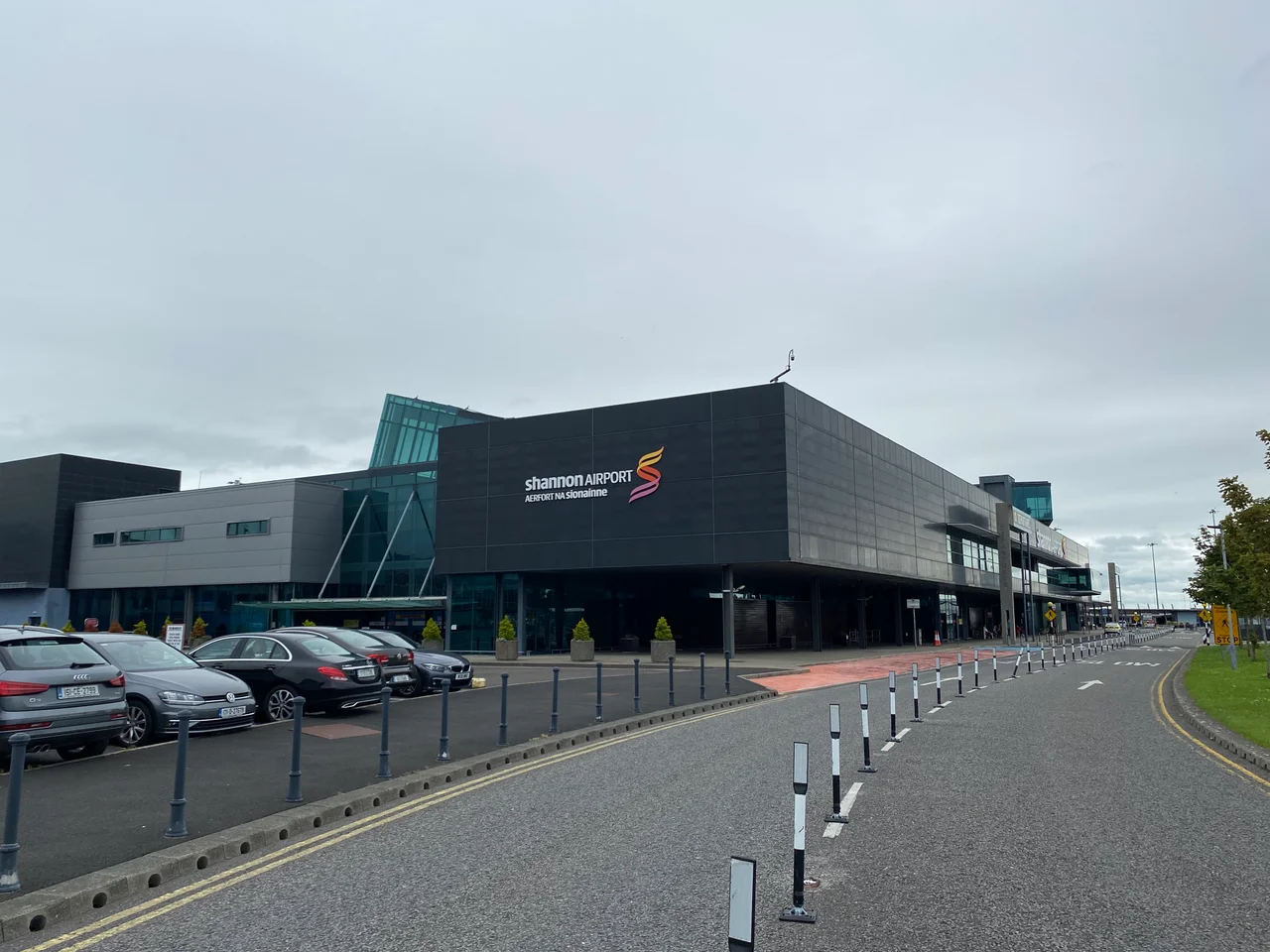

Shannon Airport
Brendan O'Regan invented the duty-free shop here. Boris Yeltsin failed to get off his plane here. NASA wrote a letter, in 1995, asking whether the Space Shuttle might land here in an emergency - and were politely told that, under international treaty, Ireland could hardly refuse. Shannon Airport sits on land that began the twentieth century as bog. Drained, levelled, and stretched into the longest runway in Ireland, it became one of the most consequential airfields in the early history of transatlantic flight: the last fuel stop before the ocean, the first piece of European soil after one, and an Atlantic-edge invention factory whose ideas - duty-free retail, U.S. border preclearance, neutral-country military stopovers - rippled outward and changed how the world flies.
From Bog to Runway
In the late 1930s the Atlantic was crossed mostly by flying boats, and a flying boat terminal already existed on the south side of the Shannon Estuary, at Foynes. But the men planning aviation's future could see that land planes were coming, and land planes needed runways. The Irish government chose a 3.1-square-kilometre site at Rineanna, opposite Foynes. The ground was wet and boggy. Drainage works began on 8 October 1936. By July 1939 a Sabena Savoia-Marchetti S.73 from Brussels, via Croydon, became the first commercial aircraft to use the new airfield. Then the war came. The airport carried on. In February 1942, BOAC began scheduled service to Bristol, providing a land-plane connection between England and the still-operating flying boats at Foynes. That August, Aer Lingus added Dublin. The bog had become Shannon Airport.
The Atlantic Bridge
When the war ended in 1945, Shannon's runways were extended, and the airport stepped into the role it had been built for. On 16 September 1945 a Pan Am DC-4 made the first transatlantic proving flight, landing at Shannon from Gander, Newfoundland. The first scheduled transatlantic land-plane service followed weeks later: an American Overseas Airlines DC-4 named Flagship New England, flying New York to London via Gander and Shannon. Two years later, in 1947, Shannon did something stranger and more lasting. Brendan O'Regan, the airport's catering boss, persuaded the Irish government to pass the Customs Free Airport Act - creating, at a stroke, the world's first duty-free airport. International passengers could now buy whiskey and tweed without paying tax on either. The idea was so good that it eventually escaped Ireland and conquered every airport terminal on earth.
The Stopover Era
For thirty years Shannon was a compulsory stop for transatlantic flights from Dublin - a policy meant to spread the economic benefits of aviation across Ireland's western counties. Travelers came to know its terminal corridors and its long final approaches over the estuary; airlines came to know its long, capable runway. By the 1960s, Shannon was a hub of refuelling activity for piston- and early jet-era Atlantic crossings. The mandatory stopover loosened gradually in the 1990s, was scaled back in 2005, and disappeared entirely in 2008 with the EU-US Open Skies Agreement. By 2007, Shannon was handling 3.2 million passengers a year. In 2023, just under two million. The traffic has changed; the position on the western edge of Europe has not.
Strange Visitors
Because Ireland is militarily neutral and Shannon is an obvious refueling point, the airport has spent decades hosting other countries' wars. Soviet Aeroflot ran a hub here in the early 1990s, with onward flights to New York, Chicago, Washington, Miami and Havana - a cold-warming irony nobody had quite anticipated. After September 11, 2001, the Irish government opened Shannon to U.S. military transit; by 2008, roughly 1.2 million American troops had passed through on their way to Iraq and Afghanistan, sparking domestic protests and High Court challenges that continue to flare. In 1986 Shannon hosted Europe's first U.S. Customs and Border Protection preclearance facility - a passenger could fly into JFK and step off as if they had never left domestic American territory. And in 1994, Russian president Boris Yeltsin's plane famously circled Shannon while the Taoiseach of Ireland waited on the tarmac; Yeltsin, apparently asleep or indisposed, never descended.
A Runway Long Enough for a Spacecraft
Shannon's 3.2-kilometre runway is the longest in Ireland - a relic of the heavy piston transatlantic era when fuel-laden Constellations and DC-7s needed every metre. That length had unexpected consequences. In 1995 the American embassy in Dublin wrote to the Irish Department of Foreign Affairs to mention, almost in passing, that NASA might need Shannon as an emergency landing site for Space Shuttles. They added that, if the orbiter missed and crashed into a populated area, the United States would pay compensation, and that international treaty obligations meant Ireland was required to allow the landing anyway. The polite letter listed Shannon as one of the global airports designated for transatlantic abort landings. No Shuttle ever actually came down at Shannon - but for nearly thirty years, it was on the spacecraft's list.
From the Air
Shannon Airport, ICAO EINN, sits at 52.70 degrees north, 8.92 degrees west on the north shore of the Shannon Estuary in County Clare. The 3.2 km runway 06/24 is the longest in Ireland - originally built for piston-era transatlantic flights, later designated as a Space Shuttle abort landing site. Approach from the west crosses the broad tidal estuary; from the east, gently rolling Munster farmland. Ennis is 20 km north, Limerick 25 km east, Galway 85 km north. Weather: Atlantic west-coast - cloud and rain are common, clear days reveal the Burren limestone country to the north.
Nearby Stories
- Abbey of Woney 1.4 km away
- Dysert O'Dea Monastery 6.1 km away
- Siege of Carrigafoyle Castle 8.6 km away
- Kilflynn 9.7 km away
- Carrigeenamronety Hill 9.8 km away
- Inis Beag 17 km away
- Charleville 19 km away
- Borrisokane 23 km away