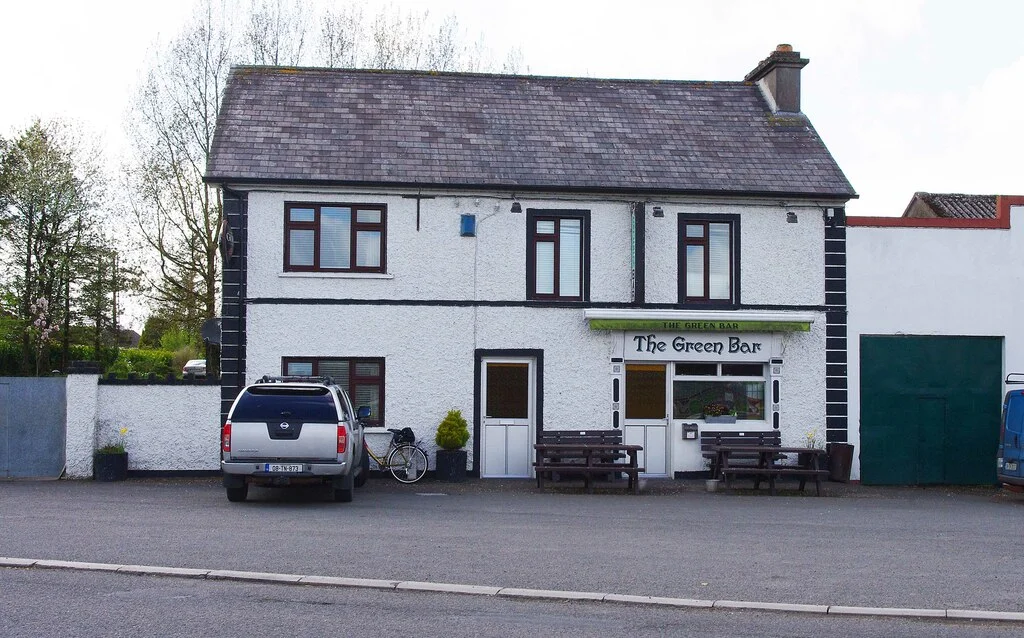

Borrisokane
On 14 April 1861, during the aftermath of the Confederate bombardment of Fort Sumter that opened the American Civil War, an Irishman named Daniel Hough was killed when a cannon misfired during the Union garrison's surrender salute. He was the first Union soldier to die in the four-year war that would claim more American lives than any other conflict in the nation's history. Hough had emigrated from a small town in North Tipperary called Borrisokane some years earlier. He was buried in Charleston in a hasty grave near the fort. His town - 1,117 people at the 2022 census - has a long and disproportionate record of sending its sons across oceans into other people's wars, and getting them killed there.
From O'Carroll to Annesley
Before the Normans arrived, Borrisokane belonged to the O'Carrolls of Ely, descendants - by their own claim - of the ancient Cianachta. The O'Kennedys held tower houses in the surrounding townlands. After the Cromwellian Plantation of the 1650s, the lands passed to a different set of names: Arthur Annesley, first Earl of Anglesey; the Earl of Cork; the Earl of Arran (whose Earldom is preserved in the townland name Arran Hill). The town that grew up on the Great Plain of Lower Ormond was a centre of wheat production from the early nineteenth century onward; its mill on Mill Street operated from 1810 until about 1940, and was demolished in April 2010 to local protest. The adjacent lane is still called Brewers Lane, suggesting another industry that left no other trace.
1920-1921: the small war
On 26 June 1920, around 200 IRA volunteers attacked the Royal Irish Constabulary barracks at Borrisokane. The attack failed; one volunteer was killed - Micheál Ó Cinnéide, whose nephew Michael O'Kennedy would later serve as Irish Minister for Foreign Affairs and European Commissioner. The barracks was so badly damaged that the RIC abandoned it the next day; the building today is the town's Garda station. Almost exactly a year later, on 3 June 1921, an IRA flying column under Sean Gaynor ambushed an RIC and Black and Tan patrol travelling to the local Petty Sessions in Borrisokane Courthouse. The Modreeny Ambush, at Kylebeg Cross between Borrisokane and Cloughjordan, killed four RIC and Black and Tan members. Later that same day a flying column robbed the Munster and Leinster Bank of £2,000 and burned the courthouse and jail. Small towns can produce large amounts of war.
Stella Days
In 1930, the David Clarke Memorial Hall opened in Borrisokane, dedicated to the local landlord David Clarke and built in cut stone in a gable-fronted memorial style. The hall hosted musical and theatrical productions and from the 1950s housed the town's small cinema. Michael Doorley's book Stella Days, written in 2003, tells the true story of how that cinema came to be - and how a rural Irish town in the era of the Catholic Church's tightest grip on social life negotiated the question of what films could be shown and to whom. In 2011 the book was made into a film starring Martin Sheen, whose mother Mary-Ann Phelan emigrated from Borrisokane to the United States in the early twentieth century. The filming was done in Fethard rather than in Borrisokane itself - the town no longer looked enough like its 1950s self - but the premiere was held here, in the Memorial Hall, on 24 March 2012. The cycle of one Tipperary family's story, leaving and returning, has now gone three full generations.
The hill of fairy Una
Four kilometres east of Borrisokane rises Knockshegowna - in Irish Cnoc Sí Úna, the Hill of Fairy Una. Edmund Spenser is believed to have used the name in The Faerie Queene (1590-1596), where Una personifies the True Church and travels with the Redcrosse Knight - a figure representing England - whom she recruits to save her parents' kingdom from a dragon. Spenser, who lived in Munster as an English colonist administering planted lands, was steeped in local Irish folklore even as his epic poem promoted the imperial project that displaced the people who knew that folklore. Knockshegowna also features in Richard D'Alton Williams's nineteenth-century poem The Fairies of Knockshegowna and in Thomas Crofton Croker's Fairy Legends and Traditions of the South of Ireland. The hill is small. Its imaginative footprint is large.
Andrew Robinson Stoney, the real Barry Lyndon
Andrew Robinson Stoney was born in Borrisokane in 1747. A career soldier who lived large and chose his wives for their money, he became infamous for marrying Mary Eleanor Bowes, the wealthy widowed Countess of Strathmore, in 1777 - and then attempting to seize and rape her, abuse her physically, isolate her from her children, and squander her fortune. The Countess eventually escaped, sued for divorce, won, and recovered her property; Stoney was sentenced to three years in prison and died in poverty in 1810. William Makepeace Thackeray, who had access to the Bowes family papers a generation later, used Stoney as the principal model for the title character in his 1844 novel The Luck of Barry Lyndon, later filmed by Stanley Kubrick. Lyndon's swagger, cynicism, and ultimate decay are Stoney's, transposed.
The town that took root in other places
The Borrisokane diaspora produced more than soldiers and screen anti-heroes. Áine Minogue, born here in 1977, became an internationally known Celtic harpist, now resident in the United States. Eugene Esmonde, who lived at Drominagh and was descended from a local landed family, was awarded the Victoria Cross posthumously for leading the disastrous Fleet Air Arm attack on the German battlecruisers Scharnhorst and Gneisenau on 12 February 1942 - the Channel Dash, in which his entire six-Swordfish squadron was shot down. Frederick Trench, first Baron Ashtown, lived at Sopwell Hall. Charlie Swan, born in Modreeney near Borrisokane in 1968, became one of Ireland's leading National Hunt jockeys before his retirement and second career as a trainer. The town today is small. The list of people who started here and ended elsewhere is not.
From the Air
Borrisokane is at 52.996°N, 8.128°W in North Tipperary, 15 km north of Nenagh at the junction of the N52 and N65 roads. Best cruise altitude 2,000-3,500 ft. The town lies on the Great Plain of Lower Ormond - flat farmland, easy to identify by its junction. Lough Derg is 8 km west; the Shannon River and County Galway border are nearby. Borrisokane Forest extends north of the R445. Nearest airports: Shannon (EINN) ~45 km southwest, Birr (private) ~25 km east. Visual landmarks: the N52/N65 junction, Lough Derg shoreline, and the forested Borrisokane area.
Nearby Stories
- Siege of Bunratty 4.2 km away
- St Stanislaus College 4.8 km away
- Gort 7.7 km away
- Newport, County Tipperary 10 km away
- Kinnitty Castle 12 km away
- Kilcooly Abbey 13 km away
- Durrow Abbey 16 km away
- 126 Artist-run Gallery 17 km away