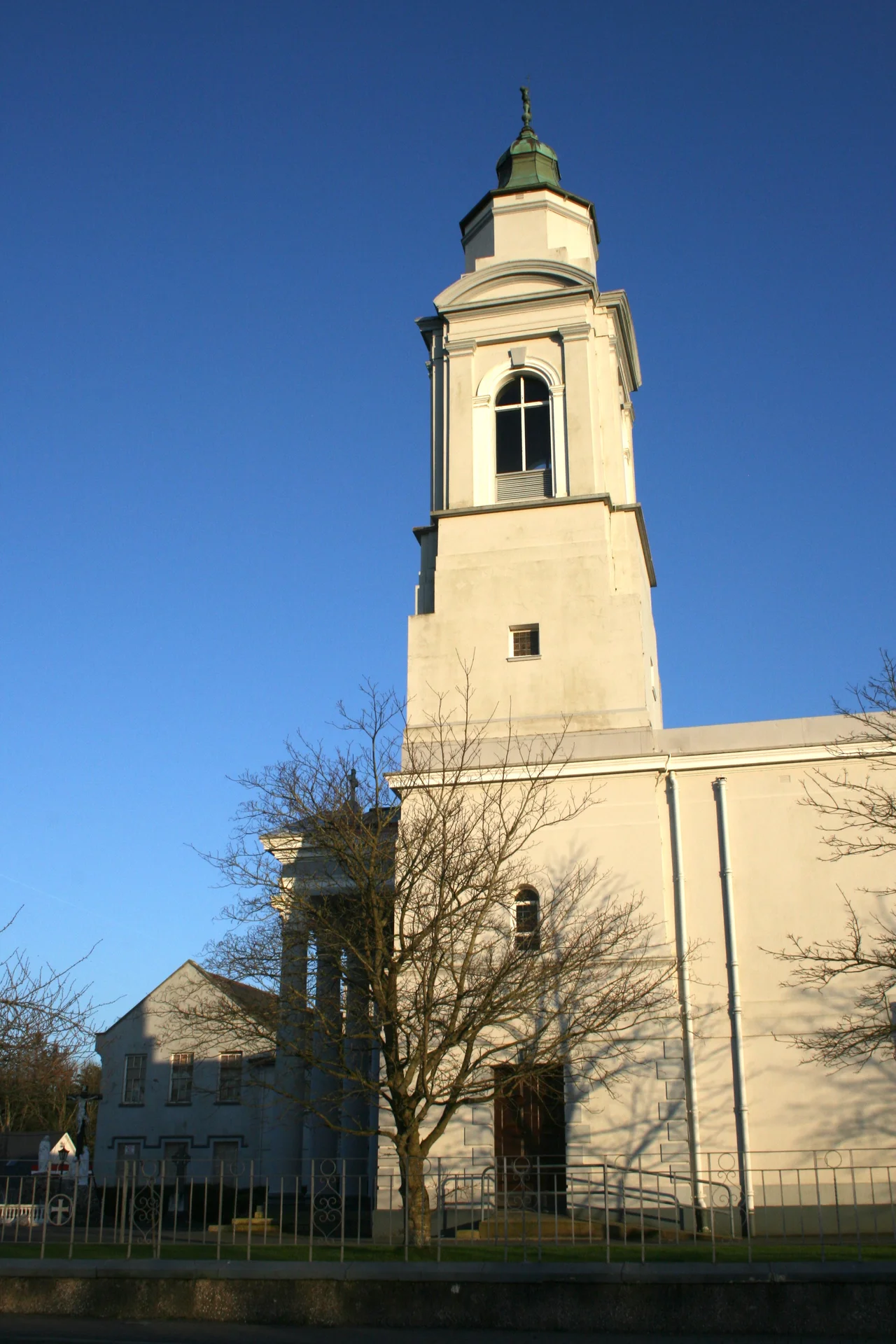

Newport, County Tipperary
On the evening of 14 May 1921, in the foothills of Keeper Hill, the IRA brigade of Newport sprang an ambush on a District Inspector of the Royal Irish Constabulary named Harold Biggs. Biggs was returning from dinner at Glenculloo Lodge, the shooting lodge of the Barrington family of Glenstal Castle. He was killed in the ambush. So was Winifred Barrington, daughter of Sir Charles Barrington, who had been with him in the car. The Barringtons had been a Limerick baronet family for generations. After Winifred's death they sold Glenstal Castle and left Ireland for good. Eight years later their old castle became Glenstal Abbey, the Benedictine monastery and school that still operates today. Newport's small place in the long story of the Irish War of Independence was made that May evening. The town's GAA pitch, Pairc Chuimhneachain Padraig Ui Riain, is named for a member of the raiding party - Patrick Ryan - who later became a TD for Tipperary.
Below Keeper Hill
Newport - formerly Tulach Sheasta, the hill of Sheasta - sits about eight kilometres from Birdhill and sixteen from Limerick city, nestled in the foothills of the Silvermine Mountains. The highest peak in the range, Keeper Hill (Cnoc an Choimheada in Irish, 695 m / 2,280 ft), rises to the south-east of the town and gives every Newport street its long horizon. The Newport River, a tributary of the Mulcair (Mulkear), flows through the middle of the town, joined there by the Cully River. Lough Derg, the great lake formed by the Shannon, is just a few kilometres north-west, and the villages of Murroe (with Glenstal Abbey), Killaloe (with its medieval cathedral), and Ballina spread around Newport in walking distance. At the 2022 census the town's population was 2,183. The settlement here is older than the Norman invasions; the name change from Tulach Sheasta to Newport came in the seventeenth century when the English settler Richard Warren Waller rebuilt the ruined Cully Castle as Castle Waller in the 1650s.
The Waller baronets
Richard Warren Waller arrived in Newport in the 1650s, in the aftermath of the Cromwellian conquest. He was granted 1,195 acres in the locality and rebuilt the wrecked Cully Castle as Castle Waller - the townland that bears the name today is what remains of his original grant. He died in 1676. His descendants became the Waller baronets of Newport. Through marriage and inheritance the Waller line connected to other ascendancy families across Limerick and Tipperary: Vice-Admiral Robert Otway and Sir Arthur Otway, 3rd Baronet, were direct descendants. The eighteenth and nineteenth centuries saw Newport develop as a small Protestant market town within a much larger Catholic hinterland. The Bridewell - the town courthouse and small jail built in 1862-63 on land owned by Sir Edward Waller - is the most visible relic of that period. It contains eight cells, two day rooms, and two limestone staircases. It now houses the Peter Dee Academy of Music.
The ambush at Coolboreen
By the early twentieth century the Wallers were declining. The Barrington baronets of nearby Glenstal Castle were still vigorous - and they were a target. On 14 May 1921, the Newport IRA brigade planned an attack on RIC District Inspector Harold Biggs. The intelligence pointed to Biggs being a guest that evening at Glenculloo Lodge, the Barrington family's shooting lodge in the foothills of Keeper Hill. The ambush was set at Coolboreen, on the road back. Biggs was shot dead. Winifred Barrington, daughter of Sir Charles Barrington, was killed alongside him. The IRA had not intended to kill her - the brigade had thought she was a hospital nurse - but her death was the consequence of the ambush. Within a few years the Barringtons had left Glenstal and Ireland. Their castle was sold in 1925 to Monsignor James J. Ryan, who invited the Benedictines from Maredsous in Belgium to found a new monastery there. The chain of events at Coolboreen led, indirectly, to Glenstal becoming a Catholic abbey instead of an aristocratic seat.
After the treaty, more killing
Newport also lost two more men in the revolutionary period after the treaty had been signed. Sergeant John Walsh of the RIC and Patrick Gilligan, a former soldier, were both shot on 22 May 1922 - well into what should have been a more peaceful interval between the War of Independence and the outbreak of the Civil War in late June. The pattern of personal violence that defined Irish revolutionary politics did not stop at the Truce; it deepened and turned against new targets as the country split over the Anglo-Irish Treaty. Other Newport incidents of the period included the burning down of business premises (Cullen's shop and Daly's Public House) and houses (Clareview, the former Charter School), and the shaving of a local woman's head as punishment for what was called keeping company with policemen - the kind of public, ritual humiliation that recurred in many Irish towns in those years. Today the events are remembered locally and recorded in the parish histories. Patrick Ryan, one of the men involved at Coolboreen, became a TD for Tipperary, served until his death in 1944, and gave his name to the Newport GAA pitch.
Clare Glens, hurling, and a sprinter
Three kilometres from the town lies Clare Glens, a wooded beauty spot along the banks of the Clare River, a popular walk in any weather. The Catholic Church of the Most Holy Redeemer, built in 1933 on Church Street, replaced the older 1796 chapel. The Church of Ireland church of St John's, dating from 1766, was demolished after its final service in 1964; only its graveyard remains. Newport Town AFC, founded in 1970, fields more than two dozen teams today, and Newport GAA at Pairc Chuimhneachain Padraig Ui Riain remains the heart of the town's sporting life. The town has produced its share of public figures: William Lee (1941-2024), the Catholic Bishop of Waterford and Lismore; Sharlene Mawdsley, born in 1998, the Irish 400-metre runner whose Olympic relay performances have made her one of Ireland's best-known contemporary athletes; Denis Carey, composer and member of the Brock McGuire Band; and Patrick Ryan, the IRA man-turned-TD. The Bridewell still stands. Keeper Hill still watches the town.
From the Air
Newport sits at 52.71 N, 8.41 W in north County Tipperary, in the foothills of the Silvermine Mountains, near the border with County Limerick. Shannon (EINN) is 16 nm west-northwest; Cork (EICK) 55 nm south; Waterford (EIWF) 68 nm east-southeast. Recommended viewing altitude 1,500-2,500 ft AGL. Keeper Hill (695 m / 2,280 ft) is the dominant peak 4 nm southeast. Lough Derg lies 6 nm northwest. The Newport River runs through the town and joins the Mulcair south. Glenstal Abbey is 5 nm south at Murroe. The town's distinctive long main street is easily identifiable from the air.
Nearby Stories
- Clonmel 3.6 km away
- Bunratty Castle 5.8 km away
- Kilcooly Abbey 11 km away
- Mitchelstown Castle 12 km away
- Borrisokane 13 km away
- Aghaboe 15 km away
- Kilmacduagh Monastery 17 km away
- Dromagh Castle 31 km away