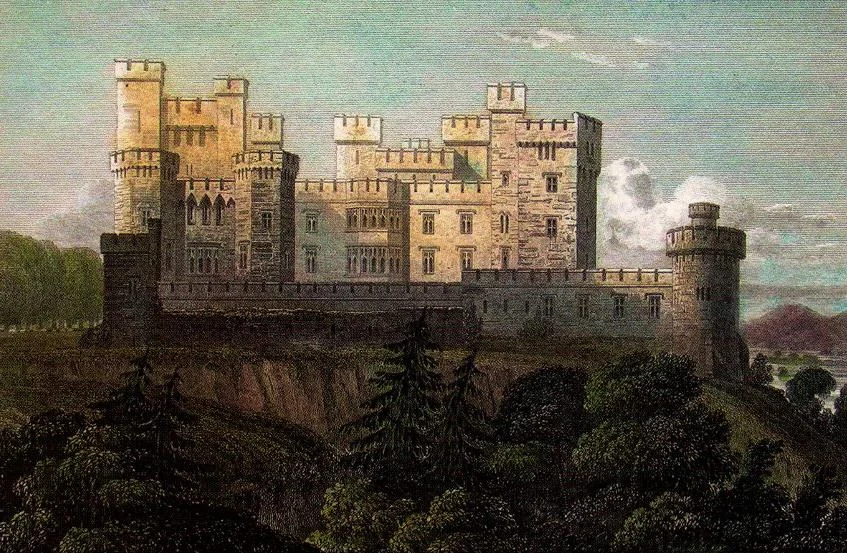

Mitchelstown Castle
On 12 August 1922, on the orders of a local republican leader whose father and grandfather had been middlemen on the Kingston estate, the biggest neo-Gothic house in Ireland was set alight. Sixty principal bedrooms. A 100-foot gallery. A dining room that could seat 100 guests. Three libraries. Paintings by Gainsborough and Beechey. The whole vast pile - which had cost a hundred thousand pounds to build in 1823 and become "the fashion statement of its time" - went up in flames at Mitchelstown, County Cork. When the fire stopped, what remained was an ascendancy ruin and a hard question: what to do with all that beautiful cut limestone. The answer came in 1925. Steam lorries, two consignments a day for at least five years, carried Mitchelstown Castle's stones twenty-eight miles east to the Knockmealdown foothills, where Cistercian monks rebuilt them as Mount Melleray Abbey.
From White Knights to Earls of Kingston
The first castle here was raised in the 15th century by the White Knights of Mitchelstown, a Hiberno-Norman family who held this corner of north Cork. Through marriage it passed to the Kings, who became Barons and eventually Earls of Kingston. James, the 4th Baron, modernised the place in the 1730s. After his death in 1761 it descended to his granddaughter Caroline Fitzgerald, who married her cousin Robert King - the man who would become the 2nd Earl of Kingston in 1797. The Kingsboroughs demolished most of the old castle in the 1770s and built a Palladian mansion in its place, what they called a "house with wings." To educate their children, they hired a young Englishwoman named Mary Wollstonecraft. She would later write A Vindication of the Rights of Woman and become one of the foundational figures of modern feminism. One of her Mitchelstown pupils, Margaret King, grew into Countess Mount Cashell, the friend to whom Percy Bysshe Shelley dedicated his poem A Sensitive Plant.
A hundred thousand pounds
In 1823 George, the 3rd Earl of Kingston, decided the Palladian house was not grand enough. He pulled it down and commissioned the architects James and George Richard Pain to build him something extraordinary. The new Mitchelstown Castle had sixty principal bedrooms and twenty minor ones. The gallery ran a hundred feet. The dining room sat a hundred guests at one sitting. Three libraries. A morning room. The bill came to £100,000 - a fortune even for an earl - and the result became, in the language of the time, the biggest neo-Gothic house in Ireland and the fashion statement of its time. Strancally Castle in Waterford copied its style. So did Dromoland for Lord Inchiquin. But the estate that financed it - 100,000 acres of north Cork tenantry - was already groaning. The Great Famine of 1845-51 forced the Kingstons to sell 70,000 acres in the Landed Estates Court. Family squabbles, lawsuits, and the Land War of the 1880s did the rest. By the early twentieth century the great castle was sustained by little more than inertia.
A guest list of the famous
Even in its slow decline, the castle drew remarkable visitors. George Bernard Shaw came to stay. So did Arthur Young, the great agricultural writer. Elizabeth Bowen, the Anglo-Irish novelist, walked these rooms and would later make Bowen's Court at Farahy, a few miles away, the subject of her own meditations on the fading Big House world. Prince Hermann von Puckler-Muskau, the eccentric German landscape designer, made the journey too. The castle was a place where the literary and aristocratic worlds of the Anglo-Irish ascendancy still crossed paths, even as the politics of land and nation were moving sharply against them. Wollstonecraft was long dead by then, but her ghost lingered: the proto-feminist tutor in the great Tory house, whose ideas would outlive the family that paid her wages.
12 August 1922
In June 1922, with the Irish Civil War about to begin, the IRA occupied the castle. The then-owner William Downes Webber, his relatives, and his servants were evicted to King Square in the town. For weeks the building was held by republicans seemingly preparing for siege. In early August some of them stripped the place: the paintings by Gainsborough and Beechey, the silver, the furniture, the wall hangings, the mantelpieces - all stolen. Then on 12 August the order came from P. J. Luddy, a local republican leader whose father and grandfather had been Kingston middlemen on this very estate. The castle was burned. The same night, the British military barracks at Fermoy, Mallow, Mitchelstown, and Kilworth all went up, along with the workhouse and the RIC barracks in Mitchelstown and the railway viaduct at Mallow. Webber sought £149,000 in compensation. Judge Kenny of the Irish High Court, ruling in 1926, called the destruction "an act of wanton destruction which had no military purpose" and awarded £27,500 for the building. It was not enough to rebuild. Most of it was spent on replacement properties in Dublin instead.
Stones that became an abbey
The site of the castle is now a milk processing factory owned by Dairygold Co-op. There is no ruin to visit; the dairy levelled what was left. But the stones survive elsewhere. In 1925 the family dismantled the burned shell and sold the cut limestone to the Cistercian monks of Mount Melleray Abbey, twenty-eight miles east in County Waterford. Steam lorries hauled the blocks, two consignments daily, for at least five years. The monks ended up with far more stones than they needed; they stacked the surplus in fields around the monastery. The Cistercian abbey they raised over their dead was finally consecrated in the 1930s. Mount Melleray itself closed in January 2025, the surviving six monks moving to Roscrea. The Kingston dynasty is gone. The republican leader who ordered the fire is forgotten in most places. But the limestone, cut in north Cork in the 1820s and reset by Trappists in the 1930s, still stands.
From the Air
Mitchelstown sits at 52.27 N, 8.28 W in the Galty foothills of north Cork, between the Galtee Mountains to the north and the Knockmealdowns to the south. Cork (EICK) is 28 nm south-southwest; Shannon (EINN) 36 nm north; Waterford (EIWF) 40 nm east. The town today is dominated by the Dairygold creamery on the site of the old castle. Recommended viewing altitude 2,500-3,500 ft AGL to see the town in its valley between the two mountain ranges, with the Galtees - Ireland's highest inland range - dominating the northern horizon.
Nearby Stories
- Adare 1.2 km away
- Doon, County Limerick 5.2 km away
- Inislounaght Abbey 6.1 km away
- Old Parish 7.3 km away
- Ballingarry Coal Mines 11 km away
- Aghavrin House 12 km away
- Clonmult Ambush 12 km away
- Dromagh Castle 22 km away