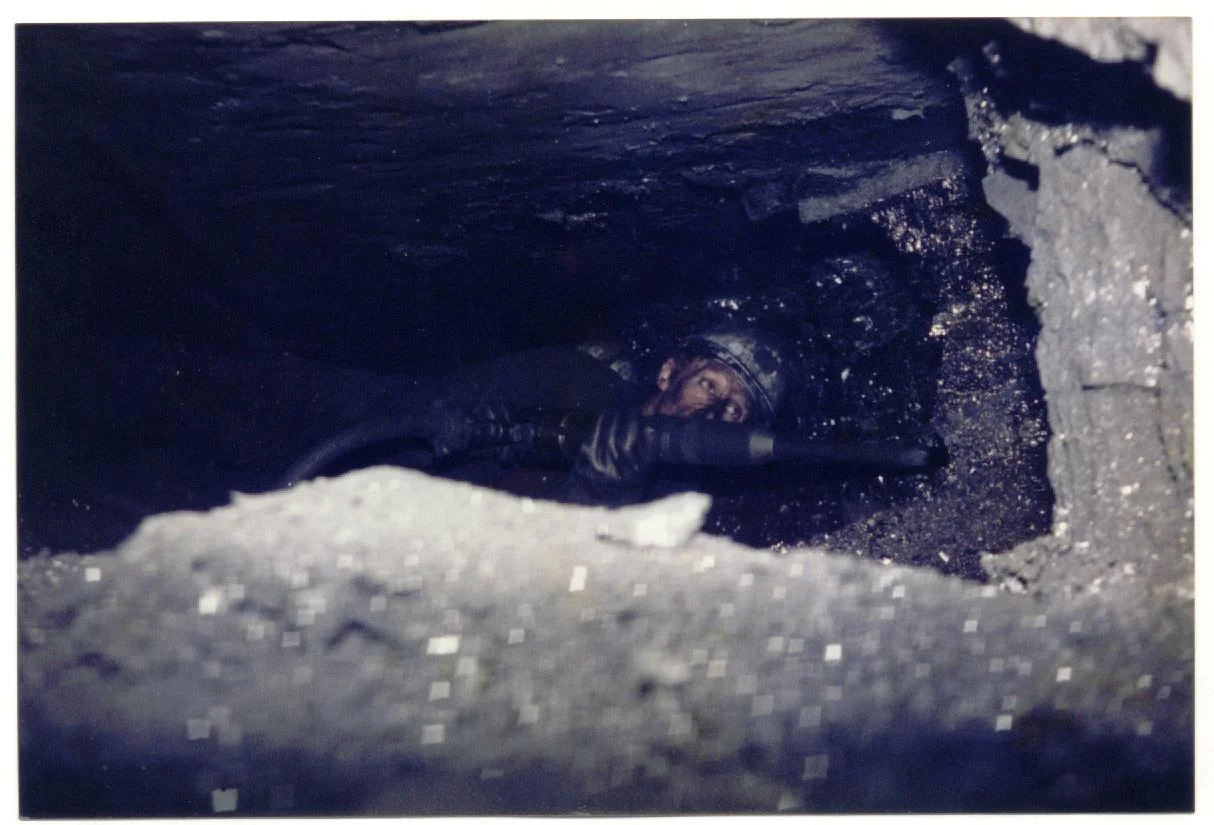

Ballingarry Coal Mines
There is a word for the form of culm or duff with high clay content that miners pulled out of the Slievardagh seams: shining ball. There is a word for a stick of gelignite ready to be loaded into a borehole: cane. The compressed-air rock drill with the extending mono-pod was a banshee. The pneumatic pick was a jigger. The brass token a miner threaded on a string around his neck to mark his team's full coal tubs was a tally. Every job in the Ballingarry coal mines had its own vocabulary, and most of it died with the mines. The pits flooded after the pumps were disconnected in the mid-1970s. Beneath the green hills above Ballingarry, they are still down there.
Anthracite Under the Snow
The coal at Ballingarry was anthracite -- the hardest grade, virtually smokeless, with high calorific value and low ash. The coalfield sat in the Slievardagh range of hills, a southern extension of the great Leinster coalfields separated only by a narrow band of Carboniferous limestone. The deposits ran in three thin strata, the lowest averaging nine inches and the others around two feet, heavily faulted and tilted so that crushed coal blended with the shale to form a less commercially attractive material the miners called culm. The high elevation of Slievardagh had its own particular hazard: when winter snow melted, the runoff produced large volumes of floodwater on a short time-of-concentration, sometimes threatening to overwhelm the ordinary pumping capacity of the mines.
A Century and a Half of Pulling
From 1826 the main commercial operation was the Mining Company of Ireland, which kept going until 1926. In the 1840s, 50,000 tons a year came out of the Slievardagh hills. By 1866 twelve pits were being worked locally with three recently abandoned. The mines also became part of national history in 1848 when the Young Irelander Rebellion erupted at the Commons just outside Ballingarry, with rebels barricading themselves at the Commons colliery before the famous Battle of Widow McCormack's Cabbage Patch. From 1942 to 1950 the mines were run by the government under the name Mianrai Teo, and in 1953 the lease was bought from the state by Tommy O'Brien, a County Mayo man returned from Lancashire. He drew home many local miners who had emigrated for work, and three years later 330 men were employed at the pits.
Underground Fire, Above-Ground Failure
By the early 1970s the mines were in financial trouble. In 1971, 100 workers were made redundant, and 150 more lost their jobs the following year when the operation went into receivership -- just before the first oil crisis sent fuel prices soaring. In 1973 an underground fire threatened the lives of 17 workers, and disaster was narrowly averted by the Kilkenny Fire Service. Despite efforts to keep maintenance going, the mines closed soon afterward. The pumps were disconnected and the pits flooded. When the second oil crisis arrived at the end of the 1970s, Ballingarry briefly looked viable again. In 1978 Kealy Mines, named after its principals Patrick Keating and Gilbert Howley, reopened workings at Lickfinn near New Birmingham. The Electricity Supply Board expressed interest in burning Ballingarry anthracite for power generation -- until preliminary tests showed the high temperatures from the anthracite caused the fire-grates of a peat-burning power station to overheat.
Last Cuttings, and Memory
A Canadian consortium, Flair Resources Ltd., took over operations in 1982, expanded the workforce to 80, and traded as Tipperary Anthracite. By 1985 it too was in receivership, with financial irregularities around IDA grants investigated by the Gardaí and aired on RTÉ's Today Tonight programme. Emerald Resources held a licence in 1989 for sporadic work at Lickfinn-Earl's Hill, but the era was effectively over. The Old School at the Commons has since been renovated by Slieveardagh Rural Development to display the heritage artefacts of the region's mining history and serves as a social centre for former miners and their families. The vocabulary survives there as much as in the language. The banshees and jiggers and tallies sit behind glass cases now, the tools of a working culture preserved like artefacts of an ancient craft, because that is what they have become.
From the Air
Located at 52.59 degrees N, 7.58 degrees W in County Tipperary, Ireland, in the Slievardagh hills near the border with County Kilkenny. From altitude the area appears as rolling upland country with scattered farmsteads, the village of Ballingarry to the south and New Birmingham nearby. Surface traces of former mine workings -- spoil heaps, capped shafts -- are visible from low level. Nearest airports: Waterford (EIWF) approximately 50 km southeast; Cork (EICK) approximately 90 km southwest. Best viewed below 2,500 ft AGL.
Nearby Stories
- Aghaboe 3.3 km away
- Castle Gurteen de la Poer 3.4 km away
- Borrisokane 9.9 km away
- Doon, County Limerick 12 km away
- Dunbrody Abbey 12 km away
- County Carlow 14 km away
- Mitchelstown Castle 18 km away
- Kildare Cathedral 29 km away