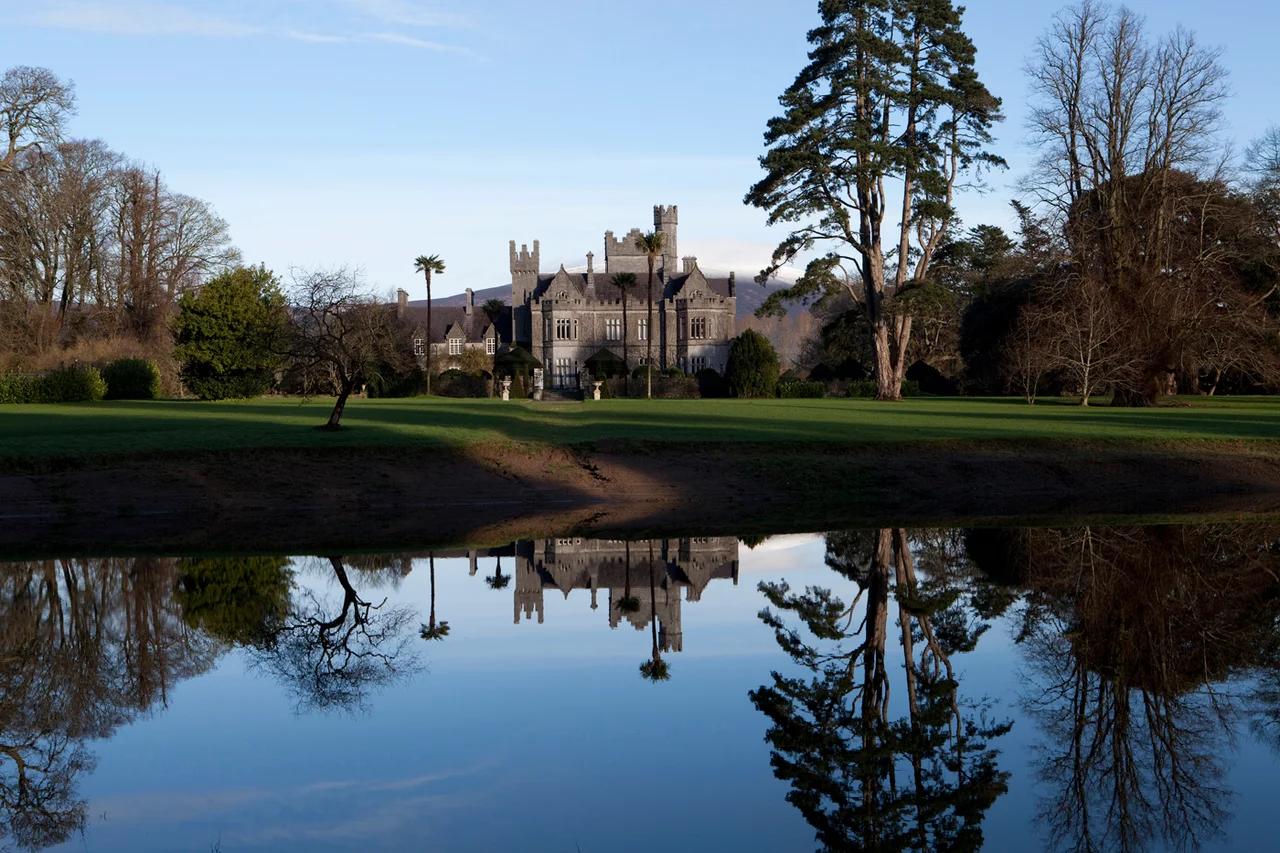

Castle Gurteen de la Poer
Marilyn Manson and Dita Von Teese were married in a private non-denominational ceremony in the great hall on a December afternoon in 2005. That sentence alone tells you something is unusual about Castle Gurteen de la Poer. The Elizabethan Revival pile rises in a long sweep of turrets and battlements on the south bank of the River Suir, eight kilometres east of Clonmel, with the Comeragh Mountains making a slow grey horizon behind. It was built in the 1860s by a Catholic Anglo-Norman count who needed somewhere big enough to express six hundred years of dynastic history. A century later it became the studio of one of the most unsettling living painters in Europe.
An Anglo-Norman House
The de la Poers - sometimes anglicised as Power, sometimes as le Poer - arrived in Ireland with the Anglo-Norman invasion of the 12th century. They settled in Waterford and stayed for the next eight hundred years. Their refusal to leave Catholicism behind in the Protestant 17th century cost them politically: an attainder against John Power in 1691 wiped out the formal barony. The family kept the land. Edmund, born in 1841, made the gamble that would define them again: he built a new castle on the old Gurteen estate to announce that the de la Poers had not gone anywhere. In 1864, Pope Pius IX created him 1st Count de la Poer of the Papal States. He served as Knight of Malta, Private Chamberlain to two popes, High Sheriff of Waterford in 1879, and finally Lord Lieutenant of the county and city in 1909.
Roberts and Burn
The architect was Samuel Ussher Roberts, great-grandson of John Roberts, the 18th-century Waterford designer of Christ Church Cathedral. Construction began in 1863 and finished in 1866. The design owes a lot to the Scottish architect William Burn, whose Tudor-Baronial mansions had spread across Britain a generation earlier, and there is a clear family resemblance between Gurteen and Kylemore Castle (now Kylemore Abbey) in Galway - which Roberts went on to design immediately afterward, with the same builder Thomas Carroll. The entrance front presents a square tower and an attached polygonal turret across a forecourt of castellated walls. Inside, the centre of the house is a top-lit great hall, a screen of Gothic arches dividing it from the staircase, wrought-iron balustrades climbing to a galleried first floor. The library has bookcases to the ceiling and red walls. The drawing room and ballroom open into each other along the south garden front.
St. Hubert's Stag
The dining room is the heart of the house, kept in Victorian Baronial style. Faded red walls rise above a dado of brown oak panelling. A carved oak chimney piece carries heraldic angels holding the family arms, and above them sits the family crest: St. Hubert's Stag, antlers and crucifix mounted at the top of the mantle. The legend behind the crest is medieval: Hubert was a young Frankish nobleman who, while hunting on a Good Friday, was confronted by a stag with a crucifix glowing between its antlers and abandoned his old life on the spot. The de la Poers had taken the image as their own. Edmund the 1st Count died in 1915; his son John William, the 2nd Count, claimed the original barony of Le Poer and Curraghmore in 1922 and the House of Lords' Committee of Privileges agreed that, but for the 1691 attainder, the claim was sound. The 3rd Count, Edmond Robert Arnold, finally sold the castle in 1979 - to a German businessman named Günter Rombelsheim - but retained the right to live in the West Wing until his death in 1995.
The Helnwein Years
In 1998 the Austrian-Irish painter Gottfried Helnwein bought Castle Gurteen and began a long restoration. Helnwein is best known for huge photo-realist paintings of wounded children, masked figures, and bandaged faces - work that has made him one of the most exhibited contemporary artists in Europe and that has sold for millions at auction. The castle became his studio. His family lives in the great house; visitors over the years have included Sean Penn, Sir Ben Kingsley, Beck, William S. Farish (then U.S. ambassador to the United Kingdom), the speaker of the German parliament Antje Vollmer, and the former President of the Seychelles James Mancham. In December 2005, Marilyn Manson and the burlesque performer Dita Von Teese were married in the great hall. The New York Times ran a three-page feature on the Helnwein family in the castle in December 2014. A house that began as a Catholic statement against Protestant ascendancy has settled into being a working studio for an artist whose paintings come up in conversations from Vienna to Los Angeles.
Behind the Gates
Gurteen is private; the public does not get in. From the road between Clonmel and Carrick-on-Suir, the castle is visible through trees in winter and almost vanishes in summer leaf. The river path - the Suir Blueway - runs along the opposite bank, and walkers can sometimes glimpse the turrets from across the water. The grounds were originally laid out as a Victorian deer park; some of those parkland trees are now mature beyond easy measurement. What makes Gurteen unusual among Irish big houses is simply that it has been continuously lived in. Most of its peers were demolished, burned in the troubles, or quietly let go to ruin. Gurteen had a Catholic owner who never had to leave, then a Bavarian who restored it, then an artist who stayed. That continuity is rare. It is also what keeps the house, with its St Hubert's stag still over the dining room fire, a living building rather than a relic.
From the Air
Castle Gurteen de la Poer sits at 52.36°N, 7.59°W on the south bank of the River Suir in northern County Waterford, about 8 km east of Clonmel and 12 km west of Carrick-on-Suir. From the air, look for the long crenellated silhouette amid mature woodland on the south side of the river, with the Comeragh Mountains rising further south. The N24 road runs along the north bank. Nearest civil airports: Waterford (EIWF) about 30 km east, Cork (EICK) about 100 km west-south-west, Shannon (EINN) about 110 km north-west.
Nearby Stories
- Young Ireland rebellion 3.7 km away
- Clonmult Ambush 4.2 km away
- Dunbrody Abbey 5 km away
- Old Parish 5.8 km away
- Doon, County Limerick 12 km away
- Mitchelstown Castle 13 km away
- County Carlow 18 km away
- Ramsey Island 117 km away