
Old Parish
Two famous mayors of Chicago - Richard J. Daley, who ran the city for twenty-one years until his death in 1976, and his son Richard M. Daley, who ran it for twenty-two more - both had grandparents who came from this Irish-speaking corner of County Waterford. The Daleys and the Dunnes left An Sean Phobal during the Great Famine, when the parish's population was shaken loose by hunger and emigration. In Móin na Mín a plaque honours Richard J. Daley, who in 1970 sent a sum of money back to refurbish the local church. The man who built modern Chicago kept faith with the place his grandparents had been forced to leave.
The Name Stayed Irish
Old Parish - An Sean Phobal in Irish, An tSean Phobail in the genitive - is one of the few places in Ireland where the bilingual road signs were deliberately reduced. Both forms appeared on local signs until 2005, when the anglicised "Old Parish" lost its official status. Today the signs say An Sean Phobal only. The parish is part of Gaeltacht na nDéise, the Waterford Gaeltacht, where Gaoluinn na nDéise - the Waterford variant of the Munster Irish dialect - is still a daily language. According to the 2016 census, 14% of the population spoke Irish on a daily basis outside the education system. The official maps say one thing in one language; the people say it another way that has not been bent by translation.
A Large, Quiet Parish
An Sean Phobal covers about 35 square kilometres - the second largest parish in Waterford by area - with roughly eight kilometres of coastline along Muggort's Bay. About 350 people live within its boundaries. It runs west to east from Ardmore and Grange to the neighbouring Gaeltacht parish of An Rinn, and north to south from beyond the N25 Cork-Waterford road down to the sea. The closest larger settlements are Dungarvan, nine kilometres north, and Youghal in County Cork, sixteen kilometres southwest. The landscape is mostly small green fields, drystone walls, and stretches of bog and rough grazing. The parish has no town centre to speak of; the community gathers around its primary school, its church, and the community hall at Halla Cholmáin.
Education Through Irish
Every level of education in An Sean Phobal is delivered through Irish. There is one pre-school, Lios na Síog, and one primary school, Scoil Náisiúnta Baile Mhic Airt - a co-educational Gaeltacht national school under the patronage of the Catholic Bishop of Waterford and Lismore. Children pass through the system speaking and writing in a language that elsewhere in Ireland has shrunk to school subject status. The fact that this works at all is itself a small triumph: state policy, parental commitment, and a critical mass of native speakers all have to align. When any one of them weakens, the Gaeltacht shrinks. The Waterford Gaeltacht is one of the smallest in the country, and An Sean Phobal is one of its two principal parishes.
The Castle and the Famine Stone
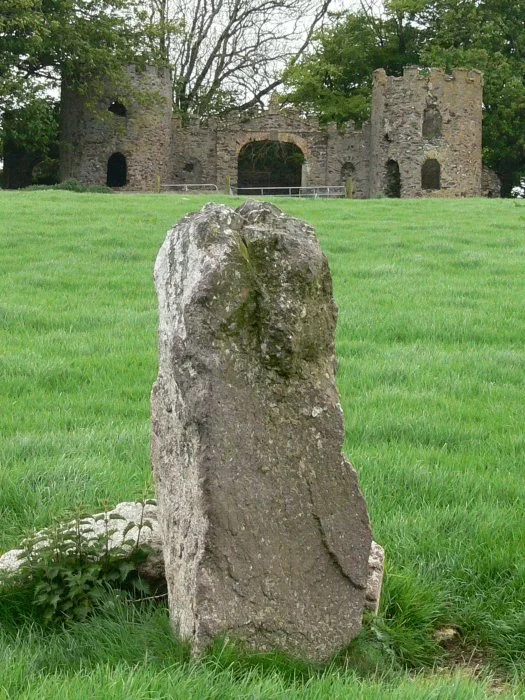
In Baile Mhic Airt Lower stand a ruined castle and a famine mass stone. Little is known about the castle's earliest history. Local tradition says it was built by a Lord Barron as a hunting lodge. The Buildings of Ireland Survey records the surviving structure as an early-19th-century gate screen incorporating a central gateway with flanking lodges, probably built as part of plans to develop Glenanna Cottage grounds. The famine mass stone is more poignantly direct: a slab where the local priest celebrated Mass during the Penal Laws and again during the Famine years, when the parish was hollowing out as families left for Liverpool, New York, Boston, and - eventually - Chicago. The stone is small. The history it represents is not.
Sport, Drama, and Sondes
Cultural life in An Sean Phobal still happens in Irish. The drama group Aisteoirí An tSean Phobail produces plays each year in the local hall. The community development committee Coiste Forbartha an tSean Phobail won recognition in the 2006 An Baile Beo competition. The parish's GAA club, CLG An tSean Phobail - nicknamed the Shocks, club colours red and white - competes in Gaelic football and reached its peak in 1949 when it won the Waterford Junior Football Championship. For hurling the area is associated with the neighbouring Rinn Ó gCuanach club. In 2013 the Shocks helped host Comórtas Peile na Gaeltachta, the annual Gaelic football competition between clubs from every Irish-speaking Gaeltacht in the country, by providing their playing pitch at Páirc Cholmáin. The route of the Seán Kelly Heritage 100K cycling event also runs through the parish - a different language, the same hills.
From the Air
Located at 52.01°N, 7.63°W on the south coast of County Waterford, with approximately 8 km of coastline along Muggort's Bay. Best viewed from 2,500-4,000 ft AGL. The parish is a large rural area without a clear urban centre; the primary school and church near Baile Mhic Airt are the main visible structures. Nearest larger settlements: Dungarvan 9 km to the north, Ardmore 5 km to the southwest, Youghal 16 km to the southwest. Nearest airports: Cork (EICK) approximately 65 km / 35 nm to the southwest, Waterford (EIWF) approximately 40 km / 22 nm to the northeast. The N25 trunk road runs along the parish's northern edge between Cork and Waterford - a useful straight-line navigational reference.
Nearby Stories
- Clonmult Ambush 5.9 km away
- Dunbrody Abbey 9.8 km away
- Mitchelstown Castle 15 km away
- All Together Now (festival) 16 km away
- Hook Lighthouse 21 km away
- Walter Siepmann 29 km away
- Alfred Lämmerhirt 60 km away
- Action of 17 November 1917 117 km away