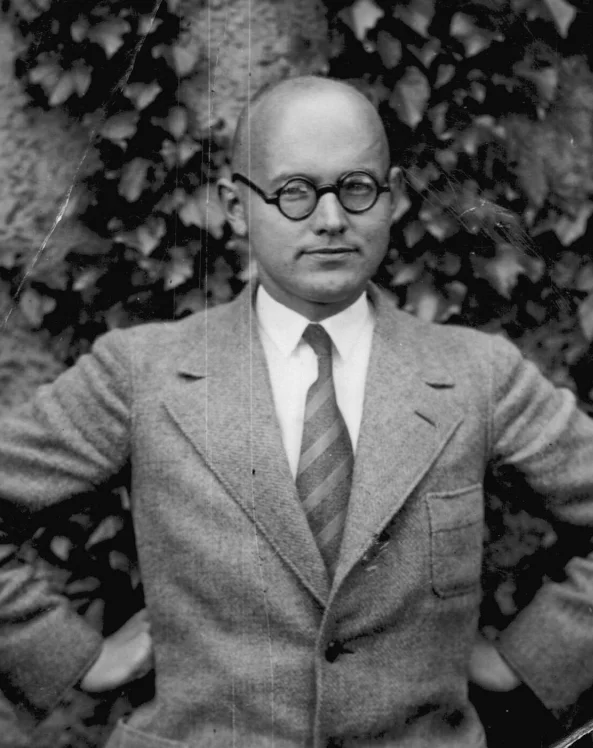

Walter Siepmann
Walter Siepmann's story has darker corners than his father's or his uncle's. He inherited a factory and ran it through two of the most morally complicated decades in German industrial history. Richard Rudolf Walter Siepmann was born on 11 March 1902 in Warstein, the youngest son of Hugo Siepmann and Luise Lämmerhirt - which meant he grew up on the Hauptstrasse estate that the family controlled, with his cousins on the other side of a low wall, all of them aware from childhood that the forge two streets over would someday be theirs to run. He finished his Abitur and studied mechanical engineering at the Technical University of Darmstadt, graduating in 1926. He went straight into the family company. He stayed for the next sixty years.
The 1930s, and What That Means
When Walter joined the firm in 1926, Siepmann employed about 400 people. By the bottom of the Great Depression in 1932, that number had fallen to 140. The recovery, when it came, was not a normal recovery. Beginning in 1933, the rearmament programmes of Nazi Germany flooded German heavy industry with orders, and the Siepmann drop-forge - already a specialist supplier to the automobile and railway industries - found itself supplying the war economy too. Staff levels rebounded fast, from 143 in 1932 to 312 by April 1934, and continued climbing. By 1937 Siepmann was the second-largest drop-forge plant in Germany. The company's prosperity in this period is inseparable from the political order that produced it. Walter, like many German industrialists of his generation, navigated this period rather than resisted it; the historical record on Siepmann's specific dealings remains incomplete.
Inventor in Valves
What Walter brought to the company was a patenting mind. His name appears on numerous international patents for valves, fixtures, housings, and fittings - the apparently small components that determine whether industrial machinery works at all. After the Second World War he developed a new line of oil-field fittings aimed specifically at North American mineral-oil companies, primarily in the United States and Canada. He set up a Canadian subsidiary, Forged Steel Valve Limited, in Montreal, with his son-in-law Hans-Georg Koenig running sales. PERSTA Steel Fixtures, the valve subsidiary, was founded in 1946 and remains part of the Siepmann group today. The company's pivot away from drop-forging toward precision valves is largely Walter's design.
Politics and Position
From 1940 Walter served as a councillor of Belecke, a village outside Warstein, eventually absorbed into the town. After the war he joined the Christian Democratic Union and remained politically engaged on the local level. He sat on the supervisory board of Commerzbank, one of Germany's three major banks, and was a director of the VDMA, the Mechanical Engineering Industry Association. His cousin Ernst Siepmann had been a fellow student of Alfried Krupp von Bohlen und Halbach, heir to the Krupp empire, and Krupp eventually joined the Siepmann supervisory board - the kind of social network that bound German industrial dynasties together in the postwar Federal Republic.
Haus Möhnethal
In 1933 Walter married Johanna Luise Trebs, a concert pianist whose paternal family were doctors in Marburg and whose maternal grandfather had grown wealthy from mining and merchant activities in German South West Africa and Australia. They had four children. In 1938 or 1939 Walter acquired the local hill Külbe from the province of Westphalia and the Belecke parish. The main house there, Haus Möhnethal - sometimes called Villa Siepmann - became his residence from 1939 onward and the birthplace of his younger children. He also owned property in Munich. When he died on 16 December 1985, the company had passed gradually to his youngest son Walter Jr., the fourth-generation Siepmann to run the works. The forge his grandfather and great-uncle had taken over from a bankrupt shovel manufacturer in 1891 was still in the family, still in Warstein, still operating.
From the Air
Warstein and the village of Belecke lie in the Sauerland hills of North Rhine-Westphalia, Germany - around 51.48°N, 8.34°E. (The Wikipedia article's listed Irish coordinates are a geocoding artifact.) The nearest major airports are Dortmund (EDLW) about 65 km west and Paderborn-Lippstadt (EDLP) about 25 km north. From altitude, the Möhne reservoir - dammed in the early 20th century and famously breached by the British Dambusters raid in 1943 - is visible to the south of Belecke as a long blue ribbon among the hills.
Nearby Stories
- SS Libau 3.7 km away
- Ballinacarriga Castle 17 km away
- Clonakilty 24 km away
- SS Folia (1907) 28 km away
- Wolfpack Prien 53 km away
- SM U-27 55 km away
- St. Declan's Monastery 59 km away
- 1979 Fastnet Race 113 km away