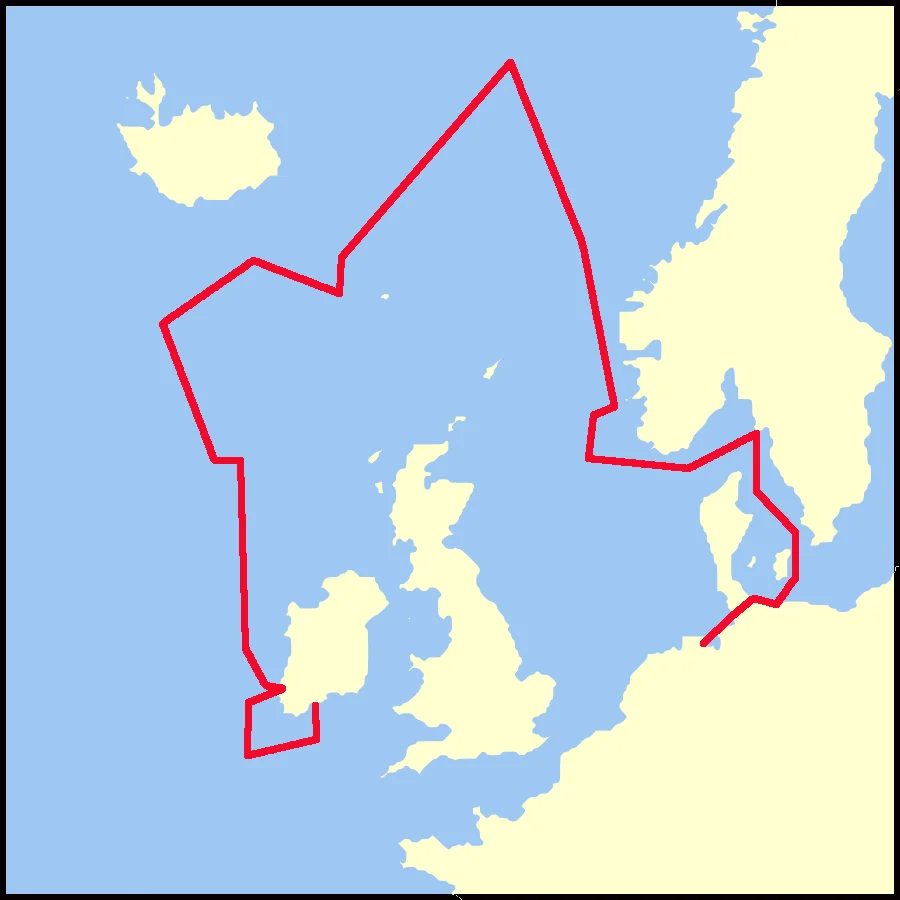

SS Libau
She set sail from Lubeck on 9 April 1916 with 22 men, 20,000 rifles, a million rounds of ammunition, ten machine guns and a hold full of explosives stacked under camouflage timber. Her papers said she was the Norwegian trawler SS Aud. Her actual name was SS Libau, and she was a captured British cargo ship sailing under a German captain through waters patrolled by the Royal Navy, headed for Tralee Bay with a cargo intended to arm an Irish revolution. Twelve days later, on Good Friday, she scuttled herself at the entrance to Cork Harbour rather than let her cargo fall into British hands. The Easter Rising would begin in Dublin two days later. Without her guns.
The Ship That Wasn't Norwegian
She was built in Hull in 1907 as the SS Castro, a 1,062-ton steamer running cargo for the Wilson Line - 220 feet long, modest, the kind of ship that crossed the North Sea without anyone looking twice. In August 1914, when the war broke out, the Imperial German Navy caught her in the Kiel Canal and took her over. For two years she sat at a Baltic quay as the Libau, the German name for the Latvian port of Liepaja, with no clear job. Then in early 1916 a plan emerged. Roger Casement, the former British diplomat turned Irish revolutionary, had negotiated a German arms shipment for an uprising scheduled for Easter. The Libau would carry it. She would also wear a stolen identity - a real Norwegian trawler, the Aud, of similar outline. Her crew was 22 German sailors. Her captain was Karl Spindler, a naval officer who would never see his own ship again.
Twelve Days, the Long Way
The route was almost absurd. To avoid the British 10th Cruiser Squadron patrolling the southern North Sea, the Libau ran north - up past the Arctic Circle, through fierce storms off Rockall, then down the west coast of Ireland and around to Tralee Bay. She had no radio. She arrived on Holy Thursday, 20 April, and waited. The Irish Republican Brotherhood contacts in Kerry had been told the ship would arrive on Easter Sunday at Fenit pier - off by three days. Nobody came to meet her. Worse, two of the Irish couriers driving to make contact crashed their car off Ballykissane pier near Killorglin and drowned. The cargo of 20,000 Mosin-Nagant rifles - taken by the Germans from Russian troops at the Battle of Tannenberg - was sitting in Tralee Bay with nobody to receive it.
Good Friday
On Good Friday, 21 April, three Royal Navy destroyers approached the Libau. British intelligence had unmasked her cover. Spindler tried to leave the bay; he was cornered. He allowed the destroyers to escort his ship toward Cork Harbour, accompanied by a sloop. Then, before the British could board, the German crew opened the seacocks and scuttled the Libau in the approaches to the harbour near Daunt Rock - a small, infamous landmark just outside Cork Harbour. Spindler and his crew were taken prisoner and interned for the rest of the war. The rifles went to the bottom with the ship. Roger Casement, who had been landed by U-boat at Banna Strand the same Friday, was arrested before he could reach his contacts. He was tried for high treason and hanged at Pentonville on 3 August 1916. The Rising began in Dublin on Easter Monday without the German guns - which is the central, painful fact of the week.
What the Sea Returned
The wreck of the Libau lies about 27 metres down, near where she scuttled herself. In 2012 a licensed salvage operation raised her anchors; after conservation and desalination, they went on public display. Other artefacts surfaced too: rifles recovered before the sinking are scattered across the Cork Public Museum, the National Museum of Ireland in Dublin, a museum in Lurgan, the Imperial War Museum in London, and - most fittingly - Spike Island in Cork Harbour, where the captured German crew were briefly held alongside the Irish gunrunners Austin Stack and Con Collins. The Spike exhibition includes a working Mosin-Nagant, the maps of the route, video of the wreck on the seabed, and an image of Roger Casement aboard the U-boat that landed him at Banna Strand. The exhibition opened in 2017, for the centenary.
The Counterfactual
Historians have argued ever since about what would have happened if the Libau's cargo had reached the rebels. The Mosin-Nagant has often been dismissed as 'outmoded' - this is a misunderstanding. The Allies actually produced great quantities of them during the First World War; the German army didn't want them only because the calibre didn't match their other ammunition. A modified version of the same rifle served European armies through the Second World War. Twenty thousand of them, with a million rounds of ammunition, would have changed the military calculation of Easter 1916 considerably. They didn't reach the Volunteers because of bad communication, a crashed car, no radio aboard the ship, and a British intelligence service that had cracked the German naval ciphers months earlier. The Libau sits in dark water off Daunt Rock and reminds anyone who looks at her wreck what a few hours' difference can mean.
From the Air
The Libau wreck lies at approximately 51.71 degrees N, 8.24 degrees W in the approaches to Cork Harbour, just outside the harbour mouth near Daunt Rock and Roberts Cove. From the air, the location is marked by the Roche's Point Lighthouse on the eastern headland of the harbour entrance, with the Old Head of Kinsale visible to the southwest. Best viewed from 1,500 to 4,000 feet on a coastal track from Kinsale eastward toward Cork Harbour. Cork Airport (EICK) lies 18 km north-northwest. The wreck itself is invisible from the air but the geography that doomed her - the narrow harbour mouth, the open Atlantic to the south - reads clearly from above.
Nearby Stories
- Walter Siepmann 6.3 km away
- Gaeltacht na nDéise 11 km away
- Fermoy 12 km away
- Canovee 14 km away
- Rathcoole Ambush 16 km away
- SS Folia (1907) 20 km away
- Cloghan Castle, Lough Hyne 35 km away
- SM U-27 91 km away