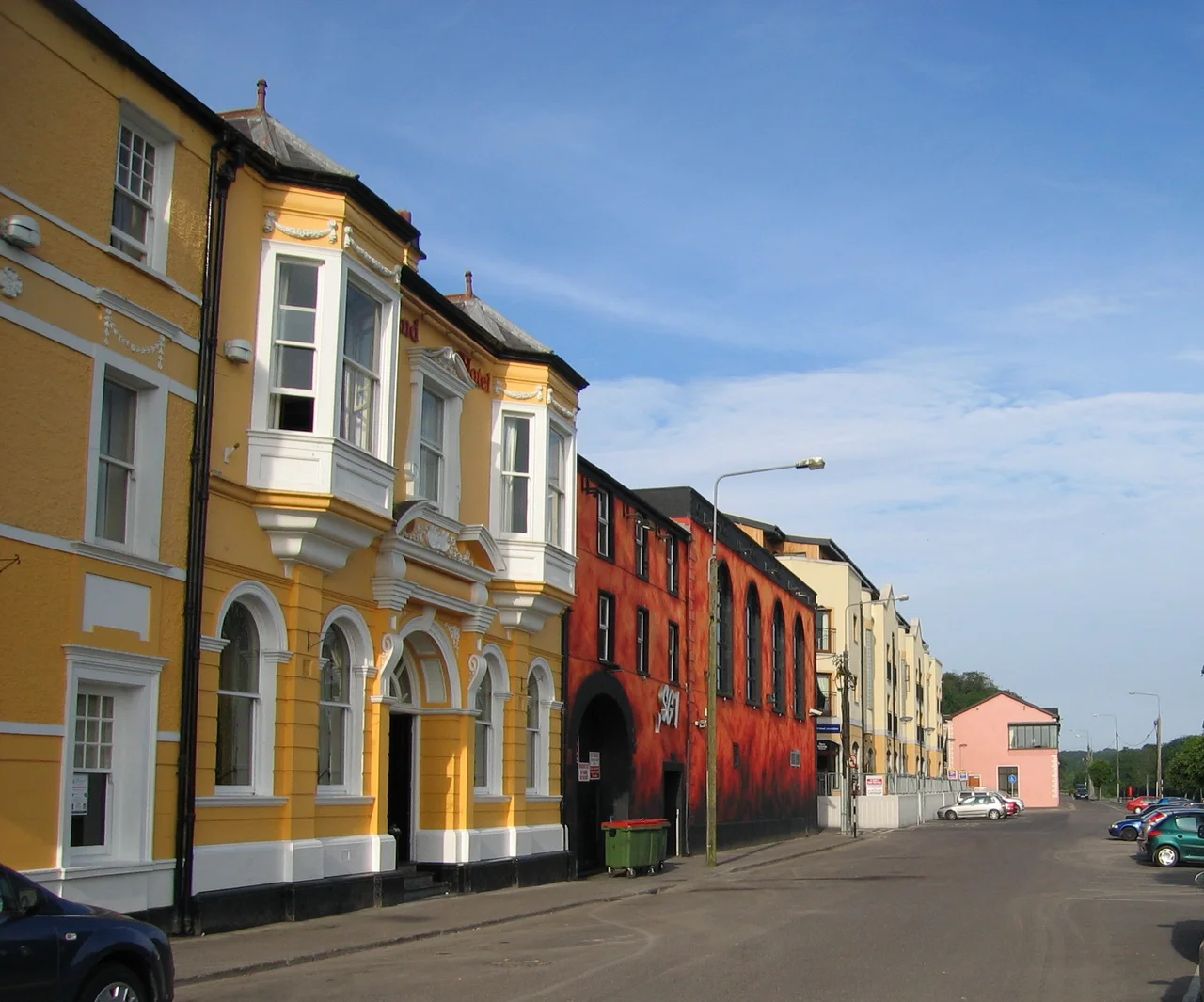

Fermoy
On 7 September 1919, the Reverend Wesley's parishioners in Fermoy were on their way to a Sunday morning church parade when the Irish Republican Army drove out of the side streets in motor vehicles and opened fire. The off-duty soldiers of the King's Shropshire Light Infantry, attending the Wesleyan Church in uniform but unarmed, lost one of their number: Private William Jones from Talog in west Wales. Four others were wounded. The IRA disarmed the rest, took their weapons, and disappeared. Their commander that day was Liam Lynch, head of the Cork Number Two Brigade. The ambush became infamous on both sides of the Irish Sea - one of the first major IRA actions of the War of Independence, executed against the largest British military establishment on the island of Ireland in the town it had built around it.
The Scotsman Who Designed a Town
In 1791, a Scottish entrepreneur named John Anderson bought the lands around what was then a few cabins and an inn on the Blackwater. Anderson had built his fortune developing roads and creating Ireland's mail-coach system. He had vision; he had cash; he had the surveying skill to design a new town from scratch. The streets of Fermoy remain almost exactly as Anderson laid them out. In 1797 he made the move that defined the town's next century. The British Army was looking for a permanent inland base. Anderson gave them the land as an inducement to locate at Fermoy. By 1806 the first East Barracks were standing on sixteen acres - accommodating 112 officers and 1,478 infantry, plus 24 officers, 120 men, and 112 horses of cavalry, with a 130-bed military hospital attached. In 1809 the West Barracks added space for further hundreds, with a 42-bed hospital of its own.
Largest Garrison on the Island
By the 1830s, with both barracks complete, Fermoy could accommodate 14 field officers, 169 officers, 2,816 men, and 152 horses. It was the largest military establishment on the island of Ireland. The town grew around the garrison economy. Pubs, shops, drapers, tailors, butchers, blacksmiths, stables - all underwritten by army pay. The relationship lasted 125 years and ended sharply. In August 1922, with the Irish Free State newly established and the Civil War already burning, anti-Treaty forces evacuated Fermoy and torched the barracks and several other buildings before retreating into the hills. The structures Anderson had given to the British in 1797 were destroyed by Irishmen who had served in the British Army a decade earlier. Some of Anderson's descendants, living in Australia, would later name a winery Fermoy Estate after the town he had created; a plaque and bust in his honour were unveiled in the town park in 2001.
The Reprisal
After the Wesleyan Church ambush of September 1919, the British soldiers responded as they often did. The jurors at the coroner's inquest on Private William Jones refused to return a verdict of murder. In retaliation, two hundred KSLI soldiers launched an unofficial reprisal on the businesses of those jurors - looting drapery and shoe stores along the town's main streets. The pattern would repeat across Ireland for the next three years. An IRA attack would draw a Crown response; the response would radicalise more locals; the radicalisation would produce another attack. By the time the Truce came in July 1921 and the Treaty followed in December, the cycle had run too deep to simply stop. Fermoy spent the Civil War on the losing side and emerged in 1923 still a market town, but no longer a garrison.
Bypassed, At Last
For most of the 20th century the main Cork-Dublin road - the N8 - ran straight through Fermoy's town square. The bottleneck was famous. Lorries from the south struggling up Pearse Square, tourists trying to find parking near the river, the entire town effectively a roundabout on the country's busiest north-south artery. The M8 motorway bypass opened in late 2006, including a new bridge over the Blackwater east of the town. The former N8 became the R639. The square, freed from through-traffic, slowly began to function again as a public space. The Blackwater flood prevention works completed in 2015 were, at the time, the most expensive ever carried out in Cork - infrastructure investment that would have been unthinkable when the river was just a place to dump tannery effluent.
Joyce's Father, Boston's Mayor, Northern Ireland's First Minister
Fermoy's roll of natives and connections is unusually mixed. John Stanislaus Joyce, father of James Joyce, was educated here. Patrick Collins, a US Representative from Massachusetts and mayor of Boston, was born nearby in 1844. Kenneth MacKenzie, the 18th-century Scottish Gaelic poet, ended his life as Fermoy's postmaster. John Magnier, owner of the global thoroughbred operation Coolmore Stud, lives in the area. Michelle O'Neill, Vice President of Sinn Féin and the first nationalist First Minister of Northern Ireland, was born in Fermoy. George Throssell, second premier of Western Australia, was also born here. The town spent five years - 2006 to 2020 - twinned with Nowa Dęba in Poland, then terminated the relationship after Nowa Dęba declared itself an "LGBT-free zone." In January 2021 Nowa Dęba revoked the declaration. The town that the British Army once garrisoned, that the IRA once ambushed, and that James Joyce's father once attended school in, was no longer afraid of telling a foreign sister-town what it thought.
From the Air
Located at 52.14°N, 8.28°W on the River Blackwater in east County Cork, approximately 45 km north of Cork city. Best viewed from 3,000-5,000 ft AGL. The town is laid out on a regular grid (designed by John Anderson in 1791) on both banks of the river, with a multi-arch road bridge spanning the channel at the town centre. The M8 motorway bypass is clearly visible to the east; the railway viaduct (the line closed in 1967) crosses the Blackwater immediately east of the town. Nearest airport: Cork (EICK) approximately 50 km / 27 nm to the south; Waterford (EIWF) approximately 75 km / 40 nm to the southeast. The Blackwater is one of Ireland's finest salmon rivers; Fermoy Rowing Club's regattas in May and September draw crews from across the country. The straight east-west axis of the river from Mallow through Fermoy to Lismore is one of the easier low-level navigation references in inland Munster.
Nearby Stories
- Cork Harbour 0.7 km away
- Abbeyside, Dungarvan 8.3 km away
- Fethard, County Tipperary 9.5 km away
- Tipperary (town) 12 km away
- Dromagh Castle 13 km away
- Newcastle West 20 km away
- Carrignacurra Castle 22 km away
- SM U-27 129 km away