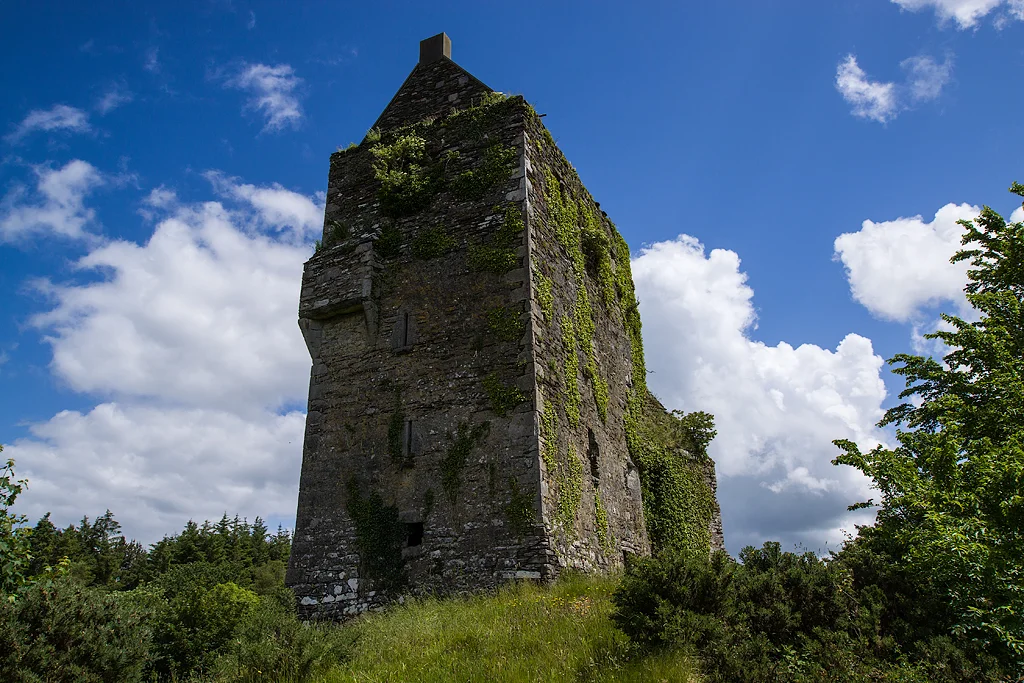
_-_geograph.org.uk_-_1392902.jpg)
Carrignacurra Castle
In September 2020, archaeologists digging at the base of Carrignacurra Castle pulled a silver coin from the soil. It was a groat - a thick medieval silver piece - and it bore the face of Henry III of England. It had been struck in 1270. The castle itself had been thought to date from the 15th or 16th century, perhaps two hundred years younger than the coin. Either a much earlier stronghold once stood on this site, or someone in the 13th century had lost a coin on a riverbank that someone else would later choose as a place to build. A second silver coin came up minted under Edward IV in the 1470s. Carrignacurra had been guarded by people, plundered, defended and abandoned for longer than its standing walls suggested. The dig is still finding things.
Rock of the Weir
The name comes from Carraig na Choradh - the Rock of the Weir. The castle was built to defend a ford across the River Lee about 1.5 kilometres east of Inchigeelagh village, on the historic route between Macroom and Dunmanway. The O'Leary clan put up three tower houses around Inchigeelagh - at Carrignacurra, Carrignaneela and Dromcarra - to control the river crossings and the road. Of the three, only Carrignacurra still stands. The others were destroyed long ago. The choice of this particular rock above this particular ford was the kind of defensive thinking that medieval Irish chiefs took for granted: anyone wanting to cross the river had to pass within bowshot of the tower, and anyone wanting to move along the road had to acknowledge the O'Learys. Inchigeelagh today is a quiet village. The strategic logic that built Carrignacurra has dissolved into the landscape, but the building remembers.
Captured, Forfeited, Restored
The castle's seventeenth century is a sequence of changes of ownership written in war. In 1602 it was captured by Donal Cam O'Sullivan Beare during his great march north - the last stand of Gaelic Munster before final English conquest. It was forfeited in 1641 after the Catholic rising, then restored to the MacCarthys of Muskerry with the O'Learys installed as tenants in their own ancestral home. The Williamite War of 1689-91 brought a fresh wave of destruction across south-west Munster, and Carrignacurra was caught in it. In 1703, the London-based Hollow Sword Blades Company bought up forfeited Catholic estates wholesale, including the Earl of Clancarty's MacCarthy holdings in Cork and Kerry. Carrignacurra changed hands again. The Masters family bought from the Hollow Sword Blades in the 1720s, the Pyne family inherited through marriage, and Jasper Pyne was still listed as occupier at Griffith's Valuation in 1868. Nobody knows when the castle finally emptied of human inhabitants, but at some point the last family moved out and the rooks moved in.
Redan, Bartizan, Murder Hole
Architecturally Carrignacurra is a four-storey rectangular tower house, 15.2 metres tall to where the battlements have been lost. The most striking defensive feature is the redan - a pointed triangular stone projection rising from the ground at the southeast corner, equipped with three gun-loops. Only three castles in County Cork were ever built with a redan: Carrignacurra, Castle Hyde and Mashanaglass. It is a relatively late feature, likely added in the late 16th or early 17th century once firearms had begun to reshape Irish military architecture. A bartizan projects from the northwest corner. The east wall carries a machicoulis - a small projecting balcony with an opening in its floor, known to the locals as a murder hole, through which heavy stones and boiling liquids could be dropped on anyone foolish enough to crowd the door below. Inside, a stone spiral staircase climbs through the north-east wall to the upper floors. The second floor has the largest chamber, with a fireplace on the north wall and a vaulted ceiling supported by a basket-weave technique. Five gun-loops line the bartizan walls; two openings in its floor would have allowed shots straight down.
A Castle Coming Back
Carrignacurra was listed for sale in 2016 - Country Life magazine ran a piece about a 195,000-pound castle complete with murder hole - and the current owners are slowly bringing it back from ruin. Stonework around the gun loops, windows and door surrounds has been repaired. The lower corner stones, vandalised by people trying to remove them, have been sensitively rebuilt. Timber floors have been reinstated. A new slated roof now covers what was open sky a few years ago. The archaeology, meanwhile, keeps producing surprises. Beneath the bartizan, animal bones; in trenches around the base, musket and pistol balls, small lead ingots, clay pipes, a bone bead, bone dice, and a brass jeton made in Nuremberg by Hans Krauwinkel around 1640. And those two silver coins - the 1270 Henry III groat and the 1470s Edward IV piece - that hint at something older underneath. The castle that once defended a ford on the Lee is now being slowly, carefully, made habitable again, four centuries after the people who built it lost everything.
From the Air
Located at 51.85 N, 9.11 W in mid-Cork, about 1.5 km east of Inchigeelagh village on the historic Macroom-to-Dunmanway route, perched above the River Lee. The four-storey tower stands prominently against the river valley and is best seen at low altitude (1,500-3,000 ft). Aerial views are popular - drone footage from 2021 shows its relationship to the river and the archaeological dig trenches at its base. Cork airport (EICK) lies about 30 nm to the east; Kerry (EIKY) about 35 nm to the northwest.
Nearby Stories
- Ross Castle 2.9 km away
- Nohoval 5.6 km away
- Rathcoole Ambush 6.7 km away
- Walter Siepmann 7 km away
- Cape Clear Island 7.9 km away
- French frigate Surveillante (1778) 8 km away
- Fermoy 17 km away
- Cloghan Castle, Lough Hyne 23 km away