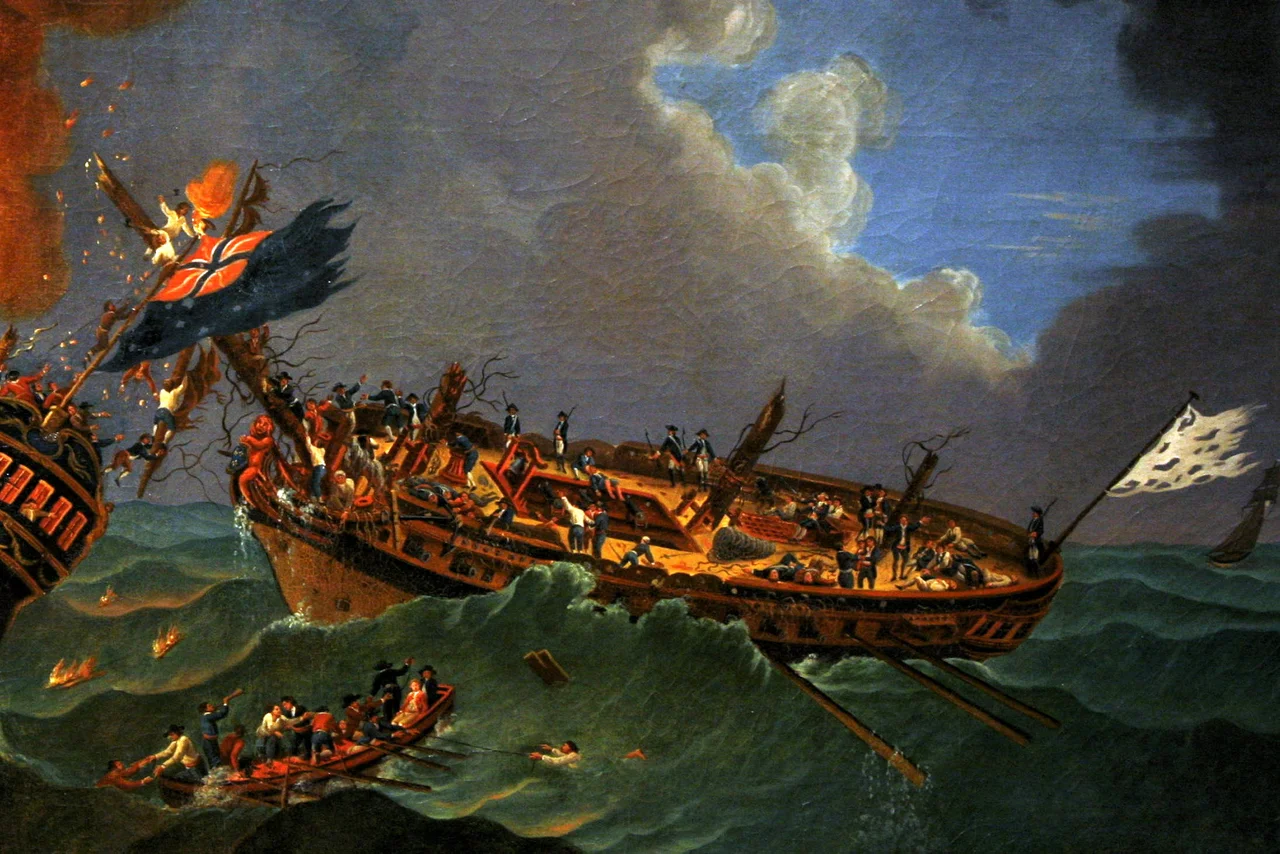

French frigate Surveillante (1778)
On the night of 6 October 1779, off the island of Ushant, two ships of nearly identical size beat one another to pieces for three and a half hours. When it ended, the British frigate HMS Quebec was on fire from her own sails falling across her gunports; moments later she exploded. The French frigate Surveillante, leaking through a dozen wounds, with 30 dead and 85 wounded aboard, sent her boat out to rescue whatever British sailors had survived the blast. They returned to Brest the next day, French and British crew working side by side to keep the ship afloat. Seventeen years later, this same Surveillante would lie on the seabed of Bantry Bay, scuttled by her own captain.
Built for a New Kind of War
Surveillante was laid down at Lorient in August 1777 as the second frigate of the Iphigenie class, designed by Leon Guignace and carrying 32 guns of 12-pound calibre. She was launched on 26 March 1778, just weeks before France formally entered the American Revolutionary War on the side of the rebellious colonists. The very month of her commissioning, she was returned to the yard to have her hull sheathed in copper - a then-novel technology that kept marine growth off the bottom and gave coppered ships a real speed advantage. By June 1778 she was at sea, hunting British vessels off Ushant in the first weeks of an undeclared war that would soon become very declared indeed.
Three and a Half Hours Off Ushant
The battle with HMS Quebec on 6 October 1779 became famous in both navies. Quebec's captain, George Farmer, fought his ship until she was completely dismasted; her topsails, falling forward across her gun ports, caught fire from her own muzzle flashes. Surveillante, under Captain Couedic de Kergoaler, was in scarcely better shape - hull leaking, masts gone, her crew exhausted. When Quebec exploded, Couedic ordered his boats lowered. The French recovered Quebec's survivors, treated them as castaways rather than prisoners of war, and limped back to Brest with a mixed crew working the pumps. Painters returned to the subject for decades: Auguste-Louis Rossel de Cercy's version of the battle hangs today in the Musee national de la Marine in Paris. George Carter and Robert Dodd painted the same scene from the British perspective.
Yorktown, and the News of Peace
Surveillante's American war was long. In June 1780 she sailed into Boston with Admiral de Ternay's Expedition Particuliere - seven ships of the line, three frigates, and 36 transports carrying Rochambeau's army to fight alongside the Continentals. She served in the squadron through the campaigns that culminated at Yorktown in October 1781. After the surrender of Cornwallis, it was Surveillante that carried the Duc de Lauzun back to France with the news of victory; she dropped anchor at Brest on 15 November 1781. Two years later, in summer 1783, she sailed back across the Atlantic in company with a British frigate to announce the Peace of Paris and the formal end of the war between France and Great Britain. The new American republic had come into being with her bow wave in its waters.
The Failed Invasion of Ireland
In December 1796, France tried to land an army in Ireland. The plan, pressed by Theobald Wolfe Tone, called for some 15,000 troops under General Hoche to come ashore in Bantry Bay, raise a rising against British rule, and open a second front in the war with Britain. The fleet of 43 vessels included Surveillante, now 18 years old. Storms scattered them on the crossing. The flagship and the army commander were blown off course entirely. Ships that reached Bantry Bay anchored helplessly while easterly gales prevented any landing. Surveillante, badly damaged in the weather, was deemed unfit to sail home. Her captain scuttled her in the bay rather than let her drift onto the rocks or fall into British hands. The Expedition d'Irlande sailed away without firing a shot in anger. Wolfe Tone, watching from the deck of another ship, called Britain saved by chance and the winds.
Found by an Oil Disaster
The wreck lay forgotten for nearly two centuries. After the 1979 Whiddy Island disaster - when the oil tanker Betelgeuse exploded at the Gulf Oil terminal nearby, killing fifty people - searches of the bay's seabed turned up Surveillante in 23 metres of water, exceptionally well preserved by the cold, dark mud. Maritime archaeologists from Ulster University surveyed the site. A model of the ship is now on display at Bantry, and the wreck itself has been designated a memorial - to a battle off Ushant, to a doomed invasion that never happened, and to the strange physics by which an industrial catastrophe in 1979 returned to history a ship that had vanished in 1796.
From the Air
The wreck of Surveillante lies at approximately 51.70 degrees north, 9.54 degrees west, in roughly 23 metres of water in Bantry Bay, off the coast of County Cork, Ireland. From the air, the bay shows as a deep, narrow gulf running west-southwest from Bantry town, with Whiddy Island near its head. Nearest international airport is Cork (EICK), about 80 km east; Kerry (EIKY) lies to the northwest. The bay's sheltered waters were precisely what made it attractive both to the 1796 French expedition and, much later, to the supertanker traffic of the Gulf Oil terminal.
Nearby Stories
- Dingle Bay 4.2 km away
- Dunmanway 5.5 km away
- Eurovision Song Contest 1993 6.4 km away
- Ballinskelligs Abbey 7.5 km away
- Aghadoe Cathedral 9.3 km away
- Dunlough Castle 11 km away
- The Sinking of the Lusitania: The Torpedo That Changed the War 43 km away
- Sao Miguel 1940 km away