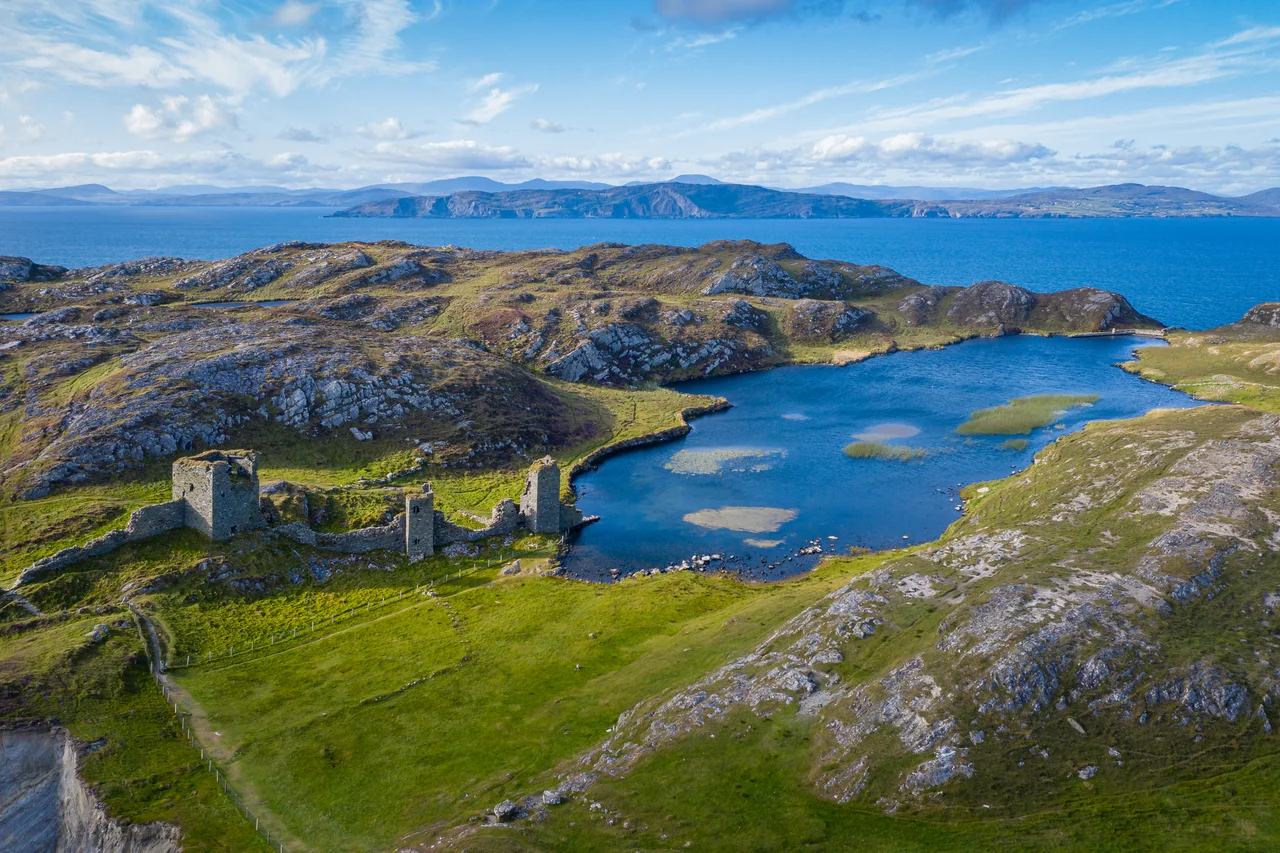

Dunlough Castle
It is not known if Dunlough was ever attacked. That sentence appears, almost as an afterthought, in the historical record of one of Ireland's oldest castles - and it tells you almost everything. Three towers and a long stone wall sit on an isthmus at the northern tip of the Mizen Peninsula, with cliffs falling 400 feet straight into Dunmanus Bay on one side and a small dark lake pressing up against them on the other. Founded in 1207 by an O'Mahony chief called Donagh, Dunlough was built where it is precisely because nobody could easily get to it. It seems they didn't even try.
Three Castles Head
The local name for the spot is Three Castle Head, and it tells you what you are looking at. Dunlough is a series of three rectangular drystone keeps strung along a wall that runs more than a hundred feet from the western cliff edge to the eastern lakeshore. The lake itself, apparently man-made, fills the small valley behind the castle. A second wall at the lake's eastern shore serves as a dam, preventing the water from spilling over the cliffs into Dunmanus Bay several hundred feet below. The only land approach is from the south, across what is now private farmland. To reach the towers you walk a small footpath squeezed between the westernmost ruins and the 400-foot Atlantic drop. As one writer put it, the cliff edge, the wall, the lake, and the impossible approach would have made the castle appear impregnable to any invading army. Whether anyone tested the theory remains a matter of speculation.
The Migrator's Last Refuge
To understand why a fortress went up here in 1207, look at the politics of Ireland in the late 12th century. When the first Norman knights crossed the Irish Sea in 1169 at the invitation of one feuding king, they triggered a slow conquest that would reshape the island. The O'Mahonys were the declining-but-still-powerful princes of Eoganacht Raithlind, holding the territory from Cork City west to Mizen Head. Their rivals and sometimes allies were the McCarthys and the O'Briens. In 1177, King Henry II of England granted the kingdom of Cork to the Cambro-Norman knights Robert Fitz-Stephen and Milo de Cogan. De Cogan took the western half and pushed toward the Atlantic, driving regional families off their lands. The O'Mahony chieftain, Donagh, earned the nickname 'the Migrator' for being pushed steadily westward until he settled at the literal end of the peninsula, where the land simply ran out. He built Dunlough on the last defensible spot in his shrinking world. His family held it for four hundred years.
Drystone and the Long Slow Crumble
Dunlough was built without mortar - drystone masonry, the same technique used in Ireland's ancient ringforts and beehive cells, where stones are fitted so precisely that gravity and friction hold them in place. This was already an old technique in 1207, and it shows in the architecture: simple rectangular towers, no turrets or parapets, each three stories high and slightly smaller than the typical solitary tower of the region. The eastern keep was probably the gatehouse - its gateway is now collapsed - and a spiral staircase still climbs through its broken outer walls, visible from outside. The western tower, the largest, was likely the residence. The central tower, an unusual feature for so small a castle, gave additional lookout and storage and reinforced the connecting wall. A common detail of O'Mahony architecture is preserved at Dunlough's western keep: a second-storey doorway above or beside the main entrance, accessed by a wooden ladder that could be pulled up in emergencies. The third floor in each tower was stone-paved and served as the banquet hall.
Confiscation and After
The castle's long history with the O'Mahonys ended in 1627, when it was confiscated by the British crown - one small forfeiture in the centuries-long pattern of plantation, displacement, and rebellion that defined Irish history. The towers were abandoned. Without ongoing maintenance, the drystone walls began their slow crumble: stones loosened by frost, gaps widened by gales off the Atlantic, the connecting wall now mostly fallen but still standing 15 feet in places. Later regional castles, mostly later O'Mahony keeps, used wet mortar and weathered better. Dunlough's older drystone technique is part of why it looks the way it does today - a ruin that feels less destroyed than gradually returning to the rock it came from. Standing at Three Castle Head now, with the wind off the Atlantic and the dark lake at your feet, you can understand the impulse of the original builders. The world ended here, in 1207. They built accordingly.
From the Air
Located at 51.48 degrees N, 9.83 degrees W on Three Castle Head at the northern tip of the Mizen Peninsula in County Cork. From the air the three towers appear as small grey rectangles set on a green isthmus between Atlantic cliffs to the west and the small dark lake behind. The site is best appreciated at low altitudes in clear weather, when the relationship between the castle, the lake, and the 400-foot drop into Dunmanus Bay becomes legible. Cork Airport (EICK) is the nearest major airfield, about 80 kilometres east; the unlit nature of the peninsula makes night approaches inadvisable.
Nearby Stories
- Adrigole 4 km away
- Dunmanway Castle 4.7 km away
- Ballinskelligs Abbey 16 km away
- Glandore 17 km away
- Dursey Island 21 km away
- Wolfpack Prien 55 km away
- SM U-27 168 km away
- Sao Miguel 1912 km away