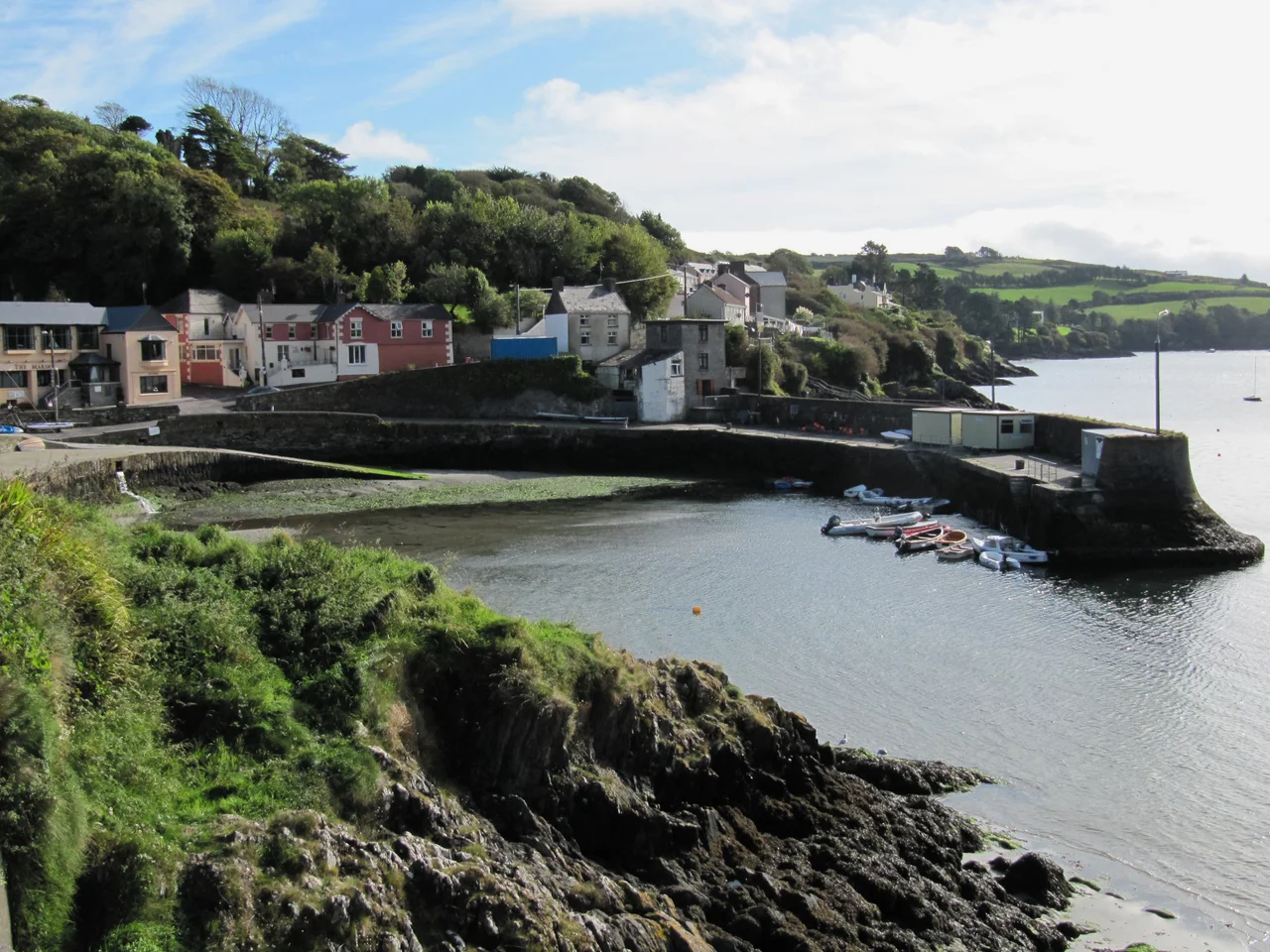

Glandore
Sailors entering Glandore Harbour learn one rule before they learn anyone's name: avoid Adam, hug Eve. The two small islands at the harbour mouth are called precisely that - Adam to the west, Eve to the east. Adam is surrounded by foul ground, half-submerged rocks that will tear out the bottom of an inattentive boat. Eve is clean. Pass close to Eve and you are safe. Generations of fishermen, racers, and weekend cruisers have repeated the rule until it became part of the village. The name Glandore itself comes from Cuan Dor - the harbour of the oak trees. The oaks are mostly gone. The harbour and its rules remain.
Adam, Eve, and the Perches
Glandore Harbour stretches roughly three miles north to south, narrow enough that hills enclose both sides. At the north end is the village of Leap. On the west side is Union Hall, a fishing port whose name commemorates the 1801 Act of Union with Britain - a fact the village has never been able to entirely forget. Between them, on the east shore, sits Glandore itself: a single line of houses climbing the hill above the pier, with the yacht club at the bottom and the old Church of Ireland rectory near the top. In the middle of the harbour, rocks called 'The Perches' break the surface at low tide, marked at their western edge by a flashing green light indicating safe water. The Danger Rock, further north, is marked with a northern cardinal buoy. Sailing here is a discipline of attention. The harbour rewards it.
From Normans to O'Donovans
Glandore was one of the earliest settlements in this stretch of coast. In 1215, the Normans built two castles at the harbour - presumably to control its trade and military value. Within decades, the O'Donovan family had taken control of the harbour from the Normans and occupied the castles. The O'Donovans would hold the area for centuries, one of the Gaelic dynasties that absorbed and outlasted Norman expansion in West Cork. The present pier and harbour wall were built in the first half of the 19th century, around the same time the Allen family built three of the village's grandest houses - the former Church of Ireland rectory (originally East View), Bearna Donn (originally West View), and Stone Hall. The houses still stand. The Allens are long gone. The O'Donovan name is still common around the harbour.
The Regatta
On the third weekend of August, the Glandore Regatta has been held for so long that nobody alive remembers when it started. The harbour fills with Dragon class keelboats - the elegant, narrow international racing class that has been raced at the Olympics - along with Squibs and Topaz dinghies and whatever else local sailors have managed to put in the water. The Lar Casey Cup goes to the winning Dragon. Every odd year, the Glandore Classic Boat Regatta takes place over a week in July, drawing classic wooden yachts from across Ireland. Don Street, the veteran transatlantic yachtsman and author of multiple cruising guides to the Caribbean, made his home here and continued to race Dragons in the local fleet into his eighties. The yacht club runs courses every year - junior sailing, powerboat handling, instructor training - sending generations of children out onto the harbour that taught their parents.
Wildlife on the Wing
The harbour and bay between Galley Head and Toe Head support a striking range of species for a place so close to a working village. Grey herons stalk the mudflats at low tide. Oystercatchers, gannets, shags, cormorants, herring gulls, and black-tipped gulls work the water. Seals - both grey and common - are visible most days on the rocks. Whales, dolphins, porpoises, and basking sharks pass through the greater bay seasonally, particularly in late summer when the mackerel and herring shoals are running. Mackerel itself can be plentiful inside the harbour depending on the time of year - a small boat with handlines and a sliver of patience can fill a bucket on a good evening. The wildlife survives because the harbour is small enough not to support intensive commercial fishing and large enough to feed everything else.
The Quiet Famous
Glandore is one of those Irish villages with a curiously high concentration of quietly famous part-time residents. Margaret Jay - Baroness Jay of Paddington, former Leader of the House of Lords - has kept a house called Elm Bank here for decades. The Irish businessman Tony O'Reilly, at one time chairman of Heinz and one of the richest people in Ireland, lived for years at a complex called Shorecliffe before selling it in the 2000s. The diplomat Michael MacWhite, who served as the first Irish permanent delegate to the League of Nations, lived here. Seán Hayes, a Sinn Féin TD from 1918 to 1923, was from the village. The Irish Coast Guard maintains a unit at the 'Rocket House' at the western end of the village - the building takes its name from the 19th-century life-saving rockets once stored there. The combination of a working harbour, a sheltered anchorage, and a fishing village that has held its character has made Glandore the kind of place people return to all their lives.
From the Air
Glandore village sits at 51.567 degrees north, 9.117 degrees west, on the east shore of Glandore Harbour in West Cork. From the air, look for the long narrow inlet running north-south with the village of Leap at the head and Adam and Eve islands at the harbour mouth - the rocks are unmistakable, two small green islets in line at the entrance. Union Hall is on the opposite (west) shore. The Atlantic coast continues east toward Galley Head and west toward Toe Head. Cork Airport (EICK) is approximately 65 km east-northeast. Drombeg stone circle is 2.4 km east. Recommended viewing altitude 2,000-4,000 feet for the harbour layout. Coastal fog can fill the harbour even when surrounding hills are clear.
Nearby Stories
- Douglas 2.4 km away
- Macroom 5.5 km away
- Schull 8.2 km away
- Walter Siepmann 14 km away
- Killarney National Park 18 km away
- HMHS Llandovery Castle 29 km away
- Wolfpack Prien 72 km away
- SM U-27 101 km away